
Difference between CBR (fixed), VBR (variable) and ABR (average) [bit rate]
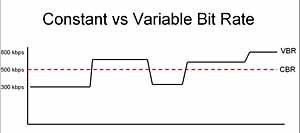
CBR (constant bit rate)
VBR (variable bit rate)
ABR (average bit rate)
There are three types.

I will present the differences between them.
See the following article for the “bit rate”.
Reference: What is a bit rate? Relationship between image quality and sound quality [Video / Audio]
Related: Difference Between VFR (Variable) and CFR (Fixed) [Frame Rate]
Every feature
I will briefly explain each feature.
CBR (constant bit rate)
CBR (constant bit rate) is
A video with a constant video bit rate.
for instance,
Scenes with intense movement
Scenes with complex audio
Even in “scenes that require a large number of bit rates”, for example, the bit rate to be assigned is constant and
Motionless scene
Scene without audio
Even in “scenes that do not require a lot of bit rate”, the bit rate to be assigned is constant.
In this way, a video that assigns a constant bitrate to “Assign a constant bitrate!” In any scene it is called CBR (constant bit rate) video.
The following are the characteristics of CBR.
(○) Search (fast forward / rewind) is fast
Since the transfer rate is the same, you can search instantly.
(○) File size can be predicted
If you decide beforehand to “encode at XX bit rate”, you can predict the file size from resolution, frame rate, video length, codec, and so on.
(○) Easy to use as a material
In the case of video, there is no need to worry so much, but in the case of the sound source, various problems can occur such as drift of sound with VBR or ABR (so if there is a possibility that it will be used later to video edit material, etc. Better to encode with CBR)
(○) Fast encoding speed
It doesn’t change much, but unlike VBR and ABR, you don’t need to “predict” it, so encoding is faster.
(X) Image quality and sound quality are not very good for the file size
Even a monotonous scene that does not require a lot of bit rate allocation may be assigned a certain number, or a scene that requires a large bit rate may not have enough bit rate, so the image quality and sound quality for the file size. Cospa is bad
VBR (variable bit rate)
VBR (variable bit rate) is
A video whose bit rate varies depending on the scene.
VBR_figure
for instance,
Scenes with intense movement
Scenes with complex audio
In “scenes that require many bit rates”, such as assigning many bit rates and
Motionless scene
Scene without audio
For “scenes that do not require a lot of bit rate”, assign a lower bit rate.
In this way, a video that assigns only the required bitrate according to the scene, “You need this bitrate, don’t you?” It’s called VBR (Variable Bit Rate) video.
The following are the characteristics of VBR.
(○) Image quality (sound quality) by file size is the best
Compared to CBR and ABR, the image quality (sound quality) by file size is the best.
(△) Unpredictable file size after encoding
The file size cannot be predicted because the bit rate fluctuates extremely depending on the content of the material to be encoded. (However with the x264 encoder etc it is possible to predict because it puts an upper limit on the file size and allocates the maximum bit rate within that range)
(X) Old MP3 players may not play well
If you have an old MP3 player, the playing time display may be strange, the bit rate display may be strange, or you may not be able to play from beginning to end.
(X) When used as video editing material, it may cause sound drift.
For more information, see the following article
Reference: Causes and countermeasures for sound deviation [Encoding]
If you want to encode video with high image quality and low capacity, VBR is your choice.
By the way, in VBR, it is common to determine video quality by “quality standard” (CRF value in x264 encoder) rather than by “bit rate standard”.
For example, instead of saying “Encode at 192bps!”, Specify something like “Encode at


