
Comparison of audio encoding formats
Parameters and nouns

Rate/bit rate/code rate, Kbps, i.e. the volume of data contained in a transmission medium or audio file per unit of time. In general, the higher the volume, the higher the sound quality. Of course, the comparison standards are different under different compression algorithms, and the bitrate may be lower as well. The sound quality is relatively high, for example, the sound quality of aac with a medium bitrate is better than that of mp3 with a high bitrate. The CD bit rate is 1411.2 kbps and there are some lossless compressions that can come close to this value, such as flac.
The sampling rate, KHz, is the number of points that the audio acquisition device collects audio signals in unit time. In general, it is believed that the higher the sample rate of the same encoding algorithm and the same bit rate, the higher the sound quality. However, the standards of comparison between different encoding algorithms are different. Currently, 44.1 KHz and 48 KHz are more commonly used in mobile devices, and the sample rate in instant messaging is lower, possibly 16 KHz or less.
The number of channels, it is generally believed that the greater the number of channels, the more stereoscopic the sound. Real-time communication can be monophonic, and network transmission often uses two channels. Minimal mono, up to 5 channels?
Tracks, sounds made by different instruments/people, up to 48 tracks?
Compression ratio, compared to the source audio file, the volume changes after compression, such as 1/18, 1/12. Compression ratio opus>aac>ogg>mp3 (and wma)>ape>flac>wav (under the same sound source condition). The compression ratio of wma below 192kbps is higher than that of mp3.
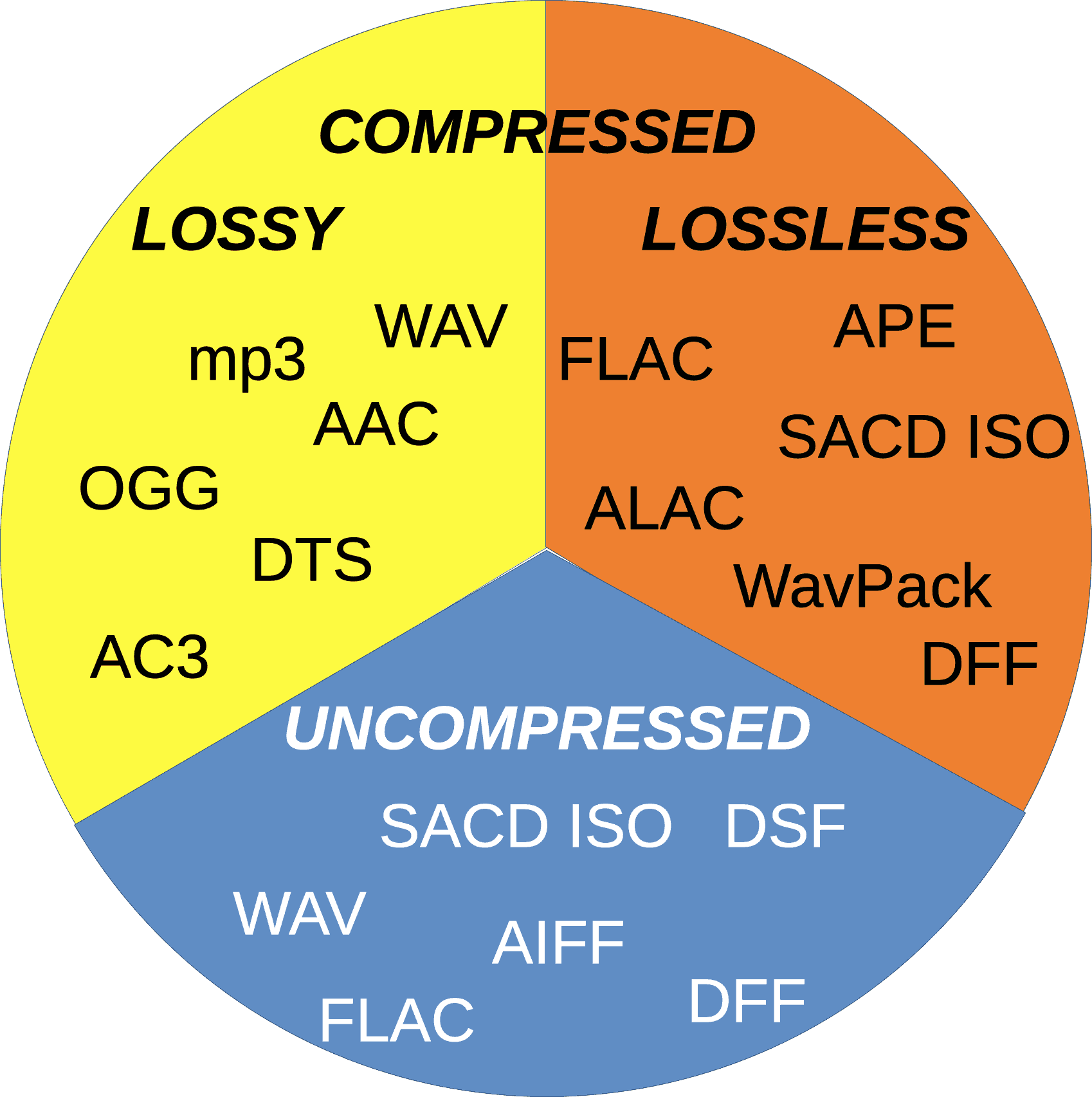
Sound quality, lossy or lossless, can be restored to the audio source file after decoding. Sound quality comparison wav=flac=ape>aac=opus>ogg>mp3~wma
Frequency, Hz, low frequency or high frequency. Note that the human ear is more sensitive to low frequency signals. For example, the mp3 compression algorithm removes all high-frequency signals.
Hardware support, device support on the capture and playback end, mp3>wma>aac~wav~opus>flac~ogg>ape.


