
Nowadays, with so much multimedia information that we consume, whether in the form of video, audio or images, it is impossible to think of a simpler way to enjoy all these contents without the use of a codec. However, this small piece of software, so valuable for digital media playback, goes almost unnoticed for most users.
So important is the function of the codec in our system, that without them it would be impossible, for example, to watch a movie or listen to a song, since they fulfill the function of converting digital data to a way in which we humans can understand it. There are dozens of different codecs for each type of multimedia file, and each of them has been developed for a specific task.

If you want to know more about the fascinating technology of codecs, don’t hesitate to continue reading the rest of the article.
Most common types of codecs
Uncompressed audio or video take up a lot of storage space, and that is why codecs are one of the most viable alternatives when reducing their size for easy handling and storage.
However, the task is not so simple, since most codecs, when reducing the size of a file lose some of the original quality, and it is very important to know what codecs to use when compressing to avoid that problem.
One of the most famous codecs today is the MP3, which allows us a great capacity to reduce the size of a music file, but that offers a considerable loss of quality, even at the lowest compression rates.
In this sense, another codec that allows us to compress a music file in a good way is FLAC, which is considered a lossless codec, but with a compression rate lower than MP3, that is, the files in FLAC are larger, but also the quality that can be obtained from the original source. Other codecs widely used for compression in the musical field are Ogg Theora and Ogg Vorbis, just to name a couple.
In the field of video files, exactly the same happens with audio codecs, there are codecs that allow a high compression rate but that lose a lot of quality in the process, and lossless codecs such as MSU or Huffyuv, but which are practically unmanageable due to the resulting size of the video.
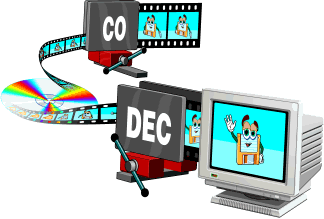
The codec name comes from the contraction of CO-code and DE-code.
And as we said before, we encode and decode to reduce the size, losing the minimum possible quality. Today we want everything to happen without cuts, without interruptions. Watching a movie without taking hours to download or load, or listen to a song equally without interruptions … that means that the video or audio (increasingly high quality and therefore of greater weight in the discussion and that would take longer time to be transmitted over the internet) should be reduced as much as possible by convincing as much as possible the same quality.
It was already understood that without codeces we would be lost and this audiovisual era of streaming we would not be possible?
Jua many audio and video formats, each one was made with a series of specifications in mind. They compete against each other and it is good that we know them and know that it is better to listen to quality music … an mp3, a FLAC, ogg, etc. The same for videos … a webp, mp4, avi, wmv, etc. is better.
That’s why codecs shouldn’t seem strange things to us, just weird names. But we must understand that without its ability to reduce the size of the files, we would not have been able to live this multimedia revolution that we are living today.


