
Why are WAV and FLAC making a fool of themselves by saying “sound quality is different”?
When looking at the audio file ( audiophile ; so-called audiophile in Japan) area, the sound quality is different between WAV and FLAC! There are people who scream. In this article I would like to consider whether it is true.
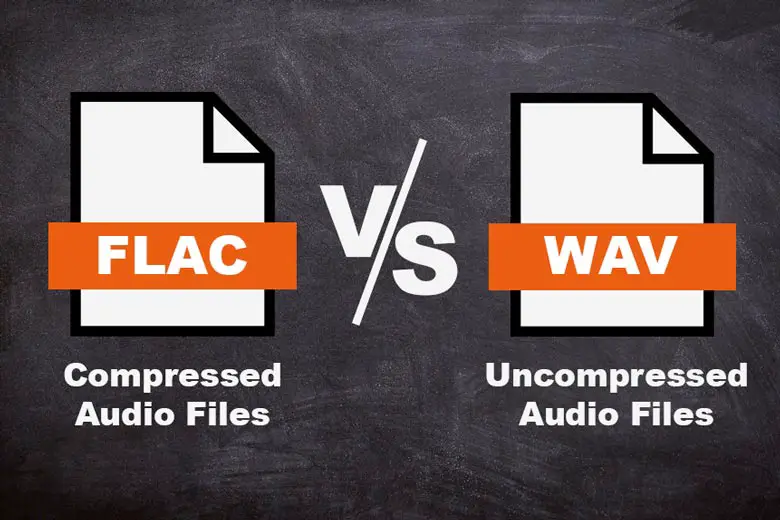
Differences between
WAV (WAVE) is a file format that can store linear PCM, and FLAC is a format that can store audio by lossless compression (ie, compression can be performed without loss of sound quality).
According to the FLAC standard, formats up to 32 integer bits/655 350 Hz can be stored, but the encoder itself supports up to 24 integer bits.
WAV is an old standard created in 1991, and is actually a kind of container standard called RIFF. Various waveform data can be stored in WAV, and 64-bit floats, etc. can also be stored.
In other words, if they are both in the 24-bit range, the exact same waveform can be saved. This is a perfect match at the waveform level.
If you’re using a music player called foobar2000 , you can confirm that there is no 1-bit difference between WAV and FLAC using a plugin called Binary Comparator .
FLAC has a CRC checksum for each frame and the file has an MD5 hash to detect file corruption. WAV may not be noticeable even if it is corrupted, such as distorted data.
By the way, if you want to save 32 bits or more, you can use a lossless compression format called WavPack.
“Decode gar load”
The logic of those who argue that there is a difference in sound quality between WAV and FLAC is generally “FLAC requires decoding to PCM for playback, and since there is a need for decoding, the CPU load is high and the audio quality is high. sound is high”. It gets worse. ”
The first half of this logic is correct. FLAC is lossless compression and must be decoded for playback. However, when discussing the second half, questions arise.
Although FLAC is a compressed format in the first place, the load during decoding is one of the lowest among all lossless compressed audio formats.
The CodecPerformanceComparison site has decoding speeds by format. Among them, FLAC is much faster than Monkey’s Audio, WAVPACK, AAC and MP3. The decoding speed is almost the same regardless of whether the compression ratio is 5 or 8.
FLAC is said to only be able to decode using integer arithmetic (source), and it’s pretty fast. Although WAV does not require decoding, it is just using the CPU in the sense that it reads the file, stores it in memory, and the CPU processes the driver and sends the data to the sound card.
Also, WAV is not compressed, so there is a problem that the file size increases. This means that reading files from storage is clearly more frequent than FLAC. This is nothing more than using more of your computer’s bus bandwidth. How do you explain the electromagnetic noise generated by these warehouses and buses? Has anyone checked it out?
Importance of the ABX test (double-blind test)
I think most people in audio files (Ota, audiophiles) downplay science and think of things with various guesses, relying solely on their own senses.
“Clear sound” “Smooth and elegant treble” “Natural bass”
These words sound good, but they have to do with falsifiability, and I can’t even start an argument.
I want to compare A and B. At that time, “ABX test” or double-blind test (double-blind method) is useful.
Suppose there is A and B. I want to compare A and B. They can be WAV and FLAC, oxygen free copper cables and Amazon Basics cables. It may be the sound that electricity generated by hydroelectric power reproduces and the sound that sunlight reproduces, or the difference between iPod and Walkman, cassette tape and record.
If you really want to make a comparison, hide A and B and ask. There is another collaborator on this. When the test starts, the collaborator first prepares the equipment of A and B, and clearly plays each sound as A or B. Then the collaborator hides A or B and plays the sound. It can be of the order of AABBABAA or ABABAAB. Anyway, play random. And the collaborator asks, “What was the random sound I originally submitted, A or B?” He can request and replay sounds A and B at any time during the test.


