
“High resolution” basics. What is the difference between DSD, FLAC, MQA, etc.? Part 3
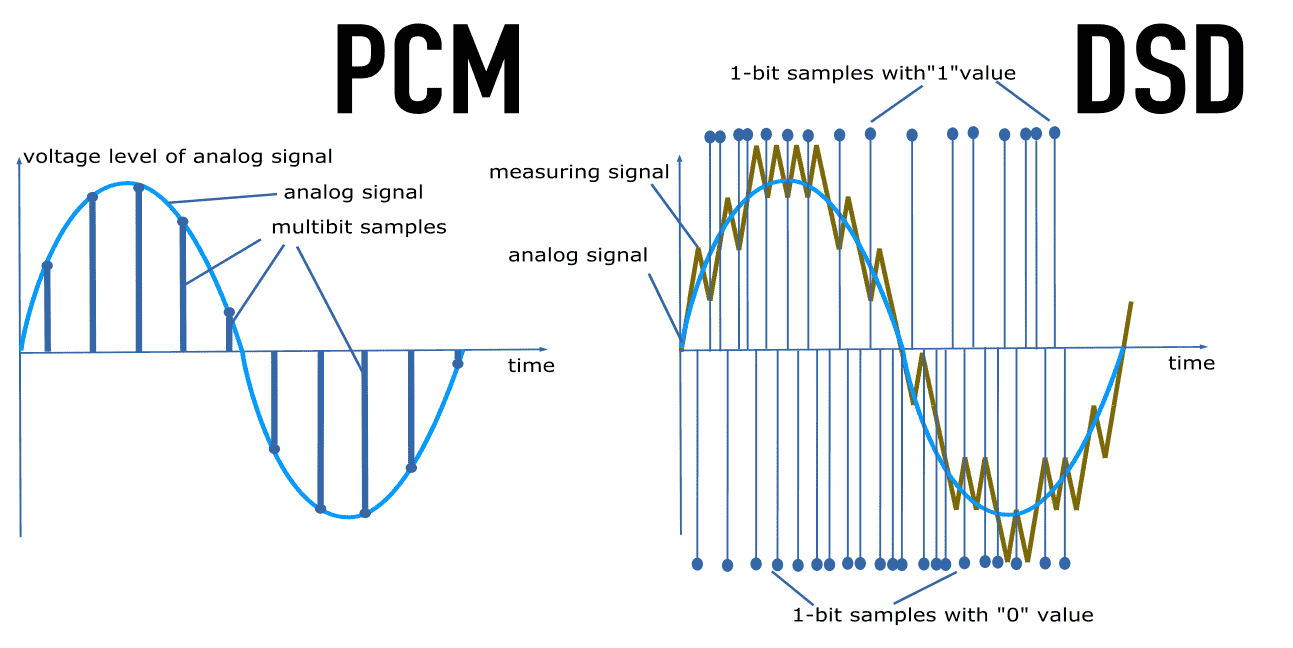
PCM or DSD

So far, we have looked at high resolution definition on the premise of PCM, but “DSD (Direct Stream Digial)” is also recognized as a type of high resolution sound source. Regarding DSD, which is not clarified in the JEITA definition, the Japan Audio Association definition recognizes products that support 2.8MHz / 5.6MHz DSD playback as compatible high-resolution devices.
Sound reproduction methods are almost completely different between PCM and DSD. DSD always records 1 bit width (1 bit is represented by “0” or “1”) subdividing only in the direction of the time axis.
In the case of PCM, the resolution can be increased and the dynamic range can be expanded by increasing the number of bits, but on the other hand, quantization noise occurs (distortion caused by an error in rounding up / down the amplitude value real). . DSD is set to 1 bit to create a state in which no quantization noise is produced and the amount of information is ensured by significantly increasing the sample rate.
DSD has a 1-bit amplitude of “0 or 1” and records sound information with little information in the direction of the time axis.
(The picture is taken from the product information page of Sony HDD audio player “HAP-Z1ES”).
Main high-resolution formats
Data as uncompressed or compressed, lossless or lossy as compressed, PCM or DSD is primarily a high resolution format, and depends on the playback device / software to be used in addition to the taste of the sound. Let’s explain the characteristics of each format for the formats handled by the so-called music distribution sites.
FLAC
Classification:
PCM compression: Yes (lossless)
Extension: .flac
“FLAC” is a representative of high resolution audio sources. It is an open source lossless codec (software whose source code is open to the public and can be freely improved / redistributed), and one of the reasons for its widespread use is that it does not generate royalties. It is thought that the sense of security that allows us to confirm that we are there also helped spread the word.
It is often created (encoded) using uncompressed linear PCM as the source, and can be compressed to a file size of around 60% compared to the source. There are many supported hardware / software. At the moment, iOS is late (some apps have already supported it), but it almost certainly is if it is a device that claims to support high resolution. If you are wondering which format to choose, choose FLAC and you are right.
Most of the hardware / software and distribution sites that claim to support high resolution support FLAC (image is blackberry screen).
ALAC (Apple Lossless Audio Codec)
Classification:
PCM compression: Yes (lossless)
Extensions: .m4a, .mov, .alac
Introduced when Apple realized lossless audio streaming using a compact router (AirTunes). Initially it was an original technology, but then it was made open source and is now popular as a lossless codec alongside FLAC.
It has been well supported by Apple products since its introduction, and the files can be generated (encoded) using iTunes. However, Apple products are designed not to consider high resolution playback, so even if you play high resolution ALAC files on iOS devices, the information will be cut (reduced) to CD quality.


