Audio recording bit rate


Free Download Mp4Gain
picture

Audio recording bit rate
BitRate

One measures speed. They both show quality.

Calidad de audio: aprende sobre bits, sample rate y formatos

Bringing the musical experience to digital music items, including a career as a music producer and composer.

The terms bit depth and bit rate in digital audio are so similar that many people think they mean the same thing. It is easy to confuse them, but they are two different concepts.

You may need to know the bitrate when choosing the best audio format for your portable device or when converting to MP3 format with an audio conversion tool or other program such as iTunes.

Bit depth is important when digitizing an analog music collection or when you need the best possible sound quality.

Audio recording bit rate
Bitrate is a unit of measurement expressed in kilobits per second (Kbps), which is thousands of bits per second. Kbps is a measure of the bandwidth of data transmission equipment. Shows the amount of data flowing through the network at a given time.

For example, recording at a bit rate of 320 Kbps is processed at 320,000 bits per second.

Bit rate per second can also be expressed in other units of measurement, such as megabits per second (Mbps) or gigabit per second (Gbps), but these are 1000 Kbps per second or bit. Only used if 1000 Mbps is met.

In general, high bitrate recordings provide higher quality audio and take up more space on your computer or mobile device. However, unless you’re using high-quality headphones or speakers, you won’t notice any improvement over low-quality headphones or speakers.

For example, if you’re listening with a standard pair of headphones, you probably won’t notice the difference between a 128 Kbps file and a 320 Kbps file.

For more information on bitrates, see the additional information, including their relationship to audio compression.

bit depth
At first, bit depth may seem like a complex topic. The simplest form is a measure of how accurately a sound is represented in digital audio. The higher the bit depth, the more accurate the digital sound.

You’ve probably already come across songs sent at specific bitrates from MP3 download services or music streaming sites, but let’s not talk too much about bit depth. However, if you want to digitize your vinyl record or analog tape collection and save them as high-quality digital audio files, you need to know about bit depth.

Increasing the bit depth will give you a more detailed recording. If the bit depth is low, quiet sound will be lost.


Free Download Mp4Gain
picture


Mp4Gain Main Window
picture


Mp4Gain Features
picture


Free Download Mp4Gain
picture

High resolution CD and sound sound. PART 3

High resolution CD and sound sound. PART 3

HIRES

Is not it possible to feel the difference in format (difference between CD and high resolution) purely by sound?

Hi-Res

As explained above, the “suspicion that sound content in each format is different” can not dissipate from the music files sold.
(It should be the same, but it is difficult to identify unless indicated explicitly).

In that case, I have no choice but to record it and touch it myself.
If you record the same sound source in different formats and play it, you can see if you may feel that the sound is different depending on the format.
The important thing is to record the same sound source in different formats with the same configuration of the equipment.
(Do not convert the recorded file to a different format).

However, even with this method, it is possible that you are listening to the habits of the equipment, not the format difference, so you should be careful, you must compare several recording equipment in the same way to extract points in common.

Teams that can be recorded at home are the UA-3FX (~ 48kHz / 24bit) and the FA-66 (~ 192KHz / 24bit).

Since there is only one for each, it is not possible to record the same sound source in several formats at the same time.
Then we must do. ..

That’s it! We are going to bend an analog disc! (Hahaha)

In modern terms, it is a digital file of analog records. .. (Smile bitter)
If you record an analog disk with the same configuration but with different sampling frequencies and bits depths, you can achieve “almost the same sound source”, “same device settings” and “different formats”, so I tried it.
I mean, half of the reason why I bought a used FA-66 was “dubbing disc”, so I experienced it a long time ago. (Hahaha)

From this moment, we are in the world of
“Individual opinions”,
“There are individual differences in how we feel the effects” and
“Compared to our company”
.
(Given that we have not confirmed the similarity between several devices, half-talks).

I certainly felt the difference in sound when I changed the sampling frequency, but I felt the difference when I changed the depth of bits was greater than that.
Expressed in words, increasing the sampling frequency made it feel smooth and courteous, and lower it made it sound more vigorous and dense.
The depth of 24-bit bits is more realistic and I felt that the feeling of location and space became clearer.

By the way, when folding analog discs, I feel that I prefer 48 kHz / 24 bits to the highest specification of 192 kHz / 24 bits.
Therefore, at present, in the analog record file (for playback purposes in NW players, etc.), the recording is made at 48 kHz / 24 bits, and the level is not altered and saved only by adjusting the Input / output reading.
In order to move to a CD, it is recorded at 44.1 kHz / 24 bits and, after adjusting the level, etc., it becomes 16 bits.

In any case, the taste is different from the feeling of “oh! Weird” that you feel when you change from the CD version of the same song on sale to the high resolution version, and the difference is very small.

High resolution CD and sound sound. PART 2

High resolution CD and sound sound. PART 2

Hi-Res

If the song occurs with some enthusiasm and budget, the content of the mastering will change according to the characteristics of the sales means, even if the original master is used, and the points of view will be different depending on the engineer, and strategy will be optimized of sales. Function of the
Therefore, it is natural that the mixing adjustment contents are different for each support sold. That is the difference in the media (format) seen from the side of the production.

Hi-Res Audio

This is because even for the same song, the recorded sound may differ slightly according to the medium (format). This means that. (Of course, it can be the same.)

So, if you compare the CD version and the high resolution version and feel a difference as “high resolution is incredible” or “high resolution is delicate but the CD version is good”, it is not the difference due to specifications Format, but the difference in sound is due to mastering. That is the possibility.

It is easy to understand if you use the fact that it actively changed the sound by mastering as a project, such as “the high-resolution version is remastered by the XX Mastering Engineer”, but in most cases there is no such description because it is Dedicated to the work behind the scenes to approach the original sound (or convert it into a sale sound) with the performance of the destination format. In addition, even if it is shown as a remastered version, the content of what was changed with the remasterization is not announced, and even if it is said that it is mastering simply by changing the level, it is up to that point, and the performance of each format And since the characteristics are different, it is not easy to compare to measure and there is a large part that appeals to the senses, so it is very difficult to understand the real difference of sound due to mastering.

Then, if you have the same song that makes the difference between the CD version and the high resolution version, convert the file from the high resolution version to make a CD and compare it.
I think you can get pretty interesting results testing some things to see if the CD you did sounds similar to the version on CD or the high resolution version.
(It is important to convert the top format file in terms of specifications to the format to compare and compare).

High resolution CD and sound sound.

High resolution CD and sound sound.

HiRes

Differences that can be heard and understood, differences that can not be understood.

What is Hi-Res Audio? HD music explained | Trusted Reviews

Recently, the same song will be launched in multiple media / formats as “CD”, “MP3 / AAC”, “44.1KHz / 16bit FLAC / WAV”, “high resolution compression format”, “FLAC / WAV high resolution” , and “DSD”. It is increasing, some of them are published on analog discs.

I am happy to have more options to enjoy music, but sometimes I see and listen to topics such as “the alleged superiority or inferiority of sound quality” and “high resolution sound is better”.
Well, manufacturers are also working hard to promote the “high resolution”, so I think that somehow is grown the image of “high resolution = good sound”.

By the way, do you feel the difference in the format of the same song, especially the difference in the sound between the CD version and the high resolution version, once you leave aside the good and the bad?

Even if it converts linear PCM music of 44.1 kHz / 16 bits, which is a CD format, a compression with loss that can not be played at 20 kHz, such as MP3 and AAC, even if you have a certain bit rate, You can change to AB. It is known that people can not distinguish between high resolution and CD, which has only the presence or absence of performance outside the limit of human perception in the first place is it easy to distinguish between high resolution and CD?
It is a simple and simple question.

Instead, in the songs that are effectively sold in normal version and in high resolution version, the sound difference is usually reviewed.
What’s wrong with this? ..

To unravel this, first we have to change our perspective.

For example, suppose you have a song whose MP3 / AAC version, CD version, high resolution version and disk version are on sale.
Is the same sound recorded in each file in the first place?

I am sure that some of you come with a pinch, but the keyword is to dominate.

Originally, it meant optimizing the original master of two tracks that was completed in the production process in the cutting process to make a disc. Specifically, keeping the signal within the physical limits of the disc, we will adjust
The level, the equalizer, the filter, etc. So that when the disc finally produced is reproduced, the sound is as similar as possible to the original master’s degree. . . In the digital age, compressed files, high resolution files and destination means have been added and changed, but the essence of mastering, which is the adjustment process to optimize destination, has not changed . It is not just about format conversion.

Review the basics of “high resolution.”

Review the basics of “high resolution.”

High-Resolution Audio

What is the difference between DSD, FLAC, MQA, etc?

HiRes Audio

There are various formats even if you say “high resolution”. If the format changes, the amount of sound information and thus the sound quality will change, the file size will also change and whether or not the playback device/software will support it will also change, so choosing a format is important. We will explain the main formats incorporating common technologies and unique pieces.

There are several high resolution formats, but…
What is the sampling rate?
Most digital sound sources are “linear PCM”. This is data obtained by digitizing (sampling) a sound waveform (analog signal) in a fixed cycle, and that cycle is called the “sampling rate”. If the sampling is done every 1/44100 of a second it will be “44.1kHz”, if it is 1/96000 of a second it will be “96kHz”, if it is 1/192000 of a second it will be “192kHz” It means the implementation cycle is shorter and the amount of information is greater. In other words, if you look at this number, you can see “how finely the sound was measured with respect to time”.

What is the number of quantization bits?
A value indicating the number of steps in which the amplitude of a signal is expressed when an analog signal is converted to a digital signal (AD conversion) for linear PCM generation. The larger the value, the finer the amplitude of the sound can be captured, and the waveform (analog signal) of the original sound can be approached, and accurate sound can be reproduced with higher resolution.

The large number of quantization bits is directly related to the resolution of the data. For example, when the number of quantization bits is 1 (1 bit), the width of the expression is 2 steps of “0 or 1”, but in 2 bits, there are 4 steps of “00” and “01”, “10” and “11”. It can be expressed. Similarly, there are 16 steps for 4 bits, 256 steps for 8 bits, 65,536 steps for 16 bits, and 16,777,216 steps for 24 bits, allowing for detailed expression.

The maximum/minimum sound ratio “dynamic range” that the sound waveform data can handle is determined by the number of quantization bits. The dynamic range of the human ear is about 120 dB, but when the number of quantization bits is 16 bits it reaches 96 dB, but when it is 24 bits it reaches 144 dB, and when it is 32 bits it reaches 192 dB . (increases 6 dB for each additional bit) If it’s a high resolution sound source, it can handle everything from tiny sounds to loud sounds with a margin.

Original waveform data. The vertical axis is the sampling frequency and the horizontal axis is the number of quantization bits.

The higher the sample rate (the finer the horizontal axis) and the greater the number of quantization bits (the finer the vertical axis), the richer the information-rich “high resolution” sound.
Definition of “high resolution”
Hi-Res quality audio sources (hereinafter referred to as Hi-Res sound sources), except DSD, are distinguished by the aforementioned sampling rate and the number of quantization bits. The expression “more than CD specifications” is often used, which means that it is based on the CD’s sampling frequency (44.1 kHz) and the number of quantization bits (16 bits).

According to the Japan Electronic and Information Technology Industries Association (JEITA) definition, high-resolution audio must “either the sampling rate or the number of quantization bits exceed the CD specifications” , and hi-res sound sources will follow this.

On the other hand, the Japan Audio Society also defines Hi-Res, and the Recommended Hi-Res logo is awarded to audio equipment that guarantees its playability. This standard is divided into analog and digital systems, and there is also a reference to the file format, such as setting the standard for high resolution sound sources to be “compatible with 96kHz/24bit FLAC and WAV”.

Disadvantages of “high resolution”

Disadvantages of “high resolution”

Hi-Res Audio

High sound quality has the downside of data.

Hi-Res Audio

Since this is digital data, the greater the amount of information, the greater the data capacity. Therefore, the amount of data from the high-resolution sound source is also quite large.

The capacity of each sound source per song for 5 minutes is as follows.

“Mp3 (normal sound quality)” =
“7.2MB” “CD” = “52.9MB”
“High resolution (such as 96 kHz/24 bit)” = “168.6 MB”

A 16 GB SD card only supports about 10 albums. It costs money

How to get and listen to Hi-Res sound source?
Due to the large capacity of Hi-Res Audio sources, they won’t fit on existing CDs, so you must purchase them through a music distribution site that handles Hi-Res music.
Currently, Hi-Res Audio sources can be purchased from music distribution sites such as “e-onkyo music”, “mora” and “HDtracks”.
If the demand for high resolution increases in the future, it can be handled by “iTunes”, etc.

Also, even if you get a sound source, you basically can’t enjoy high-quality sound unless you use a “high-resolution compatible” playback device, so be careful.

Although it is a “high resolution” that does not give the impression that the current situation is a bit high, it is an opportunity to listen to the songs of your favorite artist with better sound quality, and it will surely be a new musical experience. .

There are also electronics retail stores where you can hear them, so why not look for a viewer when you pass by?

What is the difference between “high resolution”?

What is the difference between “high resolution”?

Hi-Res

What are the advantages and disadvantages?

Hi-Res Audio

The keyword “high resolution” suddenly increasing its presence due to the proliferation of downloadable sound sources.
Even if you know that “high resolution” = “high sound quality”, there are not many people who really understand what is different from the conventional.

In this article, I will introduce how to listen to Hi-Res from the difference between “Hi-Res” and conventional sound.

What is high resolution?
High Resolution is an abbreviation for “High Resolution Audio” and means a high resolution sound source.
High resolution is used here to refer to “a digital sound source with an amount of information that exceeds the sound quality of a CD.”

So what does it mean to be a “digital sound source that exceeds the sound quality of a CD”?

High resolution sound source definition.
The sound quality of a digital sound source is determined by how accurately it is converted into a digital signal. The more information there is, the better the sound quality.

A sound source that can be called high resolution requires that the “sample rate” and “bit depth” exceed the level of the CD. I think it is an unknown word, so I will briefly explain this point.

The sound source on the CD has a “sampling rate of 44.1 kHz/s” and a “bit depth of 16 bits”.

“Sample rate” refers to “the amount of information divided per second,” and the higher the number, the smoother the sound.
On the other hand, “bit depth” refers to “data capacity per information divided”, and the larger the number, the greater the expressiveness of the sound.

Also, there is a unit called “bit rate (kbps)” when importing a CD or selecting sound quality with a streaming service.
This is the product of “sample rate”, “bit depth” and “number of channels (monaural = 1 / stereo = 2)”, and is a unit that expresses the goodness of the sound quality. Likewise, the higher the number, the higher the sound quality.

What is a high resolution sound source?

What is a high resolution sound source?

Hi-Res

High-Resolution Audio is audio that has a higher sound quality than CDs. High resolution is an abbreviation for high resolution. High resolution means high resolution.

High-Resolution Audio

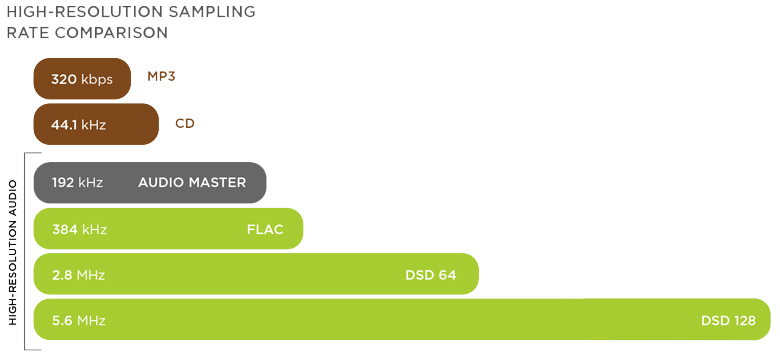
The sound source of a music CD ( CD-DA ) is recorded at 16-bit/44.1 kHz, while the sound source of 24-bit/96 kHz or higher is often referred to as a high-resolution sound source.

high resolution format
write Sampling frequency Bit depth Amount of information per second Difference in data volume on the CD
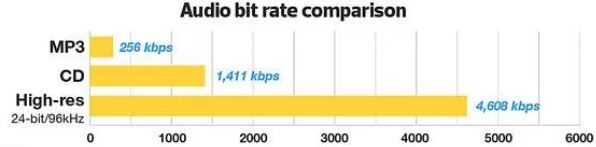
CD sound quality PCM 44.1KHz 16bit 705.6Kbps 1x
High resolution sound quality PCM 96KHz 24bit 2304Kbps 3.3 times
Hi-Res Sound Quality PCM 192KHz 24bit 4568Kbps 6.5 times
Sound quality DSC64 SACD 2.8224MHz 1 bit 2822.4Kbps 4.0 times
DSC128 5.6648MHz 1bit 5564.8Kbps 8.0 times
The sound gradation that can be expressed by the bit depth of PCM is as follows.

Sound gradation that can be expressed in 16 bits 2 16 gradation = 65,536 gradation
Sound gradation that can be expressed in 24 bits 2 24 gradation = 167,77,216 gradation
FLAC and ALAC lossless compression
ALAC of FLAC is a method of lossless compression. With the lossless compression method, the data before and after compression is exactly the same. Therefore, the sound quality does not deteriorate like MP3.

what is the difference between “high resolution”? Part 2

what is the difference between “high resolution”? Part 2

Hi-Res

How to get and listen to Hi-Res sound source?

{Hi-Res}

Due to the large capacity of Hi-Res Audio sources, they won’t fit on existing CDs, so you must purchase them through a music distribution site that handles Hi-Res music.
Currently, Hi-Res Audio sources can be purchased from music distribution sites such as “e-onkyo music”, “mora” and “HDtracks”.
If the demand for high resolution increases in the future, it can be handled by “iTunes” etc.

Also, even if you get a sound source, you basically can’t enjoy high-quality sound unless you use a “high-resolution compatible” playback device, so be careful.

Although it is a “high resolution” that does not give the impression that the current situation is a bit high, it is an opportunity to listen to the songs of your favorite artist with better sound quality, and it will surely be a new musical experience. .

There are also electronics retail stores where you can hear them, so why not look for a viewer when you pass by?

what is the difference between “high resolution”?

what is the difference between “high resolution”?

Hi-Res

What are the advantages and disadvantages?

Hi-Res

The keyword “high resolution” suddenly increasing its presence due to the proliferation of downloadable sound sources.
Even if you know that “high resolution” = “high sound quality”, there are not many people who really understand what is different from the conventional.

In this article, I will introduce how to listen to Hi-Res from the difference between “Hi-Res” and conventional sound.

What is high resolution?
High Resolution is an abbreviation for “High Resolution Audio” and means a high resolution sound source.
High resolution is used here to refer to “a digital sound source with an amount of information that exceeds the sound quality of a CD.”

So what does it mean to be a “digital sound source that exceeds the sound quality of a CD”?

High resolution sound source definition.
The sound quality of a digital sound source is determined by how accurately it is converted into a digital signal. The more information there is, the better the sound quality.

A sound source that can be called high resolution requires that the “sample rate” and “bit depth” exceed the level of the CD. I think it is an unknown word, so I will briefly explain this point.

The sound source on the CD has a “sampling rate of 44.1 kHz/s” and a “bit depth of 16 bits”.

“Sample rate” refers to “the amount of information divided per second,” and the higher the number, the smoother the sound.
On the other hand, “bit depth” refers to “data capacity per information divided”, and the larger the number, the greater the expressiveness of the sound.

Also, there is a unit called “bit rate (kbps)” when importing a CD or selecting sound quality with a streaming service.
This is the product of “sample rate”, “bit depth” and “number of channels (monaural = 1 / stereo = 2)”, and is a unit that expresses the goodness of the sound quality. Likewise, the higher the number, the higher the sound quality.

If the sound quality of the CD is the pixel art Mario from the Famicom, is it easy to imagine that the high resolution sound quality is as accurate as the pixel art Mario from the Super Nintendo?

The sound is good! That is why the disadvantages of “high resolution”
High sound quality has the downside of data.
Since this is digital data, the greater the amount of information, the greater the data capacity. Therefore, the amount of data from the high-resolution sound source is also quite large.

The capacity of each sound source per song for 5 minutes is as follows.

“Mp3 (normal sound quality)” =
“7.2MB” “CD” = “52.9MB”
“High resolution (such as 96 kHz/24 bit)” = “168.6 MB”

A 16 GB SD card only supports about 10 albums. It costs money