Sample Rate
The seconds are defined by taking as a time sample the period of oscillation of the light waves emitted by a cesium 133 atom in a particular atomic transition.
As we have already observed in the dedicated paragraph, sound is generated by small variations in atmospheric pressure that propagate in space and time and until the end of the 40s of the last century it could only be transduced by the human auditory system or by the microphone devices used. for the transmission of signals by radio but it cannot be stored in any type of support dedicated to mass cultural diffusion. In fact, there were already several technologies dedicated to the memorization of sound waves but they were either of poor quality and diffusion such as phonographs and gramophones or were used only experimentally or were dedicated to communications between military devices.
The only vehicle to transmit sound events for musical purposes was still the score that had to be interpreted by a human interpreter and, if someone wanted to listen to a certain piece of music, they had to go to a theater or concert hall that had it on the bill. We emphasize that the performance (as well as the listening) was unique and non-repeatable and the only memory capable of preserving the sounds was the human. All this until 1948, when in the United States Columbia patented the first 33 rpm vinyl record in the 25 and 30 cm formats and where the waveform (as previously happened with 78 rpm records) was printed in micro-grooves that were They developed in a spiral along the surface of the disk and were read by one of the giradichi heads.
The following year (1949) another type of media dedicated to the preservation and reproduction of sound was also introduced on the market: the first magnetic tape recorders wound on reels and later in 1964 Philips commercialized the four-track cassette in Europe. The era of massive musical (and cultural) enjoyment has begun, which after hundreds of years has profoundly and definitely changed our relationship with the world of sounds.
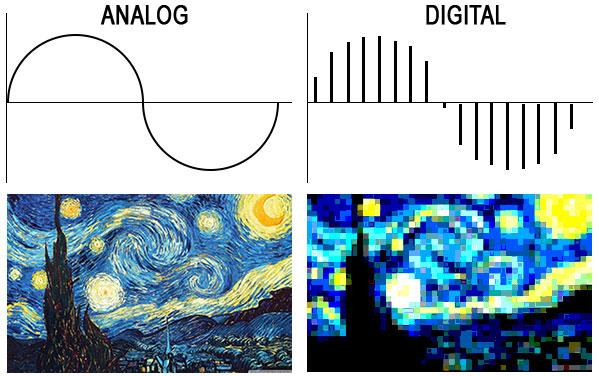
All the means and systems for storing sound waves that we have just exposed (in addition to others that I have not considered appropriate to mention here) belong to the world of analog audio since the information or rather the representation of the sound wave is produced in a continuous and analogous to the original changes in atmospheric pressure. This is because analog recording devices (transducers or microphones) transform changes in atmospheric pressure into changes in the voltage of an electrical signal, which can be stored on mechanical (vinyl records) or electromagnetic (magnetic tapes) media. to be eventually reproduced one or more times at later times. This, in addition to being a transcendental technological revolution, has also greatly influenced the diffusion of music in society, the role of music within it and the development of languages closely linked to the sound or musical arts.
In 1971 a new revolution began which, however, this time is strictly technical (from the cultural and social point of view it only amplifies and accelerates the process of global dissemination of information already underway): the birth of digital audio. In fact, in that year the research laboratories of NHK (Japanese public television radio) created the first digital audio recorder that, using the PCM (Pulse Code Modulation) technique patented by the British A.
Sampled signal
We have said that sampling a signal means measuring its amplitude (y) in each sampling period, obtaining a discrete signal in time and continuous in amplitude:

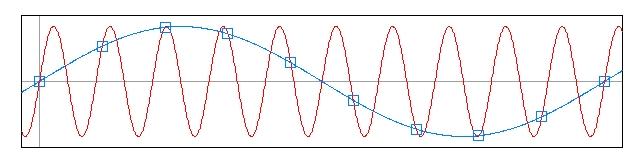
At this point, however, we are faced with a question: how often to sample the signal? Theoretically we can say that the shorter the sampling period, the less information will be lost between one sample and the next, obtaining a digital signal more similar to the original up to the ideal limit (infinitely small period) in which the analog signal and the sampled.

In practice, however, there are technological limits in the construction of ADC converters that do not allow us to achieve such short periods. Therefore, we must start from the assumption that the samples must be taken with a speed dependent on the variation of the signal and this speed depends on the harmonic component of higher frequency that will determine the sampling period.