Bit rate on the Internet


Free Download Mp4Gain
picture

Bit rate on the Internet
Bitrate

In the case of the bit rate applicable to the Internet, the higher the bit rate is the better, since the content we receive from the network arrives faster. In other words, the higher the bitrate we get from our ISP, the better the connection will be and we will be able to work much more comfortably.

Bitrate

Higher bitrate on an internet connection means streaming movies and video in high definition, playing online games with no lag, and downloading really large files smoothly and in seconds.

what-is-the-bitrate-
In the event that we want to know exactly what the bitrate of our connection is, we can do it easily and comfortably by accessing with our browser a site that is responsible for carrying out this test. One of the best on the market is speedtest.net.

Bit rate in audio and video
If we talk about audio and video, the meaning of the term bit rate differs a bit from what we use for the Internet. In this context, bit rate refers to the amount of data stored for every second of data that it reproduces. To take an example, an MP3 file of a song at 320 kbps offers a much higher quality than the same file encoded at 128 kbps, obviously as long as both files were created from the same source.

what-is-the-bitrate-
But we must always remember that if the source from which we obtained the files was of poor quality, then the copy will also be of poor quality, whether it has been encoded at 128 kbps or 320 kbps.

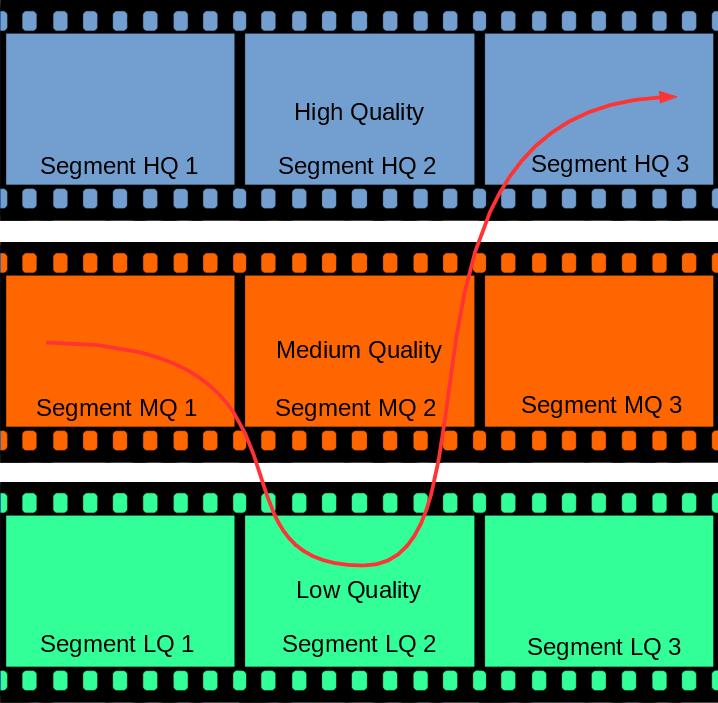
This is also the case with videos, a much higher bit rate will offer a much better display quality than video with the same resolution but at a lower bit rate.

The bit rate could be expected to increase each time the resolution increases as more data is being processed. This means that while high bitrate rates can deliver excellent display quality, they also require significantly more processing effort on the part of the hardware, forcing it, especially on modest and older hardware, to produce pauses and clipping.

what-is-the-bitrate-
Another aspect that we must also take into account since it is very important is that video file formats use different sets of compression algorithms, which could also be able to offer high quality with a more discreet bit rate. However, the extra processing load for these types of videos can also complicate the processor and systems involved in decoding.

Transfer bit rate on hard drives and SSD drives
Although most users do not pay attention to this parameter when talking about hard drives or SSDs, the truth is that it is one of the most important factors, more important even than its storage capacity or its rotation speed.

what-is-the-bitrate-
The bit rate in this context determines the reading and writing speed of these storage devices, the most delicate parameter to take into account, since this affects the performance that we will obtain from it. If we have a low transfer rate, it will slow down all the storage and reading processes, which will affect the times used to save large files and the overall performance of applications and games.


Free Download Mp4Gain
picture


Mp4Gain Main Window
picture


Mp4Gain Features
picture


Free Download Mp4Gain
picture

What is Bitrate? Bitrate of video, audio, internet and more …

What is Bitrate? Bitrate of video, audio, internet and more …

Bitrate

We have surely heard the word bitrate countless times when an expert user refers to some video or audio in digital format, and we have come to know that it is the element that defines the data flow. But what exactly is bitrate? The doubt arises because this parameter is not only used in these fields.

Bitrate

Like the resolution and the final format of the digital video or audio, another of the determining factors to obtain an excellent quality in an image or sound is, without a doubt, the bitrate, a parameter that perhaps is not always fully taken into account. And that not only applies to the field of audio or video. Therefore, in this article, we will find a lot of information to fully understand what bitrate is.

what-is-the-bitrate-

Bitrate: Why it is so important in our digital life
Electronic devices have reached operating speeds that were unthinkable just a few years ago, and that is why today we expect our device, be it a smartphone or tablet, a computer or a hard drive, to respond to us instantly and without hesitation. Many and varied factors have to do with it, but one of the most important is the bit rate at which it can exchange or process information.

The term bit rate, used in computing and telecommunications systems, basically refers to the amount of bits that can be transmitted in a given unit of time through a transmission system or between two digital devices. Depending on the context in which the term is used, the bitrate, or bitrate in English, is measured in Kbit / s or Mbps, kilobits per second or megabits per second, respectively.

what-is-the-bitrate-
Regardless of the unit of measurement used to define the bitrate, higher numbers always mean better and higher quality values, although we must not forget that low bitrate values ​​can also mean less signal processing by the hardware, very convenient in equipment such as smartphones, tablets or netbooks.

How does the bit rate affect the quality of the music?

How does the bit rate affect the quality of the music?

bit rate

Which indicator determines the bit rate of an audio file?

Bit Rate

There is a lot of talk these days that we have lost real music with the advent of compressed audio formats like MP3, AAC and the like. Is it really so? Will lossless music save music? Can an inexperienced listener tell the difference between MP3 and FLAC music? Let’s take a look at this problem.

What is Bitrate?
You’ve probably heard the term “bitrate” before, and you probably have a basic idea of ​​what it means, but it might be a good idea to familiarize yourself with its official definition to find out how it all works.

Bit rate is the number of bits or the amount of data that is processed over a period of time. In audio, this generally means kilobits per second. For example, the music you buy from iTunes is 256 kilobytes per second, which means that every second of the song contains 256 kilobytes of data.

The higher the bit rate of the track, the more space it will take up on your computer. Audio CDs tend to take up quite a bit of space, so it has become common practice to compress these files so that you can burn more music to your hard drive (or iPod, Dropbox or whatever). This is where the “lossy” and “lossy” formats conflict.

Lossless and Lossy formats: what’s the difference?
When we say lossless, we mean that we haven’t really changed the original file. That is, we copy a track from the CD to our hard drive, but we do not compress it to the point of losing data. Essentially the same as the original CD track.

However, most of the time, you will probably extract your music in Lossy format. That is, you took a CD, copied it to your hard drive and compressed the tracks so they don’t take up much space. A typical MP3 or AAC album is probably about 100MB. The same album in a lossless format like FLAC or ALAC (aka Apple Lossless) will be around 300MB, so it has become common practice to use lossy formats for faster downloads and more hard drive savings. .

The problem is that when you compress a file to save space, you are removing chunks of data. Just like when you take a high-quality image and compress it to JPEG, your computer grabs the raw data and “tricks” certain parts of the image into being basically the same, but with some loss of clarity and quality.

Let’s take the following two images as an example: the one on the right is clearly compressed and the quality is reduced as a result.

Remember that you are saving hard drive space by compressing music in lossy formats, which can make a big difference for an iPhone with 32GB of storage, but is only a trade-off in terms of size / quality.

There are different levels of compression: 128 kbps, for example, takes up very little space, but it will also have lower playback quality than a larger 320 kbps file, which in turn is of lower quality than a 1,411 reference file kbps. 1,411 kbps is CD-level audio quality, which is more than sufficient in most cases.

The problem is not how much the music is compressed, but what equipment you listen to it on.

Does bit rate really matter?
As memory gets cheaper every year, listening to sound at a higher bit rate, or even lossless formats, is starting to become more and more popular. But is it worth the time, effort, and memory usage on your phone or computer?

I don’t like answering questions this way, but sadly the answer is: it depends.

Part of the equation is the hardware you use. If you are using a good quality pair of headphones or speakers, you are used to wide frequency and dynamic range. As such, you are more likely to notice the downsides that come with compressing music into lower bitrate files.

You may notice that low-quality MP3 files lack a certain level of detail; Subtle backing tracks may be harder to hear, the highs and lows will not be as dynamic, or you may hear distortion in the lead vocal.

What is the bit rate?

What is the bit rate?

Bitrate

Bit rate refers to the data transfer rate (that is, how many bits are transmitted in a given time), generally expressed in bits per second.

Bitrate

Common units of bit rate are kilobits per second (Kbps) and megabits per second (Mbps). The term is also commonly used when talking about digital sampling and sample rates. For example, the MP3 audio compression algorithm is often configured to output files at a bit rate of 128 kbps. This means that the file contains an average of 128 kilobits for every second of audio (960 KB per minute). This is in contrast to CD audio, which is encoded as 44,100 16-bit stereo samples per second: 1411.2 kbps (16-bit x 44100 Hz x 2ch).

Often times, bytes are written in uppercase and are multipliers (for example, “KB” for kilobytes) and lowercase factors are bits (for example, “kb” for kilobytes). All modern computers use 8-bit bytes.

MP3 bit rate
The MP3 bit rate can be misleading. For example, an MP3 “constant bit rate” (CBR) of 128 kbps will use approximately 128 kilobits for every second of encoded audio (so the file size in bits divided by the length of the audio is approximately 128,000) , and headers, your frames will appear at regular intervals, but internally, from frame to frame, you can encode audio at bit rates higher or lower than 128 kbps by using a bit bucket (the ability of a frame to use bits of replacement of a previous block). However, the size of this bucket, and therefore the amount of variability, is limited, so 128 kbps will be very close to the effective bit rate throughout the file.

See also: 8D surround sound and how to do it
As another example, “128 kbps VBR MP3” is often incorrect, since the purpose of VBR is to allow each of the internal MP3 sectors to have its own bit rate. When people refer to the VBR MP3 bit rate, they are generally referring to the actual average bit rate of their frames. If the length of the encoded audio is known, then the “bit rate” can be the data size of the file divided by its duration, which will be fairly close to the same number. However, the length of an MP3 VBR cannot be accurately determined without scanning all the frames.

Let us remind you that when mixing and mastering, our engineers encode mp3s with various algorithms, and choose the best result so that the client gets the highest acceptable quality from their composition.