H.266 / VCC is now official, the new codec of the future that claims to reduce the size of videos by half


Free Download Mp4Gain
picture

H.266 / VCC is now official, the new codec of the future that claims to reduce the size of videos by half

H.266/VCC


The history of codecs is the story of how, as video qualities superior to the previous generation arrived, better compression algorithms were needed so that the size of the files did not skyrocket. In this sense, H.264 or AVC, which is still the standard today, was a great advance over formats such as DivX and fu from the one used on Blu-Ray discs. After being the winner of High Definition, H.265 / HEVC succeeded it as the winner of Ultra High Definition (on UHD Blu-Ray and 4K video compression on smartphones.

H266

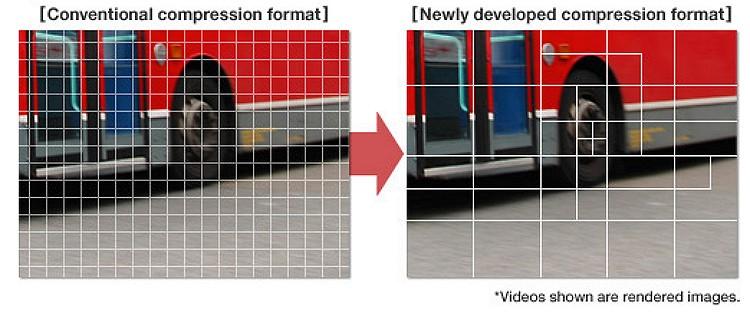
Now, facing the 8K era, there is more competition than ever, but the recently introduced H.266 / VCC is again, for what it proposes, the one that seems to be a great candidate for winner of the decade again. After five years of development, it has been presented by the Fraunhofer Heinrich Hertz Institute, and they promise that it will reduce the size of the videos in half compared to what they occupied with H.265. This means that if a current 4K movie occupies 10 GB, with this it would occupy 5 GB without losing detail.

These are the novelties of H.266, which will have more competition than ever
H266
With H.266 they have achieved the 50% bitrate reduction they were looking for
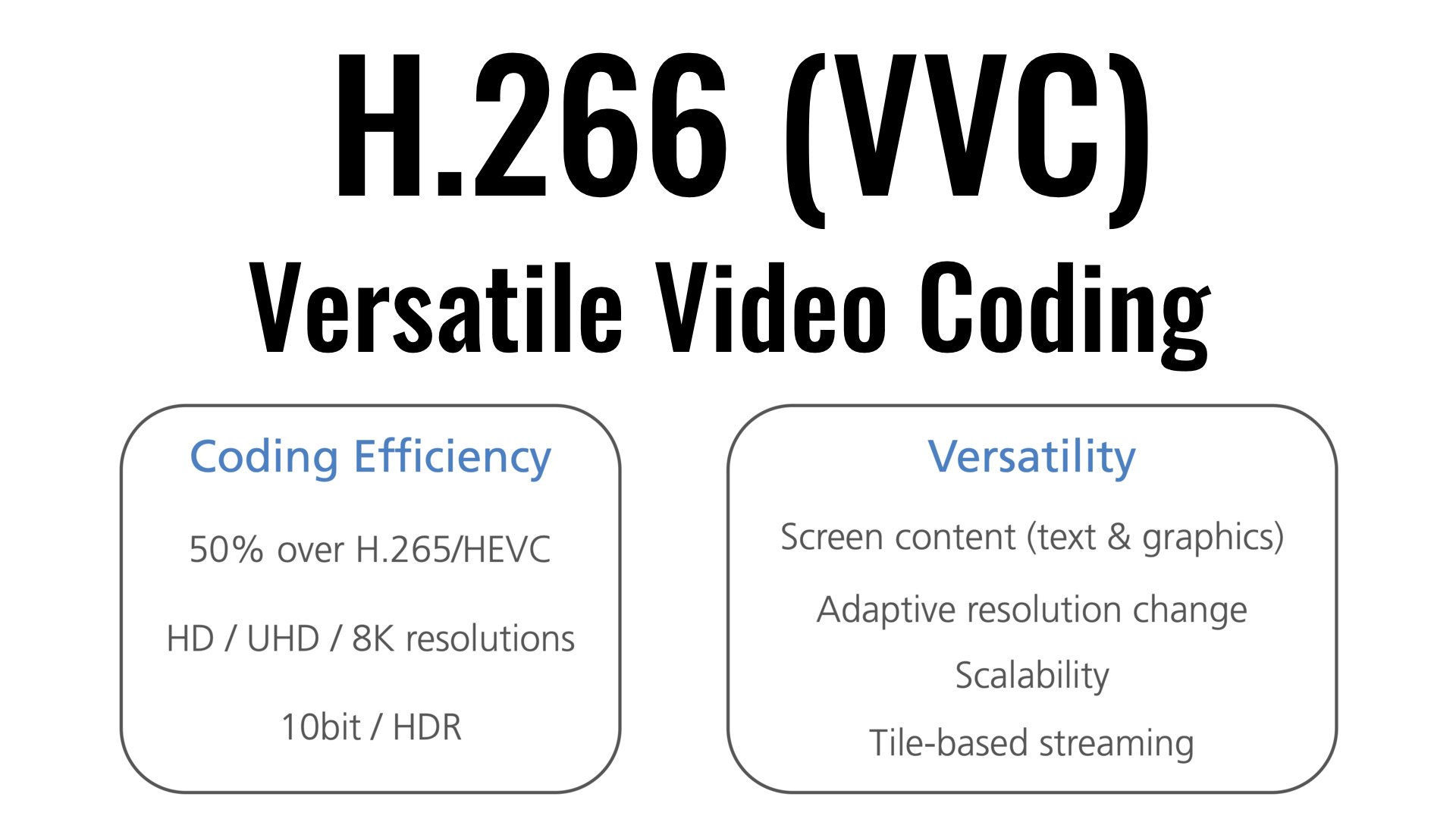
In addition to reducing the size by half, which in the official statement also relates to a 50% bitrate drop to maintain the same quality, H.266 will have support for SD, HD, 4K and 8K resolutions. In this sense, H.266 will also support adaptive resolution changes.

Additionally, how could it be otherwise, it will also support 10-bit HDR video with wide color spectra, which can be expanded in the future. This is important, because HDR formats, now being HDR10 and Dolby Vision the most popular, will also evolve. There will be support for 360 video and video streaming, such as games or shared screens.

HDR on television: this is the revolution called to eclipse 4K / UHD
IN XATAKA
HDR on television: this is the revolution called to eclipse 4K / UHD
H.266 will, according to the statement, be supported by Apple, Ericsson, Intel, Huawei, Microsoft, Qualcomm and Sony. With Apple and Qualcomm it is guaranteed that its expansion at the level of hardware support will be extensive, since chips with the ability to encode and decode need to arrive, as happened with the previous ones. Apple, for example, added these options with the A10 chip, previously, in the A9, it could only decode.

The key to adopting H.266 will be whether its advantages are worth it over being a closed standard
Even so, beyond all these advantages, the big problem with H.266 is that it is not an open codec, but a closed codec, like its predecessors. That means that, to integrate it into hardware and use it in software, you have to pay licenses, unlike the other codec called to succeed in this decade, AV1. This, which also has the support of large companies in the sector, such as Apple, Amazon, ARM, Netflix, Google, Intel, Mozilla, etc.

Being open the great asset of AV1, it will be necessary to see if its saving of 25% on average compared to H.265 compensates for its free compared to 50% of H.266. Recent history tells us that proprietary formats win.


Free Download Mp4Gain
picture


Mp4Gain Main Window
picture


Mp4Gain Features
picture


Free Download Mp4Gain
picture

What is the H.266 codec

What is the H.266 codec

H.266 (VVC)

The new H.266 standard, also known as VVC (Versatile Video Coding), is used to compress and decompress video files so that they take up less space when stored on a hard drive and less bandwidth when transferred through a net.

H.266/VVC

Codecs use different kinds of algorithms (similar to mathematical formulas) to reduce the size of files. The best codecs are the ones that reduce the files the most without significantly affecting the quality of the video.

codec h266 vvc compression
The new H.266 will be able to create files 50 percent smaller than the current H.265. This means that a 10 GB video encoded in H.264 occupies 5 GB in H.265 and only 2.5 GB in H.266.

H.264 Vs H.265 Vs H.266
Codec Publication year File size
H.264 2003 10 GB
H.265 2013 5 GB
H.266 2020 2.5 GB
This incredible reduction in file size will greatly help the playback and streaming of 8K HDR video content on the devices of the future.

In addition to that, the new codec will have support for 10-bit HDR and more versatility of resolutions (it will allow to scale or change the resolution adaptively).

The VVC standard specification document is over 500 pages long and it has taken Fraunhofer HHI engineers nearly 3 years to develop it together with their partners (Apple, Ericsson, Intel, Huawei, Microsoft, Qualcomm and Sony).

The Fraunhofer Institute for Telecommunications, Heinrich Hertz Institute, HHI, also known as Fraunhofer HHI or Fraunhofer Heinrich Hertz Institute, is an organization dedicated to applied research and development in the fields of physics, electrical engineering and computer science .
For photographers it could also lead to a more efficient image file format and another challenge to the dominance of JPEG as the lightweight file type of choice as the HEIF image format – implemented by Apple on the iPhone and, more recently, by Canon on the 1D X Mark III- is based entirely on H.265 / HEVC compression. For the same reason, H.266 / VVC could lead to an even more efficient “VIC” format for photos, although this is pure speculation at the moment.

As for when it will actually be applied, the adoption could end up being faster than H.265 thanks to the creation of the MC-IF (Media Coding Industry Forum or Forum of the Media Coding Industry). This industry body, made up of more than 30 companies, will be responsible for the “fair, reasonable and non-discriminatory” licensing of H.266 / VVC when encoding and decoding software (and hardware) are released to the market. end of this year.

The H.266 codec arrives to save the Internet: halves the size of streaming video

The H.266 codec arrives to save the Internet: halves the size of streaming video

H.266/VVC Codec

After three years of development, today the H.266 codec was introduced, which promises to halve the size of streaming videos without losing quality.

Codec H.266

The German Fraunhofer HHI institute has just introduced the long-awaited H.266 codec, which promises to lighten Internet traffic by halving the size of videos compared to the HEVC (H.265) codec. It is an important achievement considering that 80% of Internet traffic is streaming video.

The German Fraunhofer HHI institute, which is also behind the H.264 and H.265 formats, is part of the network of German institutions that also created the MP3 audio format. It has been working on the H.266 codec for three years together with Apple, Intel, Huawei, Microsoft, Qualcomm, Sony and Ericsson.

The main improvements of H.266 with respect to H.265 are two: the spectacular compression of the video, and its greater versatility. It is not only designed to encode streaming video or in local mode.

Register
Fraunhofer HHI claims that a 90 minute 4K video encoded with the H.265 codec occupies about 10 GB, but if it is encoded with H.266 it is reduced to 5 GB without losing image quality.

It is a format that accepts all resolutions, from low-resolution video to 8K, although it has been developed with 4K resolution in mind, so the main improvements are noticeable from this resolution.

As we have mentioned, it stands out for its versatility. It not only works well with conventional video or streaming. Also with 360-degree video, virtual reality, streaming video games like Google Stadia, screen sharing, etc. It also supports 10-bit color and HDR in all situations.

If you cut the video size in half without losing quality, the H.266 codec could be a major relief for Internet traffic, should platforms like Neftlix, Amazon Prime Video, YouTube or Disney + adapt it.

The main problem is that it is a licensed codec, only certain versions can be used for free and for non-commercial use. Netflix for example used H.264 and H.265 (HEVC), but for streaming on Android it opted for AV1, which is a free codec.

We’ll see what level of acceptance it has, but the fact that companies like Apple, Microsoft or Sony support it is important.

Software to encode and decode the H.266 codec will arrive in the fall. It will also be implemented in chips that will be used in mobiles, and devices such as Chromecast or Fire TV Stick.