What is High Resolution Audio (HRA)?

In most digital audio systems, the analog signal (that is, the sound we hear) is converted into a digital signal for storage and transmission using a pulse code modulation (PCM) system.

The quality of a digital recording is determined by two factors: the bit depth and the sampling frequency. Bit depth determines the number of “steps” we have to describe the sound: the higher the bit depth, the wider the dynamic range of the recording, that is, the difference between the loudest and lowest sounds.
“At the same time, the higher the sample rate, that is, how many times per second a snapshot of the analog audio signal is taken, the more accurately the audio can be analyzed and converted to digital format. That is, the range of sound from low to high. ”
The higher the bit depth and sampling frequency, the more information can be recorded.
Image “SAMPLING FREQUENCY – NUMBER OF” SOUND SNAPPIES “PER SECOND”
CDs use 16-bit / 44.1 kHz encoding. When the CD format appeared in the early 1980s, it had wonderful quality, but now we can record and stream music with even higher bit depths and sample rates in formats that have been used in music studios and mixing for many years. years. Now music in these formats is available to every home.
What is High Resolution Audio (HRA)? Beginning
Hi-Res Audio: Any format that exceeds standard CD quality (16-bit / 44.1 kHz). High-definition recordings typically use 24-bit encoding, which greatly expands the dynamic range compared to CD. The sample rate for this audio goes up to 192 kHz, which is the standard for high-definition commercial recordings. The goal of the new formats is to provide sound quality as close to the studio as possible.
Hi-Res Audio Formats
There are many High Resolution Audio (HRA) formats, and your player should be able to handle as many as possible. Technics devices work with all major HRA formats (including some less common ones), making it easy and playable even in the future when the market changes.
Music in CD quality is also available for most formats. Below is a list of some of the common formats that are used for both lossless CD quality music and Hi-Res Audio.
Hi-Res Audio Formats – Principle
FLAC: Studio Mix Quality (24-bit) and CD Quality (16-bit)
Most music files (both in high definition and CD quality) are presented on the Internet in FLAC (Free Lossless Audio Codec) format: free means the format, but not the music itself. 24-bit FLAC files are usually available in 96 or 192 kHz, although some albums are also recorded in 24-bit / 44.1 kHz or 24-bit / 48 kHz. The 24-bit / 192 kHz files are the highest quality recordings to date, identical to the studio master recording.
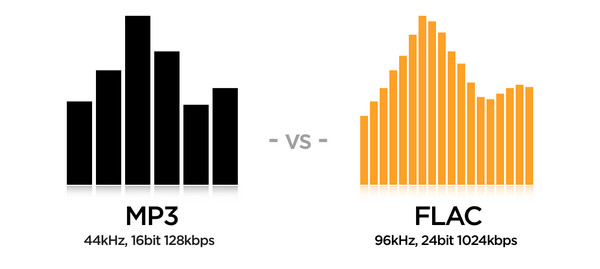
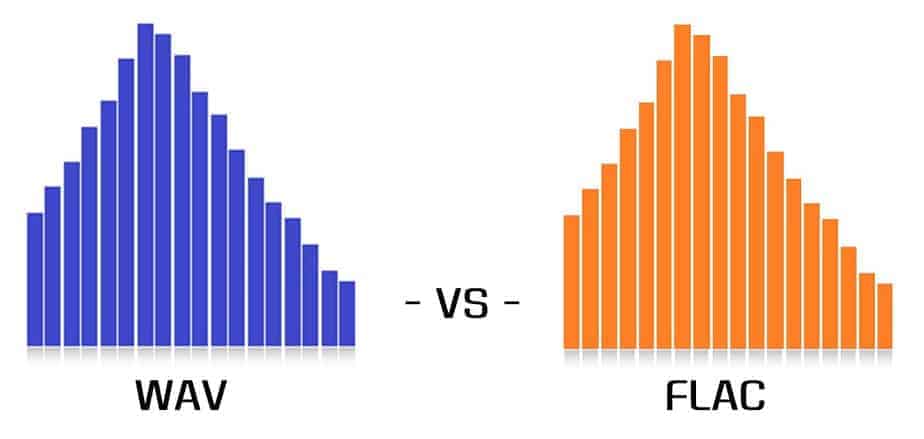
Unlike the MP3 format, which requires deleting some data to reduce the file size, the FLAC format is lossless and works like a zip file on a computer: decompression happens on the fly, while playing, and the unzipped data is identical to the previous data. compression.
Apple has its own lossless audio format: Apple Lossless (ALAC). Files in this format work in the same way as FLAC, but are compatible with iTunes. Several companies offer downloads of studio master recordings in FLAC and ALAC formats.
Another advantage of the FLAC and ALAC formats is that they store information about the music in metadata, which includes the usual information: artist name, album name, title and track number, genre, composer, catalog number, etc.
This information can be encoded on any studio master recording, on high definition tracks purchased online, or it can be burned onto the CDs you are ripping from – the ripping program searches for the saved disc in an Internet database and automatically fill in all the information. This information can also be edited or entered manually.