What is volume? Part 4


Free Download Mp4Gain
picture

What is volume? Part 4
audio volume

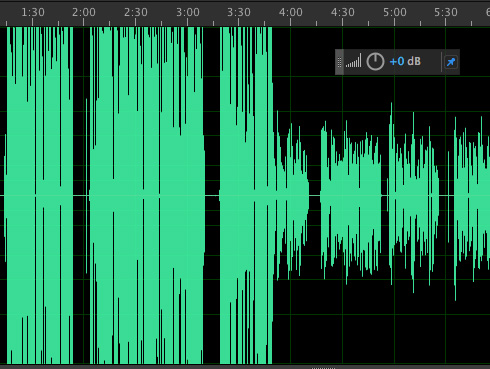
If we multiply the signal by too large a number, an overflow may occur.
AUDIO VOLUME

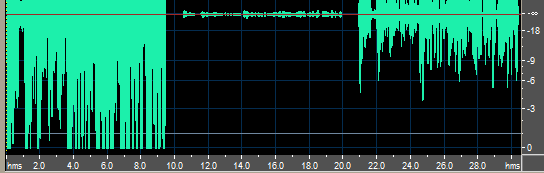
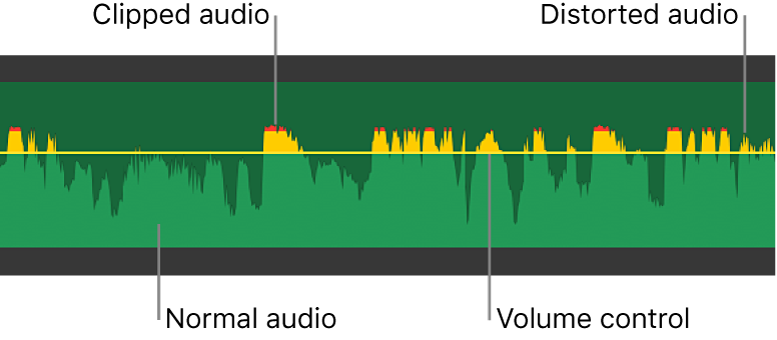
If the overflow is not monitored, then the amplitude value takes on almost random values ​​(see figure) and this leads to very noticeable frequent clicks. The simplest way to solve this defect is to cut the signal (clipping), that is, where the amplitude of the signal exceeds the limits, we ‘cut’ it (see figure). With a slight overflow, the clipping is almost invisible to the ear, however as the level increases it appears as ‘sand’ in the sound.

A more complicated way, but also more effective, is the limitation of the signal. Its essence is to automatically reduce the signal level so that there is simply no overflow. This requires an Automatic Gain Control (AGC) system that corrects the current signal level. So, as long as there is no overflow, AGC does not change the signal, and as soon as the signal exceeds the maximum level, a correction is made, which changes the signal so that its level does not exceed the maximum. As you can see in the figure, the sign completely retains its shape. However, the volume is kept at maximum:

It is necessary to pay attention to the fact that the above figure shows the amplitude, and this one shows the loudness (determined by a large group of amplitudes). Therefore, even though the loudness graph is “cut off”, the shape of the signal itself is distorted to a minimum. This method is not without its drawbacks, either. Initially, the sound had a different volume, but after limiting all the sounds outside the limits they have the same volume and the sound can become “flat” and expressionless. Let’s look at the histograms (Fight Club):

Here is an example of failed amplification. With a gain of + 10dB, distortions are still barely noticeable (there are still relatively few places in the film where spillover occurs), however, as the gain increases, the level capping appears more and more often, already a + 30dB level, the voice starts to be limited, which is extremely noticeable. The downsides of limiting are especially noticeable with significant changes in volume in a short time: subjectively, the volume begins to jump up and down. If, in the context of a conversation (which with an amplification of + 30 dB is already reproduced at maximum volume), a loud sound is produced (which is louder than the original voice, for example, a phone call), then the The amplification level is lowered so that loud sound is not distorted, but the volume of the conversation also drops sharply.

So the relative volume of the different sounds played at the same time is preserved, however the gain level is constantly changing, which is clearly perceptible and very unpleasant. Therefore, at high gain levels (20-30dB and more), limiting also gives a bad result.

At low gain levels, signal clipping defects are almost invisible, while signal clipping is almost always audible. Those. All other things being equal, the restriction gives a better quality result. The filter always produces clipping or clipping, so it is recommended to always keep the clipping option enabled.

5. Standardization

Let’s set ourselves the goal of turning up the volume without losing any quality. It’s possible? Yes, if there is a “top margin” of dynamic range. Let’s look at the histograms with movies again, Film Cube (yellow graph). The histogram shows that the volume does not rise above -15dB (there may be one or two of those moments for the entire movie, however for the purposes of this consideration we will assume there is no loud sound). And since there are no loud sounds, you can increase the volume by 15 dB without losing quality!

Other than increasing the volume, there is no change in the signal. In this case, the histogram will move close to the right edge without changing its shape:

So it turns out that the sound is now present at maximum volume in the movie. But if we increase the volume more, it will produce distortions (described above). This waveform, where there is a sound of maximum intensity without distortions being introduced at the same time, is called normalized and the process is called normalization. Normalization is usually carried out at the stage of preparing music recordings and the sound reaches us already normalized (for example, AudioCD). However, there is no standardization for movies. Why?

Think of histograms of music and chaos with volume. For music, it is important to play at maximum volume, as it is designed for the maximum target audience: CD players, street noise, subway, cheap headphones.


Free Download Mp4Gain
picture


Mp4Gain Main Window
picture


Mp4Gain Features
picture


Free Download Mp4Gain
picture

What is volume? Part 3

What is volume? Part 3

Audio volume

A completely different volume distribution immediately catches your eye.

audio volume

All sounds are heavily shifted to the ‘loud’ part of the dynamic range. The difference in the average volume of movies and music reaches 40 dB. In addition, movies are characterized by a smooth drop in the histogram in the noisy area. For music, the maximum of the histogram is usually at the maximum level (0 dB). There are few such charts, but this situation is very common.

The concept of dialogue level is often inapplicable to music, so it is very difficult to separate high and low sounds. Therefore, it is also difficult to determine the subjective volume of the composition. Therefore, a subjectively noisy composition can be objectively quieter than a subjectively noisy one. Here positive or negative drops in volume, which are not visible in these histograms, are of great importance.

The lack of a single reference point leads to chaos – the sound from different sources has different loudness – the difference in the maximums of the composition histograms reaches 20 dB. And, in general, the concept of ‘volume of a composition’ is very difficult to formalize in any way. Many people are likely familiar with the situation when there is a lot of different music from different sources and when they play it back-to-back (for example, if you record an audio CD), the volume constantly changes when you switch from song to song, which is unpleasant (and the aforementioned effect of a discrepancy between actual and subjective volume can be an even more confusing perception). The graphs given illustrate this situation very well.

The dynamic range of musical compositions (the difference between the loudest and quietest sound) is 20 to 40 dB, which is significantly less than the dynamic range of movies (70 dB).

3. DVD volume problem

On average, the volume level of music recordings (as well as Windows system sounds) is significantly louder than that of DVD movies. Therefore, with the same system volume settings, the absolute volume of the movies will be much lower and in the presence of external noise it may be insufficient, it will be difficult to hear (sic!) And it will seem that the sound is of poor quality . Increasing the gain in the system settings and in the amplifier even to the maximum may not solve the problem: the difference in the average volume reaches 40 dB, which is a lot. However, even if the power of the amplifier turns out to be sufficient and the DVD is played with enough absolute volume, it is not always convenient, since the sounds of the operating system

This problem is typical mainly of computer playback, since in hardware players, the gain level is controlled by the decoder itself. Some software DVD players can control the volume of the system, but this is also not always convenient, as the volume of all system sounds changes (you can accidentally stun the neighbors) and the program still cannot control the volume in a external amplifier. So this is only a partial solution to the problem.

The trade-off is to process the sound just before playing it. Such processing can greatly improve the playback quality of a specific recording and under specific conditions. Many may argue that this is a loss of ‘quality’, however, as already mentioned, there is no absolute quality, we did not set ourselves the goal of editing the sound, our goal is to achieve listening in our conditions, yours was pleasant . If the speaker system does not have enough power, or if we have nervous neighbors, watching a movie at a reduced volume, when half the words cannot be distinguished and half the silent sounds cannot be heard, it will be just unpleasant. Even self-hypnosis about the maximum “quality” achieved will not be able to soften this impression. I’ll repeat the main idea one more time: quality is what we hear. Sound goes through many stages of processing before reaching the listener, and the variety of acoustics and their properties is so great that the last stage of processing just before playback is practically a necessity.

4. Level change. Overflow, circumcision and limitation.

A level change is simply a multiplication of the amplitude of a signal by a certain value, as a result of which the volume of the entire signal changes (increases or decreases).

What is volume? Part 2

What is volume? Part 2

audio volume

Therefore, a sound with the same absolute volume can be perceived as high or low depending on the surrounding conditions.

Audio Volume

Let’s say we adjust the gain level so that the volume of the dialogue in the movie roughly corresponds to reality. So if the movie has the sound of a clock ticking silently, then when we watch a movie in the noise of the city, we will not hear the clock at all, as the sound of the clock is much lower than the surrounding noise, and hearing is adapted to filter out ambient noise. In good listening conditions, when there is no ambient noise, the same watch will be clearly audible.

In many cases, it is convenient to measure the recording volume relative to some reference level. For example, if the recording volume is -20dB, is it high or low? And if we know that the volume of the dialogs in the same recording is -30dB, then we can immediately say that it is loud enough, and if the volume of the dialogs is -10dB, then we can say that it is quite quiet. Dialogue level (average conversation volume) is a very convenient reference level, relative to which you can easily navigate. If the sound volume is 10 dB louder than the dialogue level, then it is loud, and if it is 10 dB lower, then it is quiet. At the same time, the level of the dialogue itself can be arbitrary and depend on the recording: in one recording, the level of the dialogue can be -10dB and in another it can be -30dB. In any case, sounds with a volume below the dialogue level will be perceived as quiet and above the dialogue level as loud, even if the speaker system is incorrectly calibrated and the dialogue will sound at an absolute volume of 40 dB. or 60 dB. Thanks to the adaptive property, the hearing adapts to the current average loudness and makes an appropriate ‘correction’.

Therefore, one more loudness scale can be entered (in addition to the digital signal loudness scale and the absolute loudness scale): the loudness relative to the dialogue level. By comparing different volume levels, we get:

absolute volume of real sounds volume relative to dialogue level recording volume-1 recording volume-2 absolute volume during playback records 1 absolute volume during playback records 2
Silent sounds
low whisper 10dB -40dB -70dB -50dB 10dB 10dB
noise standard in residential premises 20..30dB -20 ..- 30dB -50 ..- 60dB -30 ..- 40dB 20..30dB 20..30dB
quiet conversation 40dB -10dB -40dB -20dB 40dB 40dB
Dialogue level
middle volume talk 50dB 0dB -30dB -10dB 50dB 50dB
Loud sounds
typewriter noise 70dB + 20dB -10dB 0dB (maximum) 70dB 60dB
truck motor 80dB + 30dB 0dB (maximum) 0dB 80dB 60dB
strong signal from the car at a distance of 5-7m 100dB + 50dB 0dB 0dB 80dB 60dB
the noise of a tractor running at a distance of 1 m 120dB + 70dB 0dB 0dB 80dB 60dB
pain threshold 130dB + 80dB 0dB 0dB 80dB 60dB

The table also shows two hypothetical recordings recorded under different conditions: the dialogue level in recording-1 is -30dB, and in recording-2 -10dB. You can see that when played back on a calibrated system, the first recording reproduces loud sounds much better; Sounds can be played with a volume of up to 80 dB, while the second recording plays sounds with a volume of only up to 80 dB. 60 dB.

Also note that the two recordings shown require different speaker calibration. So for acoustics capable of creating 100 dB pressure, the required gain level for the first recording is -20 dB and for the second, 40 dB. So the first recording requires significantly higher gain, and when both recordings are played at the same gain setting, the first recording will sound much quieter. Therefore, the second input is convenient for uncalibrated systems, as it allows large deviations in the gain level.

Therefore, record-1 transmits loud sounds well, but requires a higher level of amplification; with insufficient gain and the presence of external noise, it will be perceived as excessively quiet. Recording-2 does not require much amplification, it is well audible even at low amplification levels and in the presence of noise, but it cannot reproduce loud sounds well.

Now let’s remember that the sound signal is variable:

What to bring to calculate loudness? Obviously, a pressure change over a period of a sound wave does not make sense to change the volume of a sound, since we do not hear individual vibrations. Therefore, loudness is not determined by a point, but by a certain period of time.

What is volume?

What is volume?

Volume - audio

This seemingly obvious question is quite difficult to formalize, as completely different things are understood in different cases.

AUDIO VOLUME

The meaning of loudness is more obvious when we talk about sound pressure, since it is something that is perceived directly by the ear.

Sound pressure: the pressure that additionally arises during the passage of a sound wave in a liquid and a gaseous medium. By propagating in the medium, the sound wave forms thickening and rarefaction, which create additional pressure changes relative to the mean pressure value in the medium. Therefore, the sound pressure is the variable part of the pressure, that is, pressure fluctuations with respect to the mean value, whose frequency corresponds to the frequency of the sound wave. (Great Soviet encyclopedia)

Therefore, we can evaluate any sound: loud sounds create a lot of pressure, quiet sounds little. Pressure is measured in pascals, but in acoustics, sound pressure is usually measured in decibels (dB) relative to the threshold of hearing. By definition, the threshold value is taken equal to pt = 0.00002Pa = 20μPa. The threshold of audibility is taken as 0dB and the volume calculated as l = 20 * log (p / pt), where l [dB] – volume (in the sense of sound pressure), p [Pa] – sound pressure, pt [Pa ] – hearing threshold. In this case: all audible sounds have a positive volume value; inaudible (below loudness threshold) – negative; a 6 dB volume change corresponds to twice the pressure change; 20 dB change – pressure change 10 times. Loudness in the sound pressure sense will be referred to below as absolute loudness.

Some typical loudness values:

Sound Volume Pressure
Hearing threshold 0dB 20 μPa
Whisper of foliage and wind
soft The ticking of a wristwatch
Breath 10-20 dB 60-200 μPa
Silent whisper The
wall clock ticking 20-30dB 200 – 600 μPa
Interior noise 30-40dB 0.6 – 2 MPa
Quiet conversation 40-50dB 2-6 MPa
Moderate talk 50-60dB 6 – 20 MPa
Loud talk 60-70dB 20 – 60 MPa
Noisy street 70-80dB 60-200 mPa
Truck motor ~ 80dB 200 mPa
Noise in the subway while driving
Jackhammer ~ 90dB 600 mPa
Noisy disco 100-120dB 2 – 20 Pa
Airplane taking off 120dB 20 Pa
Pain threshold 130dB 60 Pa

Pay attention to the range of perceived pressures: the pressure at the hearing threshold and that created by the aircraft differ by a factor of a million! Therefore, the logarithmic scale is much more consistent with the physiology of hearing: a linear change in sound pressure does not correspond to the sensation of a linear change in volume. For example, a change in sound pressure of 50 MPa during a conversation will be very noticeable, but completely imperceptible when the plane takes off. A change in sound pressure by 6 dB (twice) will be perceived as an approximately equal change in volume in both cases, although in the first case it will correspond to a change in pressure by 25 MPa and in the second – 10 Pa.

Another volume is the volume of the recording (the volume of the signal). This loudness is not sound pressure (it can be voltage, magnetization, etc.), however, the sound pressure is generated according to the loudness of the recording signal by the playback system. Each specific signal volume corresponds to a specific sound pressure. The volume of the signal can also be measured in decibels. However, if sound pressure is generally measured relative to the hearing threshold (minimum audible sound pressure), then the volume of a digital signal is generally measured relative to the maximum digital level taken as 0dB. Thus, the loudness of a digital signal is expressed in negative values ​​(-3dB, -20dB) since the loudness of the recording must always be less than the maximum. The lower the volume value, the lower the signal (-20dB is lower than -3dB). If the volume of a digital signal is positive, it means overflow and, as a result, the appearance of digital distortion. (The essence of these distortions will be discussed later).

The volume controls on the amplifier, in the system settings, on the player do not create sound pressure at all. In the absence of a signal, even with the maximum volume setting, we will not hear anything (as long as the playback system itself does not create noise). Therefore, they affect loudness only indirectly and make sense to amplify the signal. (gain may mean attenuation of the signal). In the following, the term loudness will not be used to denote gain levels, with the exception of system loudness, as it is an established term. The system volume will mean both the gain level set in the operating system settings and the player, amplifier / receiver, etc.