What is volume? Part 4
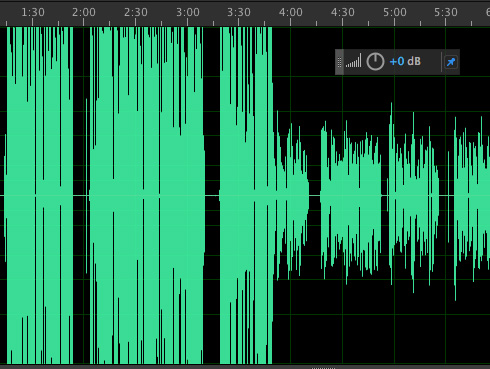
If we multiply the signal by too large a number, an overflow may occur.
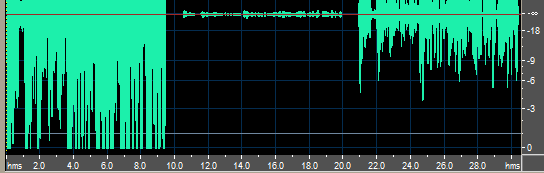
If the overflow is not monitored, then the amplitude value takes on almost random values (see figure) and this leads to very noticeable frequent clicks. The simplest way to solve this defect is to cut the signal (clipping), that is, where the amplitude of the signal exceeds the limits, we ‘cut’ it (see figure). With a slight overflow, the clipping is almost invisible to the ear, however as the level increases it appears as ‘sand’ in the sound.
A more complicated way, but also more effective, is the limitation of the signal. Its essence is to automatically reduce the signal level so that there is simply no overflow. This requires an Automatic Gain Control (AGC) system that corrects the current signal level. So, as long as there is no overflow, AGC does not change the signal, and as soon as the signal exceeds the maximum level, a correction is made, which changes the signal so that its level does not exceed the maximum. As you can see in the figure, the sign completely retains its shape. However, the volume is kept at maximum:
It is necessary to pay attention to the fact that the above figure shows the amplitude, and this one shows the loudness (determined by a large group of amplitudes). Therefore, even though the loudness graph is “cut off”, the shape of the signal itself is distorted to a minimum. This method is not without its drawbacks, either. Initially, the sound had a different volume, but after limiting all the sounds outside the limits they have the same volume and the sound can become “flat” and expressionless. Let’s look at the histograms (Fight Club):
Here is an example of failed amplification. With a gain of + 10dB, distortions are still barely noticeable (there are still relatively few places in the film where spillover occurs), however, as the gain increases, the level capping appears more and more often, already a + 30dB level, the voice starts to be limited, which is extremely noticeable. The downsides of limiting are especially noticeable with significant changes in volume in a short time: subjectively, the volume begins to jump up and down. If, in the context of a conversation (which with an amplification of + 30 dB is already reproduced at maximum volume), a loud sound is produced (which is louder than the original voice, for example, a phone call), then the The amplification level is lowered so that loud sound is not distorted, but the volume of the conversation also drops sharply.
So the relative volume of the different sounds played at the same time is preserved, however the gain level is constantly changing, which is clearly perceptible and very unpleasant. Therefore, at high gain levels (20-30dB and more), limiting also gives a bad result.
At low gain levels, signal clipping defects are almost invisible, while signal clipping is almost always audible. Those. All other things being equal, the restriction gives a better quality result. The filter always produces clipping or clipping, so it is recommended to always keep the clipping option enabled.
5. Standardization
Let’s set ourselves the goal of turning up the volume without losing any quality. It’s possible? Yes, if there is a “top margin” of dynamic range. Let’s look at the histograms with movies again, Film Cube (yellow graph). The histogram shows that the volume does not rise above -15dB (there may be one or two of those moments for the entire movie, however for the purposes of this consideration we will assume there is no loud sound). And since there are no loud sounds, you can increase the volume by 15 dB without losing quality!
Other than increasing the volume, there is no change in the signal. In this case, the histogram will move close to the right edge without changing its shape:
So it turns out that the sound is now present at maximum volume in the movie. But if we increase the volume more, it will produce distortions (described above). This waveform, where there is a sound of maximum intensity without distortions being introduced at the same time, is called normalized and the process is called normalization. Normalization is usually carried out at the stage of preparing music recordings and the sound reaches us already normalized (for example, AudioCD). However, there is no standardization for movies. Why?
Think of histograms of music and chaos with volume. For music, it is important to play at maximum volume, as it is designed for the maximum target audience: CD players, street noise, subway, cheap headphones.