
Analog to digital signal conversion Part 2

If you need no distortion of the TV signal during the sampling process with a cutoff frequency, for example 6 MHz, then the sampling frequency must be at least 12 MHz.
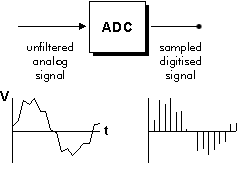
However, the closer the sample rate is to twice the cutoff frequency of the signal, the more difficult it is to create a low-pass filter, which is used in the reconstruction and also in the pre-filtering of the original analog signal. This is due to the fact that as the sampling frequency approaches the doubling cutoff frequency of the sampled signal, increasingly stringent requirements are imposed on the shape of the frequency characteristics of the reconstruction filters: it must correspond more and more precisely to a rectangle. characteristic. It should be noted that a rectangular filter cannot be physically implemented. Such a filter, as theory shows, must introduce an infinitely large delay into the transmitted signal. Therefore, in practice, there is always a certain interval between the doubled cutoff frequency of the original signal and the sampling frequency.
Quantification
– represents the replacement of the count value of the signal with the closest value of a set of fixed values - quantization levels. In other words, quantization is the rounding of the count value. Quantization levels divide the entire range of possible changes in signal values into a finite number of intervals: quantization steps. The location of the quantization levels is determined by the quantization scale. Uniform and non-uniform scales are used. In Fig. 3 shows the original analog signal and its quantized version obtained by means of a uniform quantization scale, as well as the corresponding image signals.
Signal distortions that occur during the quantization process are called quantization noise. In instrumental noise estimation, the difference between the original signal and its quantized copy is calculated and, for example, the root mean square value of this difference is taken as objective noise indicators. The timing diagram and the image of the quantization noise are also shown in Fig. 3 (the image of the quantization noise is shown on a gray background). Unlike jitter noise, quantization noise is correlated with the signal, so quantization noise cannot be removed by post-filtering. The quantization noise decreases as the number of quantization levels increases.
With a relatively large number of levels, the quantization noise is similar to the usual jitter noise. The noise oscillation was reduced, so it was necessary to increase this oscillation 128 times when obtaining an image of quantization noise to make the noise noticeable. A few years ago, it seemed sufficient to use 256 levels to quantify a television video signal. It is now considered the norm to quantify a video signal at 1024 levels. The number of quantization levels in the formation of a digital audio signal is much greater – from tens of thousands to millions.
Digital encoding
A quantized signal, unlike the original analog signal, can only take on a finite number of values. This allows a number equal to the ordinal number of the quantization level to be represented within each sampling interval. In turn, this number can be expressed by a combination of some signs or symbols. The set of characters (symbols) and the system of rules by which data is represented as a set of characters is called a code. The final sequence of code symbols is called a code word. The quantized signal can be converted into a sequence of code words. This operation is called encoding. Each codeword is transmitted within a sampling interval. Binary code is widely used to encode audio and video signals. If the quantized signal can take N values, then the number of binary symbols in each codeword is n> = log2N. A bit, or character in a word represented in binary code, is called a bit. Generally, the number of quantization levels is equal to an integer power of 2, that is, N = 2n.


