What is the best way to use compressed sound sources like MP3, AAC and WMA correctly?


Free Download Mp4Gain
picture

What is the best way to use compressed sound sources like MP3, AAC and WMA correctly?

Audio Compression

When listening to music on a smartphone or iPod, what you seem to know but not understand is digitally compressed sound sources like MP3, AAC, and WMA. Let’s think again about “in what format” and “how much bit rate” is good.

You all know that there are various formats of “digital sound sources”.

The best known is the WAV format, which is also used for CDs. Since it is an uncompressed format, there is no deterioration in sound quality and it is very versatile, but the capacity is not small, just over 50MB in 5 minutes.

Therefore, when used with a portable music player such as a smartphone, iPod, or Walkman, it is common to convert (= encode) from WAV to compressed sound sources such as MP3, AAC (M4A / M4P), and WMA.

By the way, compressed sound sources are used from the beginning for download distribution like iTunes. AAC for iTunes, MP3 for Amazon, and WMA for major national distribution sites are mainstream.

・ MP3 …… The oldest compression format established in 1995. There are many supported products, and it is the de facto standard that can be used in any case. “MP4” is a video standard, so don’t get it confused.

・ AAC (M4A / M4P) …… A standard established after MP3, which is a standard format for Apple products such as iPod and iPhone. M4P is a file protected by copyright. AAC is also used for audio on digital terrestrial broadcasts and digital BS on television.

・ WMA …… A format advocated by Microsoft. It has a strong affinity for Windows and many products are also used in voice recorders.

Based on these characteristics, let’s consider the compression format depending on the device used.


Free Download Mp4Gain
picture


Mp4Gain Main Window
picture


Mp4Gain Features
picture


Free Download Mp4Gain
picture

Methods of compression and compression of audio signals Part 3

Methods of compression and compression of audio signals Part 3

Audio Compression

The most popular compression format today is MP3.

The MP3 (MPEG Layer 3) format was developed, after several intermediate formats, by the Fraunhofer Institute in Germany. Actually, the .MP3 format relies on fooling the human ear. After some research, it turned out that human hearing tends to adapt to the appearance of new sounds, which is expressed in an increase in the hearing threshold. Therefore, some sounds are capable of masking (that is, making them subjectively inaudible) others. So in this format, some of the sounds that, according to the corresponding theory, are made inaudible, are simply removed from the general sound. The resulting “semi-finished product” is then encoded using the Hoffman method. Be sure to note that in the MP3 format, programs that compress the sound of the original are not standardized, that is, each competent programmer can implement their own compression scheme. And only the decoders obey the standards, which leads to the fact that the quality of MP3 playback does not always depend on the player that plays this file. Due to the different abilities and predilections of implementers of various encoders, some of them are better at handling symphonic music, some at rock and metal, some at rap and rave, etc.

JointStereo, which is one of the features of MP3, means that instead of encoding stereo as two independent channels, it encodes the call. center channel and the difference from the original stereo channels. Many stereo channel audio components are the same, and encoding them on the common channel allows you to free up additional bandwidth for more detailed encoding of the difference, leading to improved quality.

Be sure to mention the variable bit rate or VBR. This means that the encoder changes the compression ratio on the fly, depending on the nature of the sound. This approach results in a reduction in the final file size or, if quality requirements increase, the same file size produces better sound.

MP3 Pro – Introduced in 2001, the MP3 Pro codec was developed by Coding Technologies in association with Thomson Multimedia. It is MP3 based and as a result it turned out to be fully MP3 backward compatible and only partially forward compatible. It uses SBR (Spectral Band Replication) technology, so the codec provides good quality at low bit rates. However, the encoding quality at medium to high bit rates is inferior to almost all other codecs. As a result, MP3 Pro is used more for streaming on the Internet and demonstrating snippets of new musical compositions.

The MPEG-4 audio standard does not require a single or small set of highly efficient compression schemes, but rather a complex set to perform a wide range of operations, from low-quality speech coding to high-quality music and audio synthesis.

The MPEG-4 family of audio coding algorithms ranges from low quality voice (up to 2 kbps) to high quality audio (64 kbps per channel and higher).

RAW – Yes, it is not just the image format in which some digital cameras write photographs. In fact, RAW is the so-called. “Pure digitization”, which does not contain a title and contains only a sequence of samples of a sound wave. Typically, the scan is stored in 16-bit format.

Shorten is one of the first lossless codecs to appear. For a long time the project “slept sweetly.” However, in 2007, it began to develop again.

TTA (True Audio) – Finally about the most interesting. TTA is being developed by a team of our compatriots. And, I must say, the result of their work is impressive. All in order.

The codec is still quite young, but despite this it contains all the necessary features. We won’t list them again, we’ll just note that the format only lacks support for streaming audio over the network.

The format is open, as well as the source codes of the encoder program. There are compiled versions for Mac and Linux. There should be no compatibility issues during playback either, because there are already plugins for all popular players, as well as DirectShow filters for Windows Media Player. There is a plugin for Adobe Audition, which is important for musicians. For the past 4 years, hardware support has even appeared on players!

WAV – This is the primary audio format for many, many digital audio playback systems and is used as a standard audio file format on personal computers.

Compression and compression methods for audio signals Part 2

Compression and compression methods for audio signals Part 2

audio compression

FLAC is a member of the Xiph.Org codec family. By the way, it also includes the well-known ogg vorbis, one of the best lossy music compression algorithms. As a container for audio data, of course, OGG (files with the extension .ogg) and another open source container – Matroska (files with the extension .mka) are used.

It should be noted right away that both the FLAC format and algorithm are fully open. They are not patented, so they can be used completely free of charge in any program. This is the reason for the wide support for FLAC in players – any serious gamer has a plugin for FLAC. In addition, there are hardware mp3 players that support the FLAC codec.

The FLAC encoder is compiled for most platforms in use, so there should be no compatibility issues on alternative Windows operating systems.

FLAC supports tags in its own “FlacTags” format. There is the ability to encode multi-channel audio, a great advantage over Monkey’s Audio. The format supports any sample rate in the range of 1 Hz (!) To 65,535 Hz. Audio bit depth from 4 (!) To 32 bits.

FLAC is believed to be the most efficient use of system resources when decoding (playing) audio compared to other lossless codecs. Unfortunately, this is achieved at the expense of a significant increase in encoding (compression) time.

The FLAC website is regularly updated and new versions of the codec are released. Overall, FLAC is without a doubt the leader in terms of development activity. This may make it the main format in the future. Well, let’s see …

FLAC is the best option for storing high quality music.

MIDI (Musical Instrument Digital Interface) is a standard for hardware and software that allows you to play (and record) music by executing / recording special commands, as well as the format of the files that contain those commands. The playback device or program is called a MIDI synthesizer (sequencer) and is actually an automatic musical instrument.

Unlike other formats, it does not store the digitized sound, but sets of commands (played notes, links to played instruments, variable sound parameter values) that can be played differently depending on the playback device. The convenience of the MIDI format as a data representation format enables devices that produce automatic arrangements according to given chords, as well as 3D sound visualization applications. Additionally, these files tend to be orders of magnitude smaller than digitized audio of comparable quality.

Monkey’s Audio is a popular lossless digital audio encoding format. Distributed for free along with open source and a suite of encoding and playback software, as well as plugins for popular players. Monkey’s audio files use the following extensions: .ape to store audio and .apl to store metadata. Despite being open source, Monkey’s Audio is not free, as its license imposes significant restrictions on its use.

Audio files compressed with the Monkey audio codec have the extension ‘APE’; As you can see, the monkeys are present not only in the logo or the name (from English monkey: monkey, primate).

The average bit rate in an audio file is 600 to 700 kbps; compare with 128 kbps in MP3. Average compression is 40-50%, depending on the genre of music: if classical or jazz pieces are compressed in the best way, then compositions in the style of trash-metal or something similar “electronic noise” will show the worst result. . For codecs with acceptable quality loss, compression is approximately 80%.

There are four levels of compression. Maximum compression may seem like the only correct solution, although the compression time is quite long. However, you must also take into account the resource consumption of the system that plays the file; for the most compressed file, it is relatively high.

The .APE format provides tag support for searching for songs in your music collection. Another advantage is the verification of the integrity of the file during decoding. Recovery of original compressed .APE wav files is supported.

Monkey’s Audio has a graphical interface for Windows, in other words, a convenient window program to manage the encoding process. The rest of the codecs require the use of the command line or third-party interfaces.

Compression and compression methods of audio signals

Compression and compression methods of audio signals (types, differences, use)

Audio Compression

Basics of the analog-to-digital conversion principle, sound conversion and compression method, existing sound storage formats. Programs to convert and process sound and audio files. Application of these programs in linguistic research.

Bit rate is the amount of information per unit of time. In general, the bit rate is the number of bits that we spend encoding a sound with a duration of 1 second.

Analog-to-digital converter (ADC): A device that converts an input analog signal into a binary code (digital signal). The reverse conversion is done using a DAC (digital-to-analog converter, DAC). Typically, an ADC is an electronic device that converts voltage into a binary digital code. However, some non-electronic devices with digital output must also be classified as ADCs, such as some types of angle-to-code converters. The simplest one-bit binary ADC is a comparator.

The circuit to convert an audio signal from analog to digital:

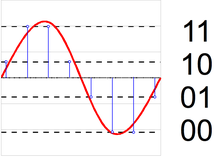
Sampling is the transformation of continuous images and sound into a set of discrete values ​​in the form of codes.

Quantization is the process of aligning a set of musical notes to a grid.

Compression (compression) of audio data is a process of lowering the bit rate by reducing the statistical and psychoacoustic redundancy of a digital audio signal.

The underlying idea behind all lossy audio compression techniques is to neglect the subtle details of the original sound that are beyond the reach of the human ear.

Codec (CoDec) is an abbreviation for compressor and decompressor. Basically, a codec is a collection of files, drivers, and libraries required to package a video or audio file into a compressed format and play the compressed file.

Formats:

AAC (Advanced Audio Coding) is an audio file format with less quality loss when encoding than MP3 of the same size. The format also allows you to compress without losing the quality of the source (ALAC AAC profile).

AAC (Advanced Audio Coding) was originally created as a successor to MP3 with improved encoding quality. The AAC format, officially known as ISO / IEC 13818-7, was released in 1997 as the new seventh part of the MPEG-2 family. There is also the AAC format known as MPEG-4

Apple AIFF: This file type is standard for Apple Macintosh systems and sound processing systems built on top of it. Apple AIFF stands for Audio Interchange File Format, an audio interchange file format, it is somewhat similar to WAV. Its peculiarity is that it allows you to place additional information along with the sound wave, in particular WaveTable samples (examples of the instrument sound together with synthesizer parameters), which improves the quality of the final result. Although today Apple computers are capable of playing files of almost any format, including MP3.

FLAC (Free Lossless Audio Codec) is a popular free codec for audio compression. Unlike lossy Ogg Vorbis, MP3 and AAC codecs, it does not remove any information from the audio stream and is suitable for both daily listening and archiving of audio collection. Today, the FLAC format is compatible with many audio applications.

Digital audio compression methods

Digital audio compression methods

audio compression

Lossless compression

AUDIO COMPRESSION

Generally speaking, the meaning of lossless compression is as follows: some pattern is found in the original data, and taking this pattern into account, a second stream is generated, uniquely describing the original. For example, to encode binary sequences in which there are many zeros and few ones, we can use the following replacement:

00> 0
01> 10
10> 110
11> 111

In this case, sixteen bits:
00 01 00 00 11 10 00 00

will be converted to thirteen bits:
0 10 0 0 111 110 0 0

If we write a compressed string without spaces, we can still add spaces in it, which means restoring the original sequence.

FLAC (Free Lossless Audio Codec)
Coding principle: the algorithm tries to describe the signal with this function so that the result obtained after subtracting it from the original (called difference, remainder, error) can be encoded with the minimum number of bits.

When the model is fitted, the algorithm subtracts the approximation from the original to obtain a residual signal (error), which is then losslessly encoded.

Lossy compression (MP3, AAC, WMA, OGG)
Using a lossy compression algorithm, the size of an MP3 file with an average bit rate of 128 kbps is approximately 1/11 of the original file of an Audio CD (uncompressed audio in CD-Audio format has a rate bit rate of 1411.2 kbps). MP3 files can be created at high or low bit rates, which affects the quality of the result.

The principle of compression is to reduce the precision of some parts of the sound flow, which is almost indistinguishable for most people. The audio signal is divided into segments of equal length, each of which, after processing, is packed into its own frame (frame). Spectral decomposition requires continuity of the input signal; therefore the table above and below are also used for calculations. The audio signal contains harmonics with a lower amplitude and harmonics that are close to the strongest; Such harmonics are cut off, as the average human ear will not always be able to determine the presence or absence of such harmonics. This characteristic of hearing is called the masking effect. It is also possible to replace two or more nearby peaks with an averaged one (which, as a rule, leads to sound distortion). The cutoff criterion is determined by the outflow requirement. Since the entire spectrum is relevant, the high-frequency harmonics are not cut off, but are only selectively removed to reduce information flow due to spectrum sparsity. After spectral removal, mathematical compression and frame packing methods are applied.

Masking effect
In certain cases, a sound can be hidden by another sound. For example, talking near the railroad tracks can be completely impossible if a train passes. This type of effect is called masking. A weak sound is said to be masked if it becomes indistinguishable in the presence of a louder sound.

Simultaneous masking
Any two sounds when heard simultaneously have an impact on the perception of the relative volume between them. A louder sound reduces the perception of a weaker one, until the disappearance of your hearing. The closer the frequency of the masked sound is to the frequency of the masker, the more it will be hidden. The masking effect is not the same when the masked sound is shifted down or up in frequency with respect to masking. Low-frequency sound masks high-frequency sound. However, it is important to note that high-frequency sounds cannot mask low-frequency sounds.

Time masking
This phenomenon is similar to frequency masking, but time masking occurs here. When the masking sound is stopped, the masking remains inaudible for some time. Under normal conditions, the temporary masking effect lasts significantly less. The masking time depends on the frequency and amplitude of the signal and can be up to 100 ms.
In the case where the masking tone appears at a time after masking, the effect is called post-masking. When the masking tone appears before the masking (this is also possible), the effect is called premasking.

Post-stimulus fatigue
Often after exposure to loud, high-intensity sounds, a person’s hearing sensitivity drops dramatically. Recovery to normal thresholds can take up to 16 hours. This process is called “temporary change in hearing sensitivity threshold” or “post-stimulus fatigue.”

Digital audio compression methods

Digital audio compression methods

Audio Compression

Lossless compression

Audio Compression

Generally speaking, the meaning of lossless compression is as follows: some pattern is found in the original data, and taking this pattern into account, a second stream is generated, uniquely describing the original. For example, to encode binary sequences with many zeros and few ones, we can use the following replacement:

00> 0
01> 10
10> 110
11> 111

In this case, sixteen bits:

00 01 00 00 11 10 00 00

will be converted to thirteen bits:

0 10 0 0 111 110 0 0

If we write a compressed string without spaces, we can still add spaces in it, which means restoring the original sequence.

FLAC (Free Lossless Audio Codec – Free Lossless Audio Codec)
Coding principle: the algorithm tries to describe the signal with this function so that the result obtained after subtracting it from the original (called difference, remainder, error) can be encoded with the minimum of bits.

When the model is fitted, the algorithm subtracts the approximation from the original to obtain a residual signal (error), which is then losslessly encoded.

Lossy compression (MP3, AAC, WMA, OGG)
Using a lossy compression algorithm, the size of an MP3 file with an average bit rate of 128 kbps is approximately 1/11 of the original file of an Audio CD (uncompressed audio in CD-Audio format has a rate 1411.2 kbps bit rate). MP3 files can be created at high or low bit rates, which affects the quality of the result.

The principle of compression is to reduce the precision of some parts of the sound flow, which is almost indistinguishable for most people. The audio signal is divided into segments of equal length, each of which, after processing, is packed into its own frame (frame). Spectral decomposition requires continuity of the input signal; therefore, the previous and next tables are also used for calculations. The audio signal contains harmonics with a lower amplitude and harmonics that are close to the strongest; Such harmonics are cut off, as the average human ear will not always be able to determine the presence or absence of such harmonics. This characteristic of hearing is called the masking effect. It is also possible to replace two or more close peaks with an averaged one (which, as a rule, leads to sound distortion). The cutoff criterion is determined by the outflow requirement. Since the entire spectrum is relevant, the high frequency harmonics are not cut off, but are only selectively removed to reduce information flow due to rarefaction of the spectrum. After spectral removal, mathematical compression and frame packing methods are applied.

Masking effect
In certain cases, a sound can be hidden by another sound. For example, talking next to a train track can be completely impossible if a train passes. This type of effect is called masking. A weak sound is said to be masked if it becomes indistinguishable in the presence of a louder sound.

Simultaneous masking
Any two sounds, when heard simultaneously, have an impact on the perception of the relative volume between them. A louder sound reduces the perception of a weaker one, until the disappearance of your hearing. The closer the frequency of the masked sound is to the frequency of the masker, the more it will be hidden. The masking effect is not the same when the masked sound is shifted down or up in frequency relative to masking. Low-frequency sound masks high-frequency sound. However, it is important to note that high-frequency sounds cannot mask low-frequency sounds.

Time masking
This phenomenon is similar to frequency masking, but time masking occurs here. When the masking sound is stopped, the masking remains inaudible for some time. Under normal conditions, the effect of temporary masking lasts much less. The masking time depends on the frequency and amplitude of the signal and can be up to 100 ms.
In the case where the masking tone appears later than the masking, the effect is called post-masking. When the masking tone appears before the masking (this is also possible), the effect is called premasking.

Post-stimulus fatigue
Often, after exposure to loud, high-intensity sounds, a person’s hearing sensitivity drops dramatically. Recovery of normal thresholds can take up to 16 hours. This process is called “temporary change in hearing threshold.”

Digital audio compression

Digital audio compression

Digital Audio Compression

The concept of loudness is close and understandable not only for a musician, but also for people who are not associated with music. The relationship between the volume of the parts of a piece and the volume of the instruments that are playing simultaneously is called the dynamic range. One of the main tools producers and musicians use to influence dynamic range is the compressor.

Digital Audio Compression

Although the compressor works with a known phenomenon, loudness, in most cases its use occurs spontaneously, randomly, without understanding the essence of what is happening. You can know the general principle of the compressor and the purpose of each handle, but this does not eliminate the stupor at the first experience.

Why do you need a compressor?

The main purpose of the compressor is to automatically change the signal level. It works roughly the same as if you kept your hand constantly on the volume fader, turning it up and down. The difference is that a compressor can react very quickly to changes, much faster and more accurately than a human.

Up to this point, the word compressor meant a whole class of dynamic devices. Using the same basic principles as a conventional compressor, various instruments work for different purposes: limiters, expanders, gates, etc. They are united by working with the volume of individual sounds or the mix as a whole.

The classic compressor is controversial by its very name. Everyone knows that he makes the loudest sound. But the name comes from compress, which means “compression”, and if you ask any sound engineer what a compressor does, you’ll hear the answer: “squash the signal.” The compressor reduces the amplitude of the dynamic bursts, makes them quieter. So what is the main purpose of the compressor: to make it quieter or louder? The answer is both at the same time.

Let’s take an example of voice recording. Very often, in the process of singing, syllables or sounds of different volume are heard. If the singer does not control the dynamics of his performance very well, then such differences create problems for the sound engineer and negatively affect the final result of the work. Silent syllables disappear into the mix, text becomes difficult to distinguish, and if you adjust the volume for a quiet area, in other places the voice begins to “stand out.”

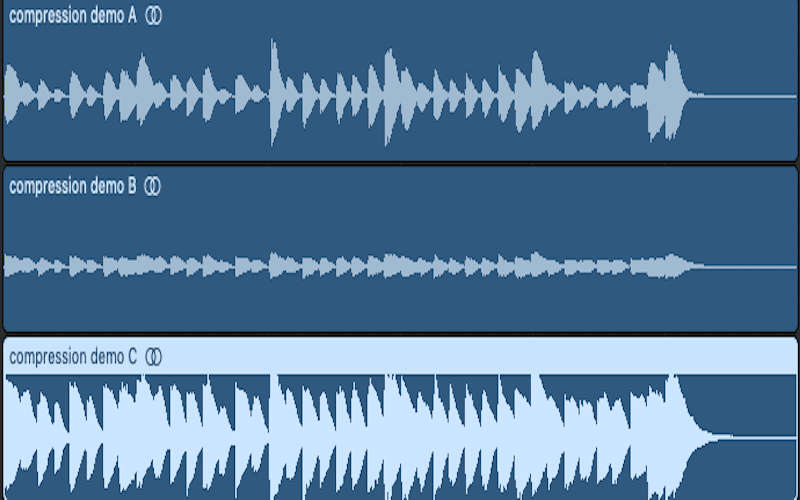
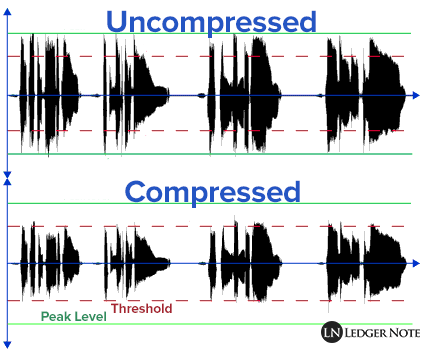
This is where the compressor comes in. It allows you to suppress strong bursts, equalize them with silent fragments. Now you can turn up the volume of the track without fear of some syllables sticking out. So the compressor makes the sound lower and higher at the same time. Three images show the stages of working with sound: a source with large peaks (a), a compressed signal (b) and an increase in the volume level of the entire file (c).

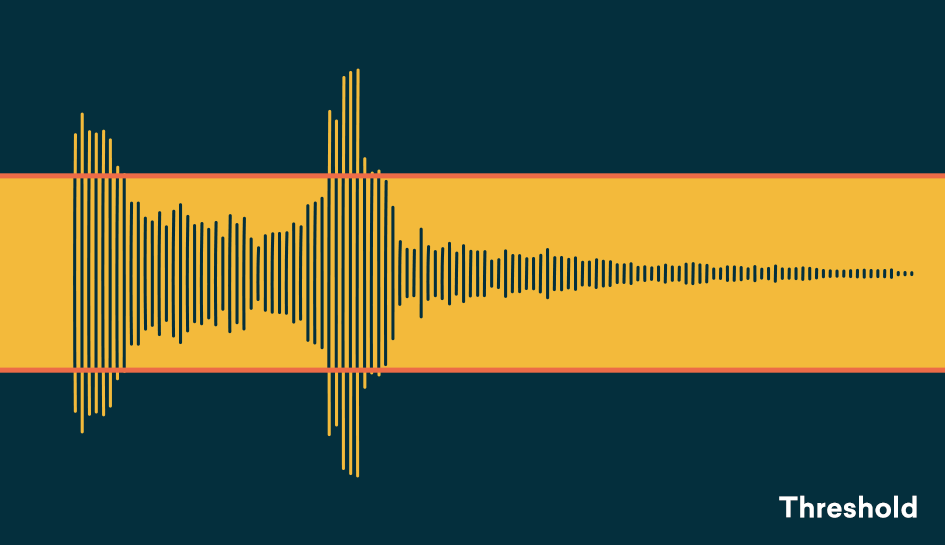
It is especially important to apply compression when recording in a digital environment, when we are forced to adhere to a maximum level of 0 dB, because exceeding this threshold leads to clips and distortion. When clips appear, we lower the preamp level, which means we lower the volume of not only bursts, but quiet areas as well, leading to signal degradation due to quantization and aliasing noise.

The compressor, positioned between the preamp and the digital recording system, operates only on the loudest bursts, reducing their volume and ensuring a smooth soundtrack. Thanks to this, we have the opportunity not to reduce the overall volume of the recorded signal and to maintain the sound quality.

Unfortunately, many modern musicians, without going into the technical characteristics of the compressor, use it everywhere, believing that with its help you can “stretch” any sound in the mix. Also, compressors are often included on the road in extreme conditions. They are only used by experienced sound engineers when there is a real need.

The compressor helps avoid recording problems. The most common causes of problems can be the following:

Non-professionalism of the interpreter (dynamic unevenness).
Mismatched path (bad, mismatched, or inadequate microphones, preamps).
Disadvantages of the digital environment (limited to 0 dB).
Uncomfortable conditions for the singer (small and stuffy room, poor monitoring).
Low qualification of a recording engineer.
If a performer has a voice and can sing into a microphone, and a recording engineer knows her job well and knows how to properly position microphones and set up equipment, a compressor may not be required at all. But this is the ideal situation.

Digital audio compression

Digital audio compression

Digital Audio Compression

Audio data compression is a real problem today. There are two reasons for the need to compress audio data: memory savings when storing audio information, low bandwidth of remote digital information transmission channels. Compression effectively solves the two problems above. Data compression is an algorithmic transformation of data performed to reduce its volume.

Data Compression

It is used for a more rational use of data storage and transmission devices. Compression is based on eliminating the redundancy contained in the original data. To guarantee the parameters necessary for the transmission of voice signals (music) over modern low-speed digital communication channels and to guarantee the specified noise immunity, it is necessary to use highly efficient data compression algorithms. The transmission channel is characterized by a concept such as the capacity of the channel: And the signal – by the volume (signal): …

Both of the above features include dynamic range D, channel width (signal spectrum), and transit time T. Digital audio compressors are used to reduce dynamic range. To improve spectral efficiency, digital filters are used to limit the spectrum of the encoder output signal (according to Nyquist criteria). Among other things, encoders based on the principles of elimination of redundancy (Huffman codes) are used to guarantee a certain information transmission speed. The essence of which is as follows: codes based on the principle of assigning more probable values ​​of the amplitudes of the codewords of shorter length than the improbable ones.

Let’s consider how the types of redundancy described above are eliminated.
Structure of a lossy audio compression encoder The original digital audio signal is divided into frequency subbands and time-segmented into a time-frequency segmentation block. The length of the encoded sample depends on the shape of the temporal function of the audio signal. In the absence of sharp peaks in amplitude, a long sample is used, which provides high-frequency resolution. In the case of abrupt changes in signal amplitude, the length of the encoded sample decreases dramatically, giving a higher time resolution. The decision to change the length of the coded sample is made by the psychoacoustic analysis unit, calculating the value of the psychoacoustic entropy of the signal.
After segmentation, the frequency subband signals are normalized, quantized, and encoded. In the most efficient compression algorithms, it is not the samples of the audio signal that are encoded, but the corresponding MDCT coefficients. (the differential between the coefficients is smaller) The accounting of the auditory perception patterns of a sound signal is carried out in the psychoacoustic analysis unit. Here, according to a special procedure, for each frequency sub-band, the maximum allowable level of quantization distortion (noise) is calculated, in which they are still masked by the useful signal of this sub-band.

The block of dynamic distribution of bits according to the requirements of the psychoacoustic model for each coding subband selects a minimum possible number of them, in which the level of distortions caused by quantization does not exceed the threshold of their audibility calculated by the model psychoacoustic.

This article will consider the functional diagrams of the audio data compression algorithms, based on µ-laws, A. The functional diagram of the compression algorithm based on the A-level compression law is shown in Fig.2. Figure 2. Functional diagram of the compression algorithm based on the A-level compression law A signal (discrete sine) is applied to the input of the compressor. After compression, the signal passes to the adder, where the noise is fed to the second input of the adder, thus simulating the additive noise of the transmission channel.

Then the noisy signal enters the input of the expander, at the output we get the reconstructed signal. The reconstructed and original signal is then fed to the adder, after which the power of the spectral noise is observed.

Simulation results (A = 87.6)
The following graphs are presented: 1-original signal, 2-signal passed through the compressor, 3-recovered signal, 4-noise power at the output of the noise generator, 5-noise power after the expander.