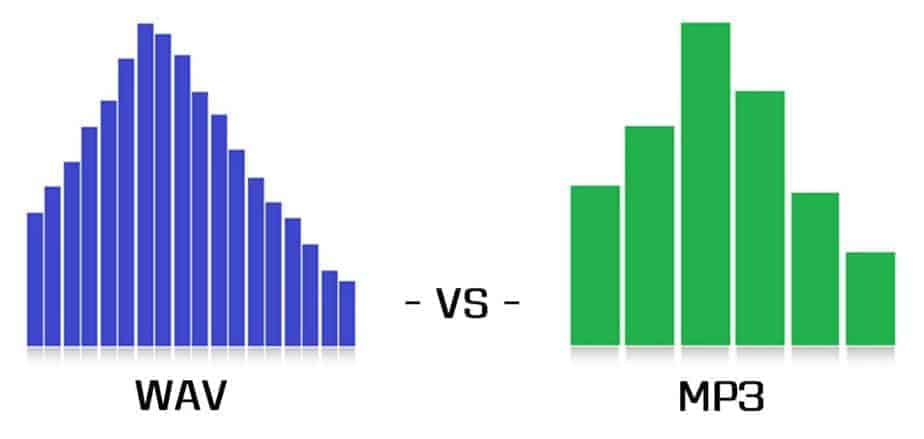
Wav and mp3, what are the differences.

Digital sound sources have become part of everyday life.
Nowadays, many people listen to music between school and work, and play music from their PCs and smartphones. Now that YouTuber is on the rise, it is difficult to break ties because it is next to MP3 and WAV. You will always be indebted to the scenes, such as applying the sound source to the image and adding sound effects. Here, we will mainly introduce the differences between WAV and MP3.
What is WAV
WAV is also known as PCM or WAVE sound source, and refers to the format of uncompressed digital sound sources. Since the sound source is not compressed, it is characterized by the same high sound quality as the recorded sound source. on the CD.
The only downside to WAV is that the higher the sound quality, the greater the amount of information that will be captured and the larger the file size. If you compare it to a 5 minute sound source file, it will be 50MB.
What is MP3?
MP3 is a lossy compressed WAV file. Lossy compression can significantly reduce the amount of data, but compressed data cannot be restored to original data even if it is decompressed. You need to be careful about the conversion as it is a way of degrading the data.
At the same time that the sounds that humans cannot hear are eliminated, the amount of data can be compressed to about 1/11 while maintaining the same sound quality as music CDs.The difference between WAV and MP3 is whether it is compressed or not.
5 differences between WAV and MP3
To briefly explain the difference between WAV and MP3, WAV is an uncompressed raw sound source, so the sound quality is very good, but the capacity is very large. On the other hand, MP3 reduces the capacity of WAV to the remove only the data that the human ear cannot hear to reduce the WAV capability. When used for video editing, MP3 can be used for short videos for SNS. WAV is used to write images to discs like Blu-ray.
Difference between WAV and MP3 1: frequency difference
First of all, WAV and MP3 have different frequencies. It is easy to understand by frequency analysis, but WAV can express all sound sources in frequency, while MP3 only has the last part cut off. Even if you convert MP3 once converted to WAV again, the sound quality will not improve.
Sound is a vibration that is transmitted through substances such as air and objects, so it is transmitted in the form of waves to the human ear.Human beings can perceive sound because it travels through the air to the human eardrum in wave form.
Difference between WAV and MP3 2: difference in data capacity
Source: 100+ Images of Free Data and Analysis – Pixel
WAV and MP3 have different data capacities. MP3s are created by compressing WAV, so they have a smaller capacity than WAV. WAV is about 50MB in 5 minutes, but it typically becomes about 5MB when compressed to MP3.
To convert WAV to MP3, there is a service called OnlineVideoConverter. It can convert WAV to OGG, AAC, WMA, and MP3.
Difference between WAV and MP3 3: difference in sound quality
WAV and MP3 also have different sound quality. Since WAV is not compressed, it has not deteriorated and it is characteristic that you can enjoy music with beautiful sound quality. Smartphones and tablets are large in size, so it will be difficult to run them smoothly.
Since MP3 is WAV compressed data, its capacity is small. Since the capacity is light, it is ideal for attaching as data. Sound quality has deteriorated, but only sounds that are inaudible to humans have been removed.