Everything musicians need to know about audio file formats pArt 3


Free Download Mp4Gain
picture

Everything musicians need to know about audio file formats pArt 3

sample rate

WAV is at the top of the sound quality pyramid. So to speak, WAV is a Cadillac luxury car audio format. WAV files sound cleaner and sharper than other compressed formats.

Audio Sample Rate

If you want to submit your demo sound source to a label, sell it to a publisher, or publish it in a medium like a blog, I recommend WAV. In such a case, you will need a mastered WAV file.

1512-38_mixtape-700×366

WAV files represent the highest quality sound you can produce and signify your own sound.

Always use WAV (input sound source) file material when mastering your own music.

WAV can be converted to other file formats at a later time, so WAV can meet the needs of any file format.

The only downside to WAV is that its large file size quickly fills up free space on your hard drive. If you only use WAV when listening to music, it means that the capacity of your computer, smartphone, iPod and Dropbox will soon be exhausted.

But when it comes to your own music, you’ll need to archive all your tracks to WAV.

Most music distribution platforms require WAV for the music upload file format they offer. For example, iTunes and Amazon MP3 require high quality WAV upload.

320MP3
The 320kbps MP3 is probably the most widely used file format. The reason is that 320 MP3 has good sound quality and file size.

320 MP3s are compressed into manageable file sizes. However, when I play it, it sounds rich.

If you’re streaming online, around 320kbps will be a good balance. For example, Spotify’s high-quality mode streams at 320 kbps.

The 320 MP3 is an excellent choice for saving hard drive space and loading time and sharing your music with realistic, high-quality sound.

192MP3
192 kbps MP3 is used instead of geta. If you need a sense of speed and want to make sharing easier, this fast and slightly grainy MP3 will come in handy.

The 192 MP3 is useful for quickly finding and sharing sound sources when sending a large number of files at once or listening to the entire back catalogue.

Bitrates below 320 kbps make sound quality even worse, but you may not even notice a difference. Test to see if you can tell the difference with your ears.
The 192MP3 is the perfect tool for musicians to share and stream music efficiently and quickly.

Tip: If you have a streaming player on your site, using a 192kbps MP3 will make it load faster.

What is the best way to use each file format?
Each format has its own uses, and the choice of format for that use depends on the intended use and environment.

Think about what sounds you are sharing or where you are sharing them. Does the file format you choose fit?

Using WAV as the output format for mastering is probably the most custom option. Also, if you have a mastered WAV, it’s very easy to convert it to other file formats.

Formatting has become a very important factor for streaming generation. Choose a format that is smart and easy to use.


Free Download Mp4Gain
picture


Mp4Gain Main Window
picture


Mp4Gain Features
picture


Free Download Mp4Gain
picture

Everything musicians need to know about audio file formats part 2

Everything musicians need to know about audio file formats part 2

Sample Rate

Now that you understand what music file compression is, are you wondering how each file format is compressed?

Audio Sample Rate

Let’s talk about the compression method for each file.

How to compress each file format
uncompressed format
Uncompressed files are, of course, completely uncompressed. The most commonly used uncompressed file formats are WAV or AIFF.

These formats are the type of format that is often used when exporting files from your DAW. If you duplicate a track with WAV, the duplicate WAV file will be a copy of the original sound.

lossless compression
Although lossless files are compressed, they are only compressed as WAV and retain the original amount of information. Lossless files are only decompressed when you open the file.

The most common lossless format is FLAC. Apple also has its own format called ALAC, so if you have a relationship with iTunes, you’ll probably use ALAC.

FLAC makes the file size smaller than WAV and preserves the original amount of information, but the file size still tends to be large.

rose compression
Compressed Rossy files are probably the most widely used audio format. MP3s are the most used. However, other file formats like OGG, WMA, AAC are also included in Rossie’s compression.

The downside of Rossy compression is that it causes “sound degradation” which actually occurs when the amount of information in the original data is removed.

However, the advantage is that the smaller size makes loading faster and requires less space to store data.

Files with lossy compression can be divided into high resolution and low resolution depending on how much they are compressed. High-quality files lose less information.

The truth about bitrate
It is the bit rate that determines the sound quality of audio files.

The bit rate indicates the amount of data processed per second. In the case of MP3, it is the part that is displayed as 320 or 192. In other words, the larger the size, the greater the amount of data packed and the better the sound quality. By the way, how to calculate the bitrate for sound quality:

Sampling rate (Hz) x bit depth (bit) = bit rate (bps)

* Is the sample rate divided into tens of thousands per second to sample the sound? Bit depth is the amount of data per divided sample.

For example, an MP3 file with a bit rate of 320 has a data volume of 320 kilobits (320 kbps for short) per second.

Uncompressed WAV and AIFF files are typically 1411 kbps.

Increasing the bit rate means that more data is processed per second. The more data you have, the better the sound. Don’t you think it’s very simple?

Now, did you understand the basics of compression, file format, and bitrate? Let’s continue.

The following is a question that is easy to catch fire.

What is the best way to use each file format?
If we were to cover all audio formats, it would take hours to finish reading. Readers have their own things to do and make music, right?

So the answer is simple, and I will list only three commonly used file formats. It is WAV, MP3 320kbps, MP3 192kbps.

Everything musicians need to know about audio file formats

Everything musicians need to know about audio file formats

Samplerate

Get the right knowledge and choose the format that suits your song.

SAMPLE RATE

Which audio file format is better? This is a frequently asked question, and I think you once had that question.

Unexpectedly, the answer to this question is simple: everything can be formatted according to your needs. But whether you’re sending a sound source, delivering your own music, or archiving your own tracks, it all depends on the format of your files.

Here you will find everything you need to know about audio formats to find the best format for your music.

The important thing is to learn each format and its characteristics, and to acquire knowledge about the correct format.

Compression: First impression
Understanding file format means understanding compression.

I am not referring to the compressor applied to the track in the DAW, but to the compression of the file.

Compression reduces file size, which reduces storage space and time for streaming, downloading, and storage.

What happens if I compress the file?
There are three types of music file compression:

Uncompressed (you’ll want to put in the tagline that “uncompressed” would not be a compressed format, but keep in mind that uncompressed makes all sounds clearer), lossless compression, and lossy compression.

Lossless, uncompressed compressed files retain their original amount of information. However, Rossy compression removes some of the information from the original data to reduce file size.

Lossie compression to reduce the amount of data does not remove the entire drum track from the song, but removes only the sounds that would otherwise be unrecognizable to the ear (dog-only sound).

In any case, if you want to know what was removed by file compression, see Hear sound lost when converting to MP3.

Understanding Music File Compression Formats
It’s surprisingly easy to understand the difference between music file compression formats.

The uncompressed file is an exact copy of the original. There is no loss of information. It’s helpful to think of the uncompressed file as an image file of the original painting.
Lossless files are compressed to reduce the file size as much as possible, but retain the original amount of information. As for the painting, it is the same as the original image, but imagine that it is stored except when you want to see the image.
Rossy compression is the format with the highest compression ratio. Since the amount of information in the original is removed somewhat during the compression process, Rossy’s compressed file will be a smaller (smaller) version of the original. There is a painting itself, but the details are lost.

bit depth

bit depth

Bit Depth

bit depth

BIT DEPTH

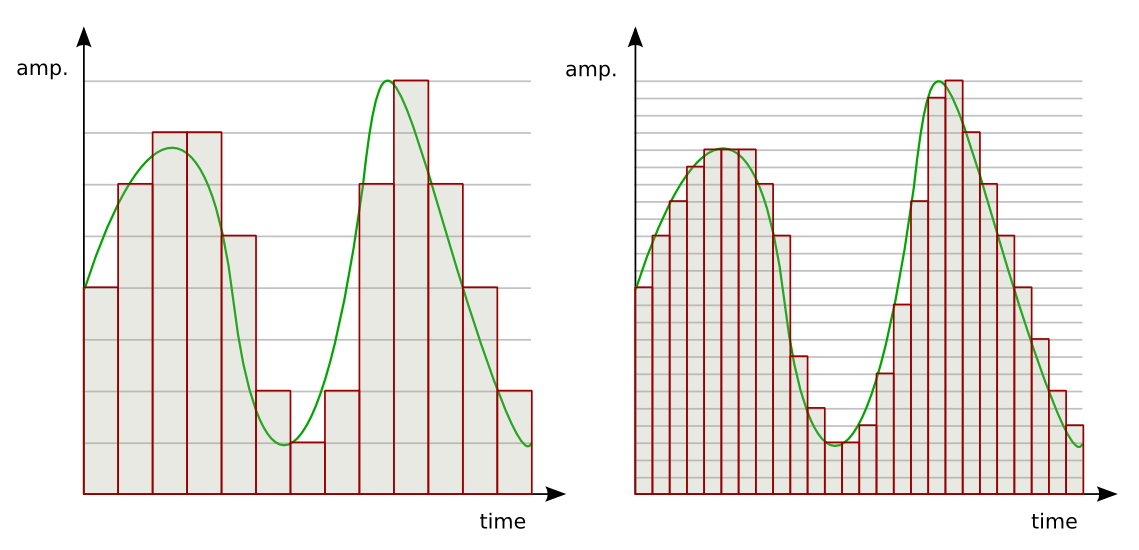
is the amount of information per discrete signal (sample) of a digital signal, that is, the number of quantization bits. Bit depth is only significant for PCM audio. There is no concept of bit depth in lossy compressed non-PCM audio such as MP3 and AAC. It is a term used in audio and graphics, and this section describes it in digital audio. == PCM Audio Bit Depth == There are several methods of recording digital audio, but most commonly used on CD-DA , DVD , computers , etc. is the pulse code modulation (PCM) method. In PCM, when the sound pressure bit depth is reduced at intervals of tens of thousands of times per second, the error between the original sound and the approximate recorded value becomes large, and it becomes difficult to faithfully reproduce the sound pressure waveform. original sound. The error is called the quantization error, and when the error tends to be large, such as 8 bits (256 steps), it can be heard by the human ear as noise. * CD-DA

(electrical voltage) at intervals of tens of thousands of times per second and records (displays) it discretely digitally, but the quantization accuracy is high and depends on the bit depth. Since digital numbers are recorded in binary and digits are bit deep, the number of recordable steps is calculated by multiplying by 2 bits deep.

It has a standard bit depth of 16 bits and a dynamic range of approximately 96 dB.
* DVD audio supports a bit depth of 24 bits per standard and has a dynamic range of approximately 144 dB.
In the field of acoustic engineering, when expressing the reproduction accuracy of sound amplitude, the ratio of the minimum and maximum values ​​that can be reproduced is expressed as a dynamic range in units of decibels (dB), which is a scale logarithmic . The dynamic range at a given bit depth can be calculated using the following formula ( audio compression and the case of uncompressed linear PCM which does not consider compression
DR_ = 20log_ (2^n), Or simply DR_ = 6.02n
The human ear is said to have a dynamic range of 120 dB and the ability to perceive frequencies from 20 to 20,000 hertz (Hz). Therefore, a bit depth of about 24 bits is said to be required to faithfully reproduce sound as long as it is not inferior to human hearing. For example, some music DVD standards are for 24-bit/96 kHz DTS tracks. In reality, however, no audio device has ever achieved a theoretical noise floor (-144.50 dB) at 24-bit depth. If you have a practical dynamic range (about 110 dB), you can handle noise other than 24-bit quantization noise.

Sample rate or bit rate

Sample rate or bit rate

Bit Depth

■ Sampling rate
(= sample rate)
If it is 44.1 kHz, the data is taken at 44100 times/sec
Wavewidth (fineness) = sound pitch Del

bit depth

sampling theorem (the original can be reproduced by sampling at twice the rate).
The calculation can be sampled up to the audio frequency of 22 kHz.
This is enough because normal CDs only record up to 20 kHz. By the way, I don’t quite understand the

sampling theorem, but is it true that sampling two points in a cycle and playing between them is an approximation with a sine wave? Addendum: Since the sampling theorem is a theorem about the result of the Fourier transform, the frequency mentioned there is naturally limited to sine waves. The sampling theorem is that “only sine waves less than half the sampling rate (fs) can be sampled”. That’s how it is. ■ Quantization bit (= bit depth) If 16 bits, divide waveform height by 2 ^ 16. Wave height = volume Bit rate is the transfer (processing) speed, in units of bps . It is completely different from the quantization bit. The bit rate will be described later. BTW, quantization is called quantize, but it seems it’s not called quantization bit.

Speaking of quantizing,
it’s like adjusting the timing of the sound in DTM and others.

Postscript:
It seems that the unit of the vertical axis is not dB. Sound pressure does not appear to be directly equal
because it becomes a wave when sound is converted to voltage. I don’t know anything because it’s about electricity. hard.

Bit depth and bit rate

From Wikipedia.
Bit rate = (bit depth) * (sample rate) * (number of channels)
For example, if the sample rate is 44.1 kHz, the bit depth is 16 bits, and 2 channels (stereo), the bit rate is as follows:
16 * 44100 * 2 = 1411200 bits/sec = 1411.2 kbps

bitrate means the amount of data processed per unit of time.

The example above is for a CD.
For mp3s, the player’s specifications are usually up to 320 kbps.
I think this number and 1411.2 kbps are quite different, but since
this bps is the data processing speed after compression
, comparing CD bitrate and mp3 bitrate has nothing to do with sound quality. There is a story that
even with 192kbps mp3, there seems to be no problem with sound quality, so even professionals can’t tell it apart from wav . I personally haven’t heard or compared so I don’t know. Maybe it’s the type that doesn’t bother me even though the recording quality is pretty bad.

known specifications


CD sample rate 44.1kHz
voice frequency band 20Hz ~ 20kHz
dynamic range 96dB (= 1bit 6dB * 16bit)


DVD Audio Sample Rate 48kHz, 96kHz,
192kHz voice frequency band ~ 88kHz (192kHz)
dynamic range of approximately 146dB (quantization bit 24bit ) )

Where is the 96db range centered?
That may be strange, but
0db is not quiet (my left ear hearing is -5db at 4kHz), so
could be extreme story -96db~0db right?
I wonder if it’s a mixer or a producer’s favourite.

Also, even if the range is 96 db,
it may not be possible to play all around the headphones.
I think I need a proper woofer.

from now on

After researching so far, I became interested in lossless!
I often watch it on FLAC or Apple Lossless.
It may be time to finally understand Huffman coding

What is bit depth?

What is bit depth?

Bit Depth

Definition and description of bit depth

Sampling

Digital audio requires certain values ​​to be set to describe the resolution of the sound data (sample) that is captured and stored in the audio file. This attribute is called bit depth.

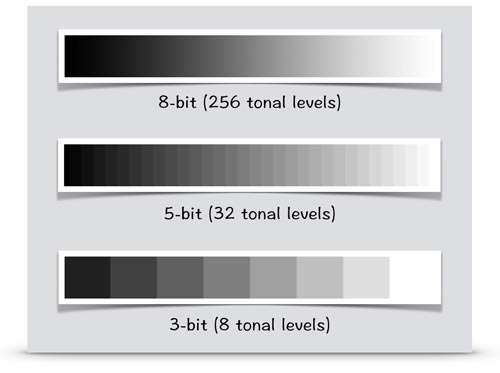
Similarly, for image and video files, this measurement range is also used to determine the resolution of the image. The higher the bit depth (for example, 16-bit vs. 24-bit), the better the image.

This attribute is exactly the same as digital audio. Therefore, a higher audio bit depth provides a more detailed sound recording.

Bit depth is often confused with bit rate, but they are very different. Bitrate (measured in Kbps) is the data throughput per second when the sound is playing, not the resolution of the individual samples that make up the audio waveform. See Bit Depth and Bit Rate for more information.

Note: Bit depth is sometimes called sample format, audio resolution, or word length.

Bit depth details
The unit of measure for bit depth is a binary number (bit), and the precision doubles for each increase in bits. This bit range is an important integer that determines how good a recording (for example, part of the music) sounds.

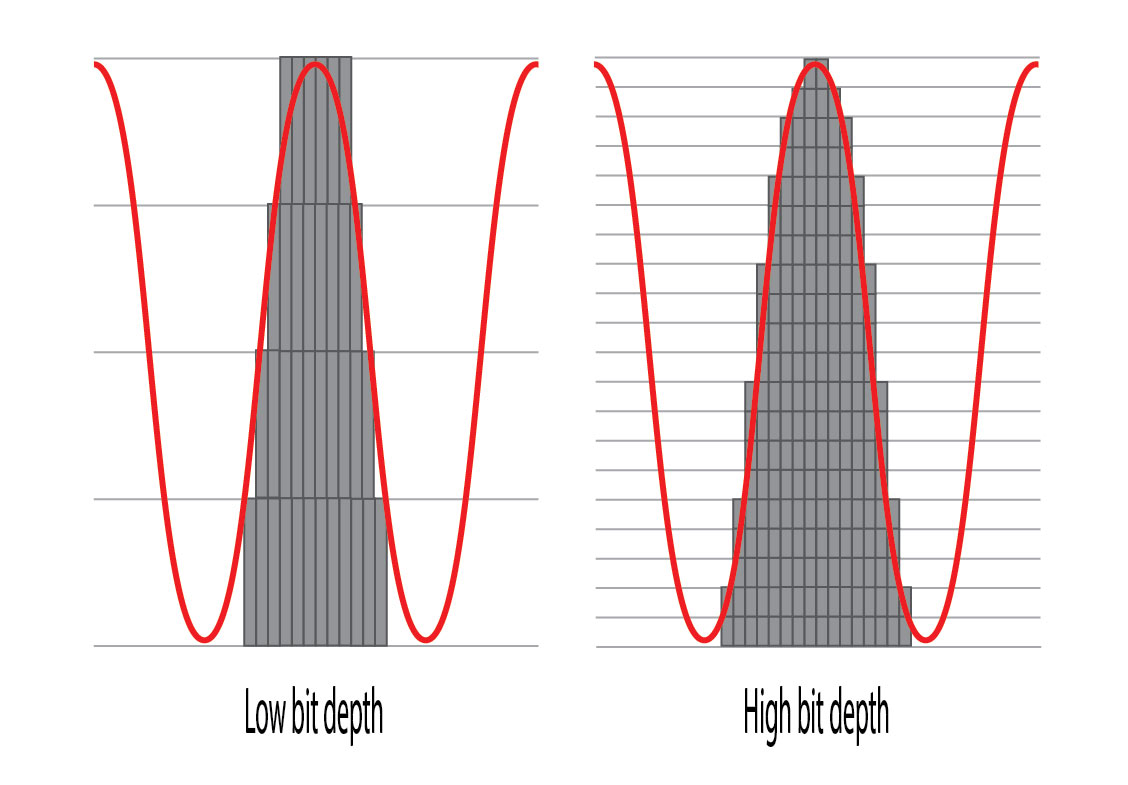
If the bit depth is too low, the recording will not be very accurate and you may lose a lot of quiet sound. For songs that make up a digital music library, MP3s encoded in a high-bit-depth PCM audio format (usually WAV ) have low bit depth compared to those encoded from the original PCM file.

Therefore, in theory it is much more precise when playing. As mentioned above, bit depth is especially important when dealing with the quiet harmonics of a song, as frequencies are lost if the bit depth is set too low.

Bit depth is relevant only within the range of the PCM signal. Therefore, there is no bit depth in the lossy compressed audio format.

Other methods Bit depth affects sound quality
While it is important to avoid clipping in your digital audio files, having the correct bit depth is also an important aspect to consider in reducing the amount of background noise.

All recordings have a degree of signal interference (called background noise) that can be minimized by using sufficient bit depth. This is because the dynamic range (the difference between the volume and the quietest sound) is much larger than the background noise, and the noise can be minimized.

The bit depth determines the volume of the recording. A dynamic range of approximately 6 dB is added for each bit increase. The most common media format in use today is the Audio CD format, which uses 16-bit depths, corresponding to a dynamic range of 96 bits. DVDs and Blu-rays have a bit depth of 24 and a dynamic range of 144 dB to improve sound quality.

What is bit depth? part 2

What is bit depth? part 2

BIT DEPTH

Frequently used bit depth in videos
The commonly used bit depth for video is “24 bit” .

Video Bit Depth

We usually look

digital terrestrial broadcasting
BS/CS Broadcasting
Youtube
Nico Nico Douga
· · Etc.
Etc are all 24 bit.

All the encoders that we use regularly are also 24-bit encoded. (Although not shown in settings)

I think it’s good to recognize that “all the videos I usually watch are 24-bit!”.

Difference in the number of colors.
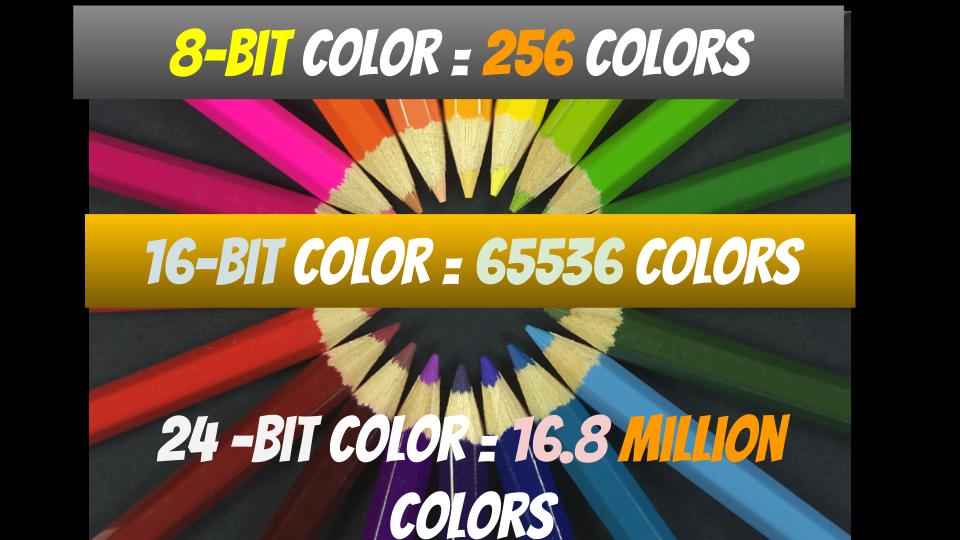
For example, in the case of 24bpp in RGB, 8 bits are assigned to R, G and B respectively.

A: 8 bit
G: 8 bit
B: 8 bit
8 bits is “256” in decimal.

In other words, you can see that “256 colors” can be expressed for each of R, G and B.

Also, there are as many color combinations as there are R, G, and B combinations, so

256 colors ✕ 256 colors ✕ 256 colors = 16777216 colors ≒ 16.77 million colors
Thus, you can see that a total of 16.77 million colors (in the 24-bit case) can be expressed.

By the way, most of the “maximum display colors” of general personal computer screens are 16.77 million colors.

screenshot_2971
▲ (Reference) Display I am using: DIOS-MF241XB specifications | Wide model | IODATA IO DATA DEVICE
As you can see from the specifications of the screen of the personal computer you are using, it probably has 16.77 million colors.

soon,

The number of colors in the videos we usually watch… “16.77 million colors”
Maximum number of colors for the screen we are using… “16.77 million colors”
That is, most of the images that we usually see are “16.77 million colors”, and the maximum number of colors on the screen that we usually use is also “16.77 million colors”.

Image quality comparison
Up to about 24 bpp, the difference in image quality is relatively visible.

2_bit 4_bit 8 bits True Color
▲2bpp ▲4bpp ▲8bpp ▲24bpp
Quote: Color depth – Wikipedia

For example, with an x264 encoder, you can encode at 24 bpp or more with a “high bit depth” setting of 30 bpp (10 bits each), but you can barely tell the difference from 24 bits.

x264_high bit depth
▲ In case of x264guiEx from AviUtl

Also, (as mentioned above) most PC screens can only express up to “16.77 million colors (24-bit)” in the first place.

Therefore, in most personal computer environments, it is (physically) impossible to distinguish between 30-bit and 24-bit.

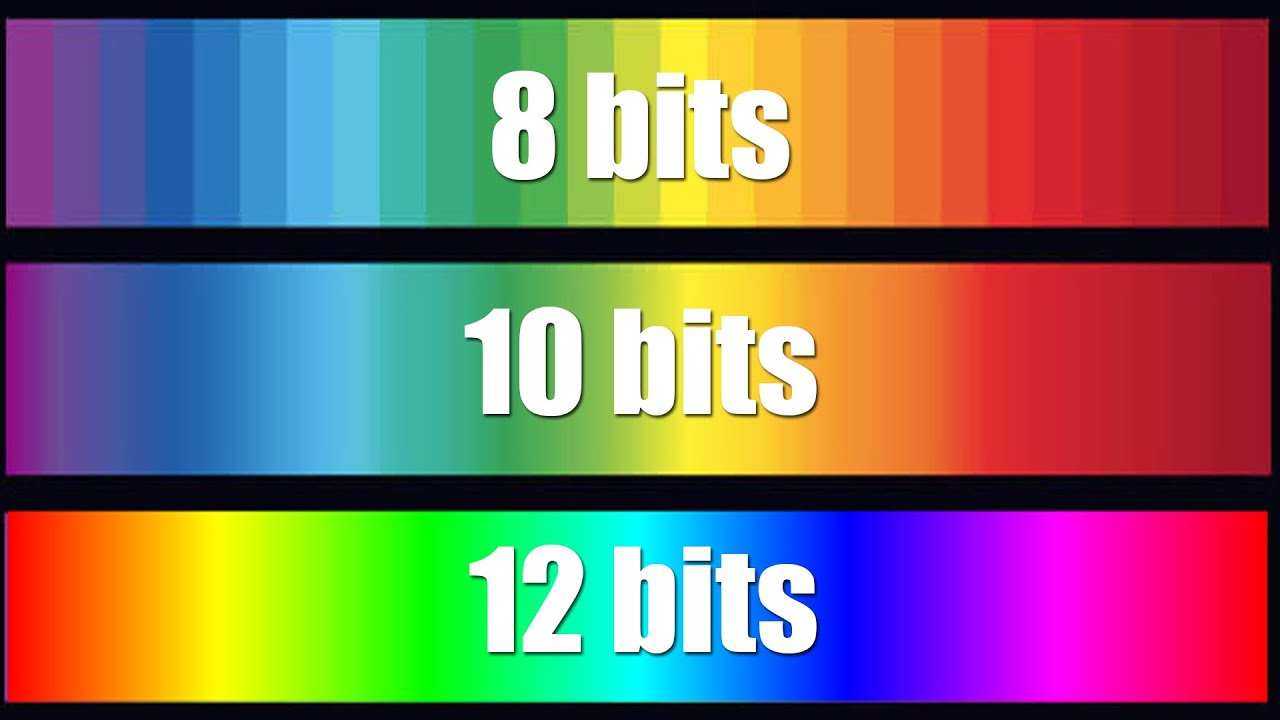
However, in the case of “video originally shot at 24 bits or more”, such as “animation” and “movie”, when encoding with 30 bits (10 bits each), the color-related filter effect will be applied without problems. As a result, banding (the noise that occurs in continuous parts of color) is reduced, and image quality tends to improve.

▼ An image of an animation encoded in 24-bit and 30-bit and the same part of the same frame cropped (the original frame is this )
8bit– 10bit–
▲ 24bit
(You can see that the banding is noticeable compared to 30 bits) ▲ 30 bits
So that doesn’t mean it doesn’t mean anything at all.

You can check it in the following blogs.

rigaya diary and notepad image quality comparison 2015.01
X264 10 bit depth is effective in anime: Cute Leaf
Name
Frequently used bit depths (color depths) are named.

16 bpp (65,536 colors): high color
24 bpi (16,777,216 colors): Full color
32 bpp (16,777,216 colors + α channel): true color
48 bpi (281,474,976,710,656 colors): Deep Color
Reference : What is color depth? | Color Depth – Meaning / Definition: IT Glossary

How to check the bit depth of a video
If you use video identification software like MediaInfo ,

You can easily check the bit depth of the video.

screenshot_298 screenshot_298
▲ In this case, 8 bits is the number of bits assigned to Y, U, and V.
So the bit depth is 24 bits (however the effective bit is YUV420 so it is 12 bits).
resume
-Bit depth: the amount of data per pixel

-The higher the bit depth, the more colors can be represented (= resulting in higher image quality).

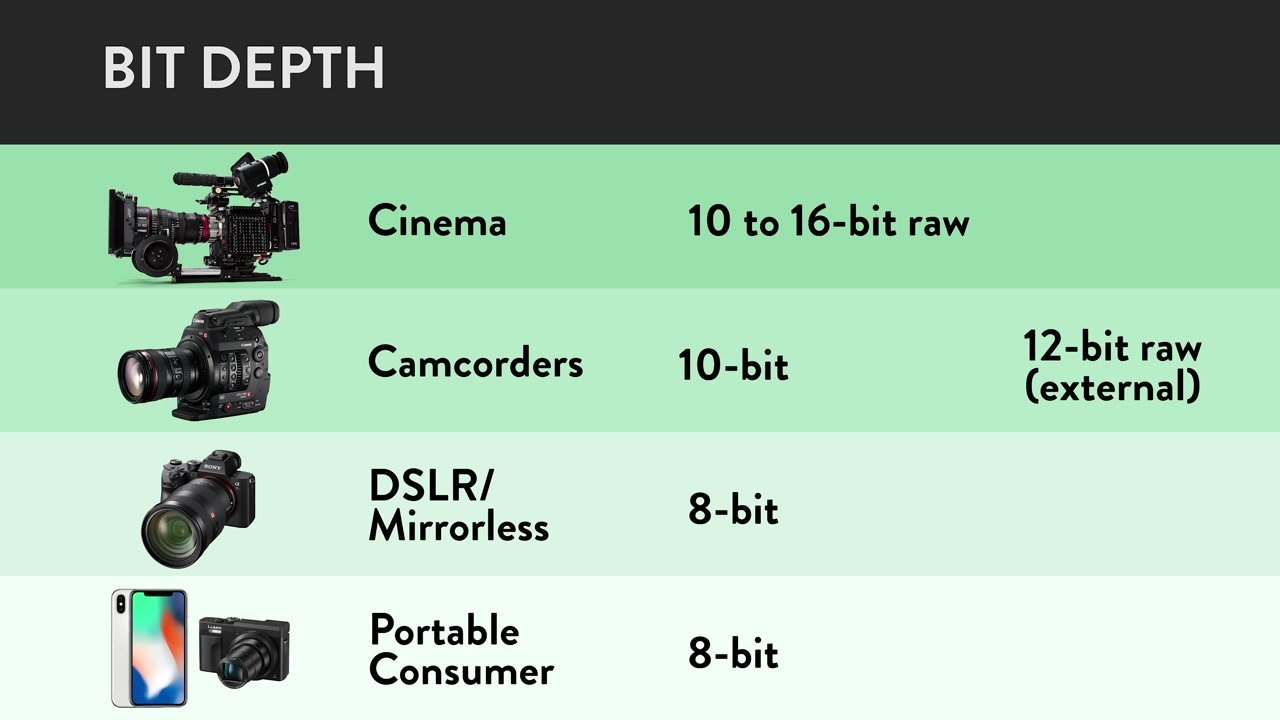
・ The bit depth (color depth) of most videos is 24bpp.

What is bit depth?

What is bit depth?

Bit-depth

The “bit depth” in a video is “the amount of data allocated per pixel”.

BIT DEPTH

It has a different meaning than “bit depth” in audio.
“Bit depth” in audio…
→ The amount of data allocated per sample
“Bit depth” on video …
→ The amount of data allocated per pixel
Reference – meaning and relationship of sample rate, bit depth, and bit rate

further,

bit depth
color depth
pixel depth
They all have the same meaning.

For example, if the “bit depth” is “24 bits”, it means that 24 bits are assigned to a pixel.

Also, “bit depth” is expressed in the unit of bpp (bits per pixel).

Example: 24 bits per pixel = 24 bpp
File size calculation
30fps image

for example,

Bit depth: 24bpp
Resolution: 1920×1080
for videos

1920 pixels ✕ 1080 pixels ✕ 24 bits = 49766400 bits = 6220800 bytes ≒ 6.2 MB
You can see that it will be a whopping 6.2MB per frame.
(For a 1 minute video at 30 fps, 6.2 MB/frame ✕ 30 frames/s ✕ 60 s ≒ 11 GB)

By the way, this is the so-called “uncompressed video (RGB24)”.
Differences due to color space.
450px-YUV_UV_plane.svg
Quote: YUV – Wikipedia

Even if it says the same “24bpp”, the mapping method differs depending on the color space.

for example,

For “24bpp” in RGB:
→ Assign 8 bits to each of R, G, B
For YUV (YCbCr) of “24bpp”:
→ Assign 8 bits to Y, U, V respectively
It is so.

In the case of YUV, the number of bits allocated depends on the “sample ratio”.

The correct answer is to express YUV as YCbCr, but for some reason it’s commonly called YUV in the PC world, so I’ll call it YUV.
In the case of YUV, it becomes “effective bit”
In the case of YUV, the “sample ratio” differs depending on the format, so the method for taking the brightness and color difference will be different.

for example,

With “YUV444”, 8 bits each are taken from Y, U and V.
With “YUV420”, Y takes 8 bits each, but U and V share 8 bits.
It will be like this.

So in the case of “YUV420”, you can see that the actual number of bits times one is “12 bits”.

The “effective number of bits per pixel” at this time is called the “effective bit”. (“12bit” for “YUV420”)

From this, there is a double difference in file size between “YUV444” and “YUV420”. . (It’s actually compressed with a codec, so it doesn’t make much of a difference)

What is bit depth?

What is bit depth?

bit depth

Definition and description of bit depth

Sample Rate

Digital audio requires certain values ​​to be set to describe the resolution of the sound data (sample) that is captured and stored in the audio file. This attribute is called bit depth.

Similarly, for image and video files, this measurement range is also used to determine the resolution of the image. The higher the bit depth (for example, 16-bit vs. 24-bit), the better the image.

This attribute is exactly the same as digital audio. Therefore, a higher audio bit depth provides a more detailed sound recording.

Bit depth is often confused with bit rate, but they are very different. Bitrate (measured in Kbps) is the data throughput per second when the sound is playing, not the resolution of the individual samples that make up the audio waveform. See Bit Depth and Bit Rate for more information.

Note: Bit depth is sometimes called sample format, audio resolution, or word length.

Bit depth details
The unit of measure for bit depth is a binary number (bit), and the precision doubles for each increase in bits. This bit range is an important integer that determines how good a recording (for example, part of the music) sounds.

If the bit depth is too low, the recording will not be very accurate and you may lose a lot of quiet sound. For songs that make up a digital music library, MP3s encoded in a high-bit-depth PCM audio format (usually WAV ) have low bit depth compared to those encoded from the original PCM file.

Therefore, in theory it is much more accurate during playback. As mentioned above, bit depth is especially important when dealing with the quiet harmonics of a song, as frequencies are lost if the bit depth is set too low.

Bit depth is relevant only within the range of the PCM signal. Therefore, there is no bit depth in the lossy compressed audio format.

Other methods Bit depth affects sound quality
While it is important to avoid clipping in your digital audio files, having the correct bit depth is also an important aspect to consider in reducing the amount of background noise.

All recordings have a degree of signal interference (called background noise) that can be minimized by using sufficient bit depth. This is because the dynamic range (the difference between the volume and the quietest sound) is much larger than the background noise, and the noise can be minimized.

The bit depth determines the volume of the recording. About 6 dB of dynamic range is added for each bit increase. The most common media format in use today is the Audio CD format, which uses 16-bit depths, corresponding to a dynamic range of 96 bits. DVDs and Blu-rays have a bit depth of 24 and a dynamic range of 144 dB to improve sound quality.

What is the sampling rate? Part 2

What is the sampling rate? Part 2

Bit Depth

Sampling rate (Hz) x bit depth (bit) = bit rate (bps)
Will be.

Sample Rate

for example,

Sampling rate: 44100Hz
Bit depth: 16 bits
stereo
for music files

44100 (Hz) ✕ 16 (bit) ✕ 2 (stereo) = 1411200 (bps) ≒ 1411 (kbps)
Will be.

Uncompressed wav bitrate is about 1400kbps so it fits.

Since the audio bitrate of Youtube video is “192kbps” at most, you can see that the amount of information is almost 7 times different from uncompressed wav.

Reference : Upload/download high quality video to Youtube = impossible

By the way, “bps” can be converted to “B/s” by dividing by “8”.

So it can be “1411/8 = 176 KB/s”.

It means that the uncompressed wav contains 176 KB of data per second. (88,000 double-byte characters)

In other words, “increasing the bitrate” means

Increase the “sample rate” or “bit depth”

That’s what it points to.

resume
・ Sampling rate: “How many tens of thousands of sounds are collected per second?”

-Bit Depth: “How much capacity is given to each split data”

-Bit rate: Multiplying “sampling rate” and “bit depth”