
Sample rate or bit rate
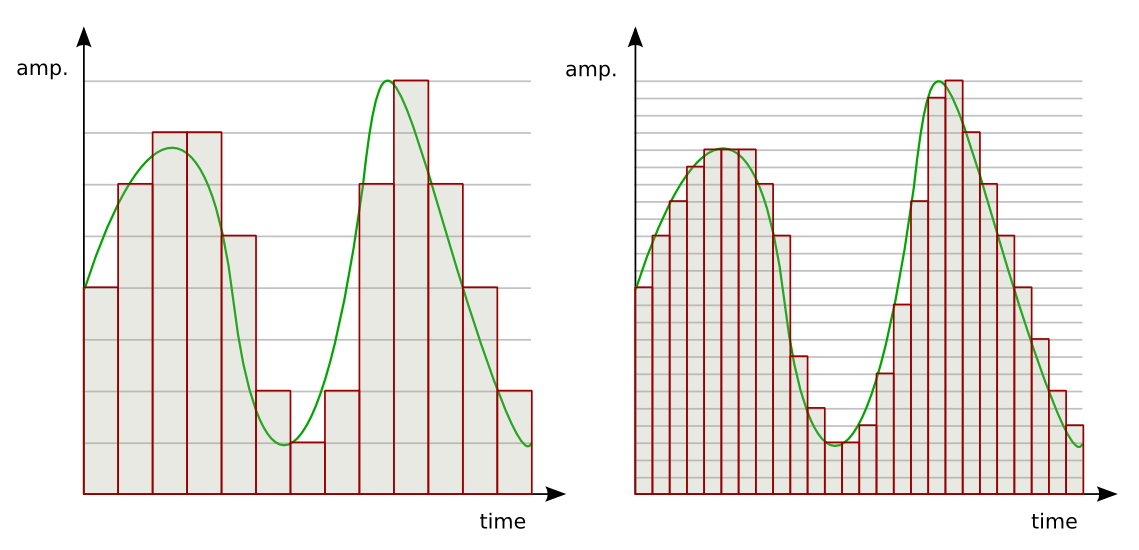
■ Sampling rate
(= sample rate)
If it is 44.1 kHz, the data is taken at 44100 times/sec
Wavewidth (fineness) = sound pitch Del
sampling theorem (the original can be reproduced by sampling at twice the rate).
The calculation can be sampled up to the audio frequency of 22 kHz.
This is enough because normal CDs only record up to 20 kHz. By the way, I don’t quite understand the
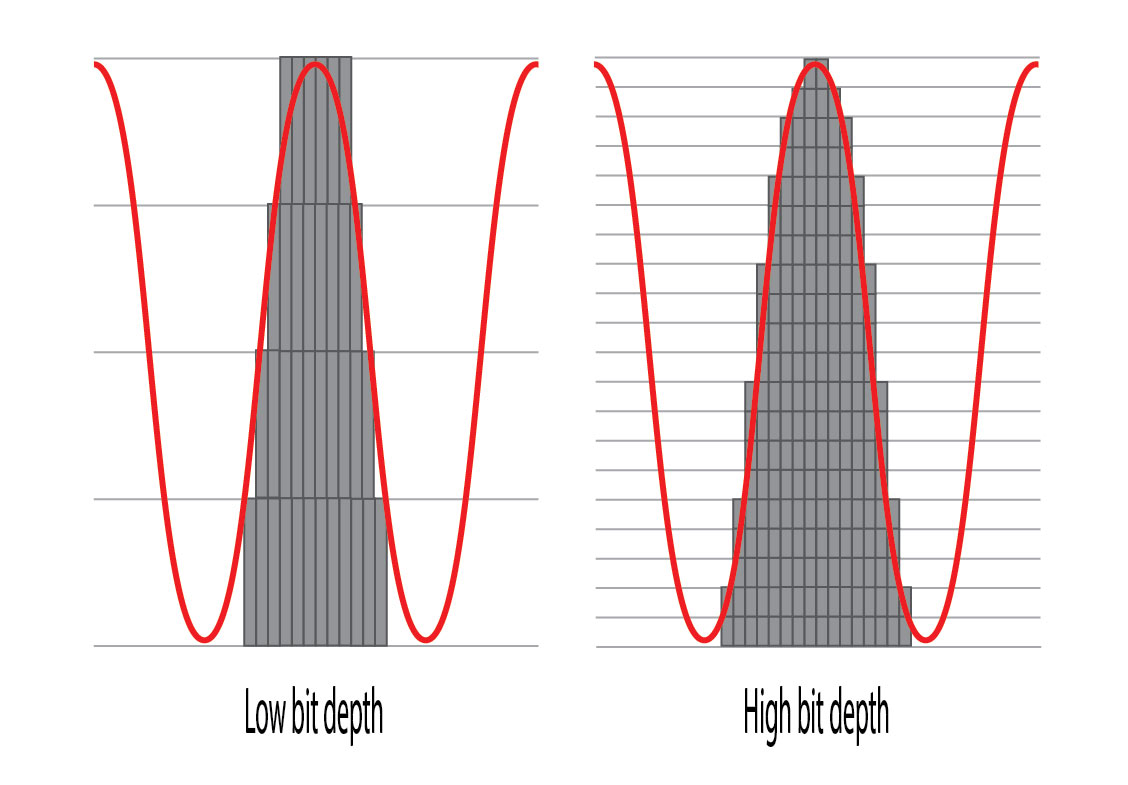
sampling theorem, but is it true that sampling two points in a cycle and playing between them is an approximation with a sine wave? Addendum: Since the sampling theorem is a theorem about the result of the Fourier transform, the frequency mentioned there is naturally limited to sine waves. The sampling theorem is that “only sine waves less than half the sampling rate (fs) can be sampled”. That’s how it is. ■ Quantization bit (= bit depth) If 16 bits, divide waveform height by 2 ^ 16. Wave height = volume Bit rate is the transfer (processing) speed, in units of bps . It is completely different from the quantization bit. The bit rate will be described later. BTW, quantization is called quantize, but it seems it’s not called quantization bit.
Speaking of quantizing,
it’s like adjusting the timing of the sound in DTM and others.
Postscript:
It seems that the unit of the vertical axis is not dB. Sound pressure does not appear to be directly equal
because it becomes a wave when sound is converted to voltage. I don’t know anything because it’s about electricity. hard.
Bit depth and bit rate
From Wikipedia.
Bit rate = (bit depth) * (sample rate) * (number of channels)
For example, if the sample rate is 44.1 kHz, the bit depth is 16 bits, and 2 channels (stereo), the bit rate is as follows:
16 * 44100 * 2 = 1411200 bits/sec = 1411.2 kbps
bitrate means the amount of data processed per unit of time.
The example above is for a CD.
For mp3s, the player’s specifications are usually up to 320 kbps.
I think this number and 1411.2 kbps are quite different, but since
this bps is the data processing speed after compression
, comparing CD bitrate and mp3 bitrate has nothing to do with sound quality. There is a story that
even with 192kbps mp3, there seems to be no problem with sound quality, so even professionals can’t tell it apart from wav . I personally haven’t heard or compared so I don’t know. Maybe it’s the type that doesn’t bother me even though the recording quality is pretty bad.
known specifications
■
CD sample rate 44.1kHz
voice frequency band 20Hz ~ 20kHz
dynamic range 96dB (= 1bit 6dB * 16bit)
■
DVD Audio Sample Rate 48kHz, 96kHz,
192kHz voice frequency band ~ 88kHz (192kHz)
dynamic range of approximately 146dB (quantization bit 24bit ) )
Where is the 96db range centered?
That may be strange, but
0db is not quiet (my left ear hearing is -5db at 4kHz), so
could be extreme story -96db~0db right?
I wonder if it’s a mixer or a producer’s favourite.
Also, even if the range is 96 db,
it may not be possible to play all around the headphones.
I think I need a proper woofer.
from now on
After researching so far, I became interested in lossless!
I often watch it on FLAC or Apple Lossless.
It may be time to finally understand Huffman coding


