I can’t even hear the difference between lossless music and 320k MP3 Part 2
Lossy vs Lossless
Is it necessary to buy headphones with good sound quality?
Lossy vs Lossless
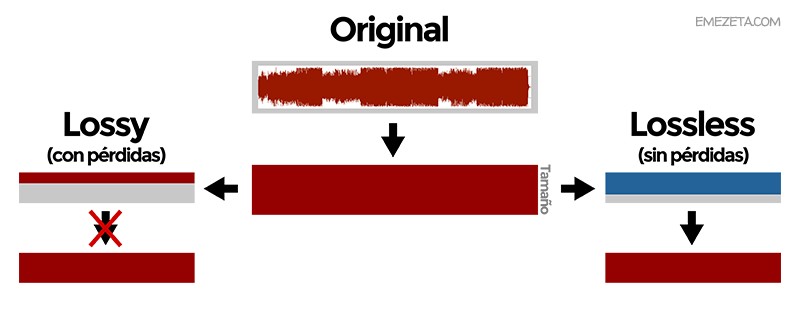
First of all, it is worth seeing it this way. Of course, most of the current lossless formats (except WAV format) do not refer to the direct storage of the original PCM stream, and still use a series of lossless compression algorithms to reduce storage space, but no matter how lossless Compression, in general, is definitely not as powerful as “lossy” compression.
Here, we have reached the first climax of the brain, obviously, in addition to using a series of compression algorithms to reduce the storage space of audio information, we can rely on more direct and rough methods, such as switching from binaural to monophonic. In this way, the storage space can be saved basically in half, but it is obviously not worth it. After all, two channel sound is still stereoscopic, and single channel doesn’t have that feeling at all, so we can start. of the sampling precision. , For example, the sampling precision directly reduces to 15 bits, which can directly save 6% of the space.
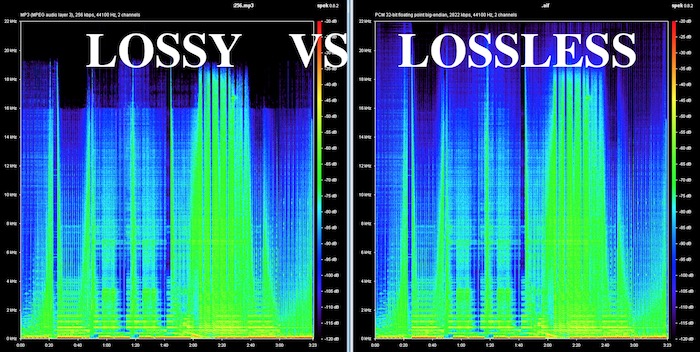
But in any case, reducing the sample depth must mean that the audio signal is corrupted (in fact, based on the current level of technology, no matter how you store it, the original audio signal cannot be restored)
So how does this “lossy” sound different?
blind listening test
Of course, practice is the only criterion to prove the truth. It doesn’t matter if you can do it or not. We cannot feel that the songs we listen to now are not good as soon as we hear the damage. they must more convincingly identify your sense of hearing. The difference between the two depends on the ABX Blind test.
I can’t even hear the difference between lossless music and 320k MP3
lossless and lossy audio
Is it necessary to buy headphones with good sound quality?
lossless and lossy audio
1. It is basically impossible for a normal human being to tell the difference between lossless and 320K MP3 in safe listening volume (maximum volume does not exceed 90dB) and general environment (environmental noise greater than 30dB). [1]
2. Generally, people’s distinction between lossy and lossless high bitrate comes from adjusting the volume during the compression process, especially on various streaming media platforms – what you hear is not the difference in quality of the sound, but the difference in volume. .
2.1 The above conditions also apply to most equipment (decoders, amplifiers) for listening comparison.
3. To hear the difference between lossless and MP3, use the following methods:
3.1 Use low bit rate MP3 (128 and below)
3.2 Increase the volume to dangerous levels (may cause permanent hearing loss)
3.3 Repeat a specific segment continuously (it is generally recommended to control the repeated segment within 2s~5s) [2]
4. In normal listening situations, there is no point in being obsessed with differentiating between 320K MP3 and lossless. But it still makes sense to buy good headphones/speakers, because the human ability to distinguish the sound from different headphones/speakers is much stronger than the ability to distinguish the sound source.
Why do we need compressed audio formats?
This question is a bit stupid. Of course, it is to save audio storage space. If you do the math, even a 3-5 minute song at 320kbps probably only takes up a few megabytes of space, but if it’s an uncompressed format, the most popular 44100HZ sample rate, two channel, quantized PCM stream to 16-bit sampling, 3 minutes need 3x60x44100x2x2 bytes, about 30M storage space, so the space for a single song can be stored using MP3 to store 5-10
Converting mp3 to flac or wav in audio is useful? Improve sound quality?
mp3 to lossless
We know that sound is produced by the vibration of objects, and sound propagation must occur in a given medium.
mp3 to lossless
The propagation form of sound in the medium is a wave, and the sound wave is a kind of mechanical wave.
In order to store sound waves, the analog medium was invented. Vinyl records and magnetic tapes essentially simulate mechanical waves through electromagnetic waves. If we put the groove of the record under a microscope, we can see the original waveform of the sound, which is continuous.
The shortcomings of analog media are obvious, such as large size, difficult to transport, and little interference during the transmission process (analog TV snow spots, transmission noise, etc.). So, in the 1980s, Sony and Philips jointly developed the CD. CDs are a completely new form of storage. Its principle is to sample continuous waveforms, that is, to replace continuous waves with discrete points in the waveform (think of the tiny particles and pixels seen after a photo is enlarged many times).
The main concepts in the sampling process are as follows:
1. Bit depth
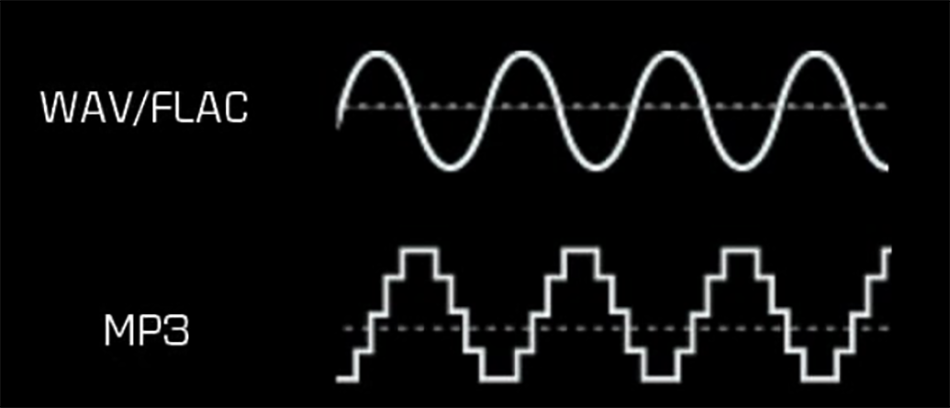
Obviously, the more points we put into it, the finer the (binary) sampling will be. We can understand it this way, assuming the sample rate is 1 bit, then the converted audio track has only two points, 0 and 1, i.e. we are using a square wave to represent a sine wave. Sure, the high points, the low points and the mid points are lost, we lose the dynamic range. 1bit = 6.02db of dynamic range. The sampling rate of the CD is 16 bits, that is, there are 2^16 = 65536 points. This music is difficult for most human ears to distinguish, and the dynamic range reaches 96db. However, in the actual listening environment, due to noise, etc., it cannot reach this range. So there is 24-bit or even 32-bit music.
2. Sampling rate
If we place the waveform in the coordinate system, the bit depth is equivalent to the fineness of the ordinate. The fineness of the abscissa is called the sampling frequency. Imagine a sound wave vibrating 20,000 times per second, if we can only collect 10,000 times per second, then we lose 10,000 vibrations and lose information. The frequency that the human ear can hear is between 20 and 20,000 Hz. According to Shannon’s sampling theorem (also known as Nyquist’s theorem), when the sampling frequency is greater than or equal to twice the highest frequency of a waveform, we can express this without waveform segment distortion. The CD sample rate is 44.1 kHz = 44100 > 20000 * 2. As for why it’s 44.1 instead of 40, on the one hand it leaves some room for the anti-aliasing filter, and on the other hand it supports PAL and NTSC video formats.
3. Bitrate
Finally, use bit depth * sample rate * number of channels to get the bit rate (bit rate) of a piece of audio, which is the number of bits passed per second. Taking a CD as an example, 16 * 44.1k * 2 = 1411.2 (kbps)
Our usual decoder (DAC) actually reverses the analog-to-digital conversion process of this sample, that is, the digital-to-analog conversion.
As for the music format, wav is a format jointly designed by Microsoft and IBM to store waveforms. The standard wav format is the same as the CD format, so we often call it lossless music (in fact, this statement is not rigorous), of course, wav can also store music with a lower bit rate.
The biggest disadvantage of wav is that it is too big. For small storage devices in the early days, wav is obviously not ideal. So, people developed various compression algorithms, like mp3, wma, etc. The mp3 format can compress a lot of space, but some of the information is removed during the compression process, so this process is called lossy compression, which corresponds to what we call lossy mp3 music. (Common bit rates are 128 kbps and 320 kbps)
When everyone’s hard drives are getting bigger and bigger, many people are not satisfied with the sound quality of mp3 compression, but at the same time they still feel that the wav is too big. Appear. The so-called lossless, because wav doesn’t lose any information when compressed into flac. This process is lossless compression, and flac can be decompressed into wav intact. Imagine that we compress the file in zip or rar, obviously no information is lost during the decompression process.