The relationship between MP3 frequency, bit rate, bit rate and sound quality. Part 2


Free Download Mp4Gain
picture

The relationship between MP3 frequency, bit rate, bit rate and sound quality. Part 2
MP3 ENCODING

Speaking of mp3, I am afraid no one will say that they have never heard of it.

mp3 encoding

Even if you are not an mp3 user, there are ubiquitous advertisements, advertising activities in the city, discussions between friends and the Internet. Rich resources, these always give you a little impression, right? For trendy youngsters, especially friends who like music and friends who like digital devices, mp3 is probably a word that should be talked about every day, but what is mp3, how to determine mp3 sound quality and what is good or How can I listen to high quality mp3? ? ? I think the following article can help you solve many doubts.
Across current mp3 users, the generally accepted standard for production is eac recording + lame compression. Those who are experienced in such production process will figure out some tricks and use different parameter and parameter settings for different music. The compression ratio varies from the standard 128 kbps to the maximum of 320 kbps, but what is the difference and the difference in effect between these bit rates? ? How is the most suitable compression ratio, which one should be better for cbr and vbr etc. These topics are often discussed by everyone. Let me share with you some of my feelings.
The repertoire selected for this test is the first track of Bach’s “Grandenburg Concerto”, performed by the Munich Bach Orchestra, eac track recording software, cd’ex compression software, fooba2000 v0.8 playback software and listening earphones are er6 from Intech and e3c from Shure. Because the classical repertoire is very detailed and the band is large, the requirements for all aspects of sound quality are relatively high, so it can clearly reflect the difference in detail between different processing methods.
I first grabbed the track with rac, and then used the lame mp3 encoder (vision 1.92 engine 3.92) engine in the cd’ex software to process the wav file. I tried the lick parameters one by one to choose a good effect:
The first thread priority parameter selects the highest and lowest respectively. When other parameters are the same, the compression comparison shows that the degree of thread priority has no effect on the sound. The size of the generated files is the same, and the comparison sounds the same, so these parameters have no effect on the sound quality.
The second parameter is the version, which can be selected between mpegI, mpegII and mpegII.V. Similarly, the other parameters are determined and these three options are used to compress three times. After listening, although the file sizes of the three methods are all the same, but the actual listening feeling of mpegI is better. The mid-low frequency compression ratio is a bit smaller, but the high frequency distortion is a bit more. It is more suitable for listening to human voice and pop music. It is also good to use mpegI type to listen to classical music, the sound background is better, but if it is solo music with a lot of mid and high frequencies like violin, it is recommended to use mpegII.v type, which will have better results.
The third parameter is the most important, which is the bit rate. Choosing it directly affects the size and listening experience of your mp3 file. The higher the compression ratio, the higher the distortion, and the lower the compression ratio, the lower the distortion, but how do we find one for ourselves? What is the acceptable balance between the two? This requires careful exploration in the experiment. Considering that the sound quality of low bitrate files is not suitable for playing music, the minimum set is 128kbps, and four fixed bitrate files of 128, 192, 256 and 320 are used for comparison. and try.
The compression ratio of 128 kbps is still relatively rough, and the high-frequency part has obvious distortion after compression. It sounds hollow, wrinkled, scratchy, and often has a flickering sound. Misunderstanding, the compressed volume of a 3 minute 39 piece of music is 3414kb, although the volume is not large, the sound is not satisfactory, and there is a relatively large flaw.
192kbps bit rate compression effect is much better than 128. First of all, the sound is solid, at least there is no empty feeling, the high-frequency distortion is also much less, the sound is compact, the noise is small and clean, achieving relatively ideal listening. The sound effect, only because the compression is still relatively strong.


Free Download Mp4Gain
picture


Mp4Gain Main Window
picture


Mp4Gain Features
picture


Free Download Mp4Gain
picture

The relationship between MP3 frequency, bit rate, bit rate and sound quality 

The relationship between MP3 frequency, bit rate, bit rate and sound quality.

mp3 encoding

Each song is ripped from a CD, converted to a WAV file, and then converted to MP3 using encoding software.

mp3 encoding lossy compression

So it should be a sample rate of 44100 KHz. Unless yours isn’t a song, but you record it as a WAV file and choose another sample rate when recording.
The main factor that affects the sound quality of MP3 is the bit rate. Now the best is 320K CBR (fixed bit rate) and VBR (variable bit rate), VBR files are a bit smaller than CBR. 192K VBR is the most popular on the Internet, which can meet the requirements of sound quality and file size at the same time, but I usually use CD to rip tracks or download APE (lossless compression, which can be restored to WAV file) and then convert it to 320K VBR.
Final reminder: MP3 transcoding is distorted and this distortion cannot be reversed. That is, if you convert MP3 to WAV sound quality, the file size increases dozen times, but the sound quality remains the same as MP3 sound quality.
If you want to hear low distortion, it’s better to listen to a CD or download APE.
First of all, sound quality is a very subjective thing!
It is often said that the sound quality is good, one refers to the good degree of reproduction, that is, the smaller the difference with the recording, the better; the other refers to the pleasant sound, which is good. As for mp3, mp3 is a compressed format, the higher the bitrate, the less compression and less loss of detail, that is, the higher the bitrate, the closer to the original sound. But sound quality is also related to your output device, such as a good mp3 player and a good pair of headphones, all of which will help your listening quality!
So if you want to improve sound quality, you can also start from the above perspectives and not overemphasize any one of them. When you have higher requirements for sound quality, you can give up mp3 and directly switch to stop CD. The CD carries waveform files, which are completely in lossless sound quality format, which will give better results.
If you want to reduce distortion, the only way is to increase the bitrate. It’s best to use variable bit rate (VBR) compression to produce mp3 files, which can strike a balance between maximum fidelity and minimum file size.
Finally, if you want completely lossless sound quality, you should still use audio files in a lossless compression format or an uncompressed file format. How good is the sound quality in MP3 format? 128/192/256/320 etc What is the difference in MP3 sound quality of various compression ratios/compression modes? What are some basic principles? How about the sound quality of other formats like APE/WMA/etc?

Bit rate – definition

Bit rate – definition

Bitrate

Introduction

BITRATE

The term quality is widely used.
In multimedia technology, quality is often used to judge the effect of audio, and quality here is actually bitrate.
On WINDOWS it is called “bit rate” and on some players it is described as ” bit rate “.
Quality refers to the bit rate at which digital sound is converted from analog to digital format. The higher the bitrate, the better the quality of the restored sound.
sound control edit stream
16 Kbps = phone quality
24 Kbps = increase phone quality, shortwave transmission, longwave transmission, European standard medium wave transmission
40 Kbps = American standard medium wave transmission
56Kbps=Voice
64 Kbps = boost voice (best bitrate setting for cell phone ringtones, best setting for cell phone mono MP3 players)
112 Kbps = FM stereo broadcast FM 128 Kbps = tape (best setting value for mobile phone stereo MP3 player, best setting value for low-end MP3 player)
160 Kbps = HIFI high fidelity (best setting for mid to high end MP3 players)
192Kbps=CD (best setting for high-end MP3 players)
256Kbps=Studio Music Studio (for music enthusiasts)
In fact, with the advancement of technology, the quality of music is also getting higher and higher, the highest quality of MP3 is 320Kbps, but some formats can achieve higher sound quality.
For example, the emerging APE audio format can provide real audiophile-level lossless sound quality and smaller volume than WAV format, and its quality is usually 550kbps-950kbps.
encoding modeedit stream
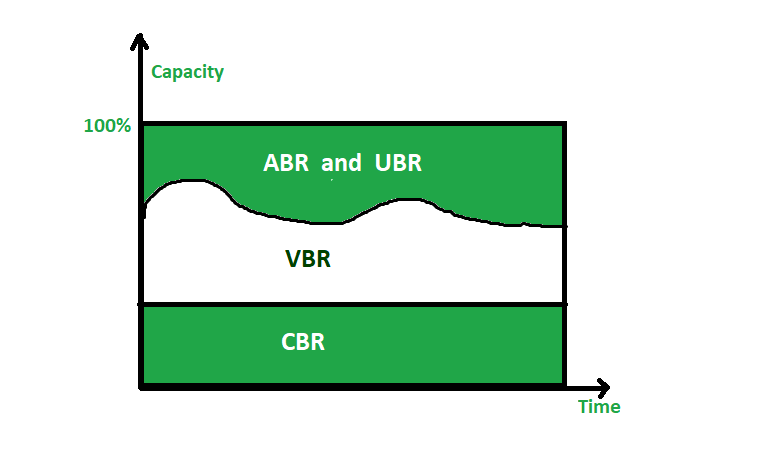
VBR dynamic bit rate (variable bit rate) means there is no fixed bit rate. The compression software immediately determines which bitrate to use based on the audio data being compressed. This is a method that takes quality as a premise and takes file size into account The recommended encoding mode;
ABR Average Bit Rate (Average Bit Rate) is an interpolation parameter of VBR. LAME created this encoding mode in response to the low file volume ratio of CBR and the variable size of files generated by VBR. Within the specified file size, ABR takes every 50 frames (about 1 second for 30 frames) as a segment. High-frequency and insensitive frequencies use relatively low traffic, and low-frequency and large dynamic performance use high traffic, which can be used as VBR and CBR, a compromise option.
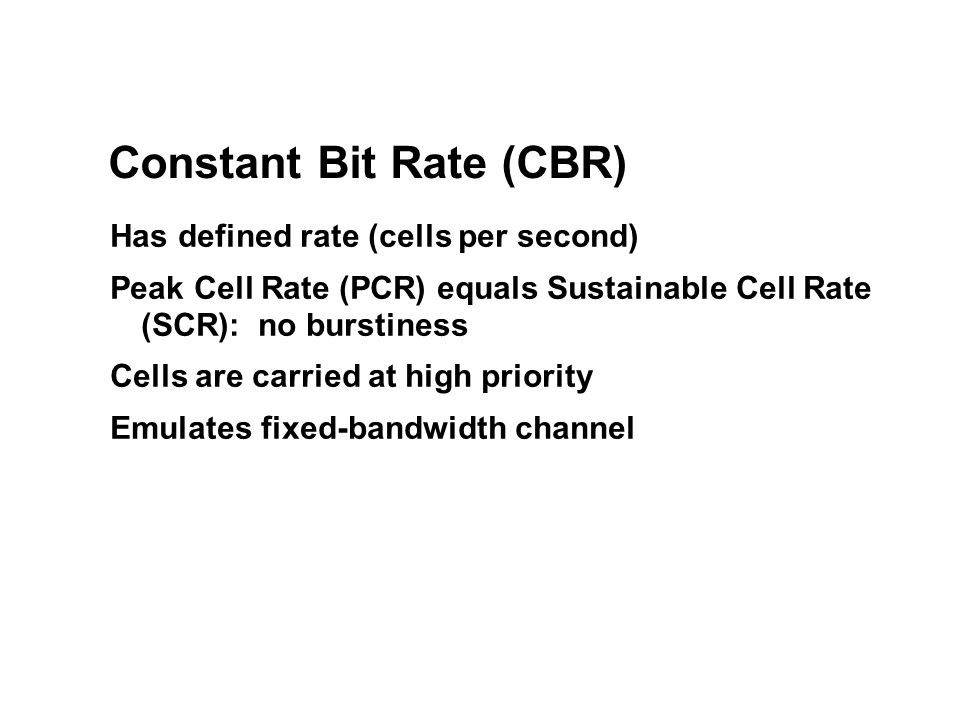
CBR (constant bitrate), constant bitrate means the file has one bitrate from start to finish. Compared to VBR and ABR, the compressed file size is very large and the sound quality will not improve significantly compared to VBR and ABR.

The difference between progressive download and streaming delivery

The difference between progressive download and streaming delivery

Streaming


When a business or organization publishes a video on the web or operates a video service, it is important to select a video distribution method.

streaming

On this occasion, we will explain the characteristics and differences between the two distribution methods, “progressive download” and “streaming distribution”.

What is progressive download?
Progressive download is a delivery technology that downloads data such as video and audio and plays them at the same time.

Sometimes referred to as “pseudo-streaming,” the video data is played back as it is saved as a temporary file on a terminal such as a PC or smartphone.

Thus, once the video data is downloaded, it can be freely viewed offline without having to go through the internet.

What is streaming distribution?
Streaming is a technology that transfers audio and video data, plays it back in sequence, and distributes the data to terminals such as PCs and smartphones without saving it.

Streaming distribution uses a dedicated streaming server for video and audio distribution and transfers only the data required for playback, making it suitable for distribution of long duration video such as movies.

Due to the technology to play while data is transferred, if the communication environment is poor, the data reception cannot be maintained and the video may stop in the middle.

Advantages and disadvantages
Let’s take a look at the pros and cons of “progressive download” and “streaming”.

Progressive discharge
merit
Even if the communication environment is bad, smooth playback is possible after the data download is complete.
Since the video data is saved as a temporary file in the terminal, the saved video data can be played repeatedly as long as the cache remains.
Operation is possible without preparing a dedicated streaming server
* Recently, streaming servers are becoming more common.
Demerit
Since the entire video file is downloaded to the terminal and distributed, it is easily copied and no copyright action can be taken.
* Recent video data security
Large video files put a strain on your bandwidth, so they take time to play.
As the number of concurrent viewers increases, the server will become overloaded and viewing will become difficult.
Transmission delivery
merit
Only the video being played is transferred to the user, so if the communication environment is stable, you can comfortably watch long and large-capacity videos.
Since there is no data left on the device, copyright-related measures such as data redistribution and falsification are higher than progressive downloads.
* Recent video data security
By using a CDN, a stable distribution is possible even if the number of concurrent viewers increases.
Reference: What is a CDN that is often used for video distribution?

Demerit
Stable playback is not possible unless the communication environment is protected.
A dedicated streaming server needs to be set up, which requires upfront and running costs.

Video Distribution Advantages and Disadvantages of High Bitrate Part 2

Video Distribution Advantages and Disadvantages of High Bitrate Part 2

Bitrate

Let’s think about the optimal bitrate for each video.
When creating a video, you need to think about how to set the optimal codec, resolution, frame rate, and bit rate yourself.

Bitrate

Then
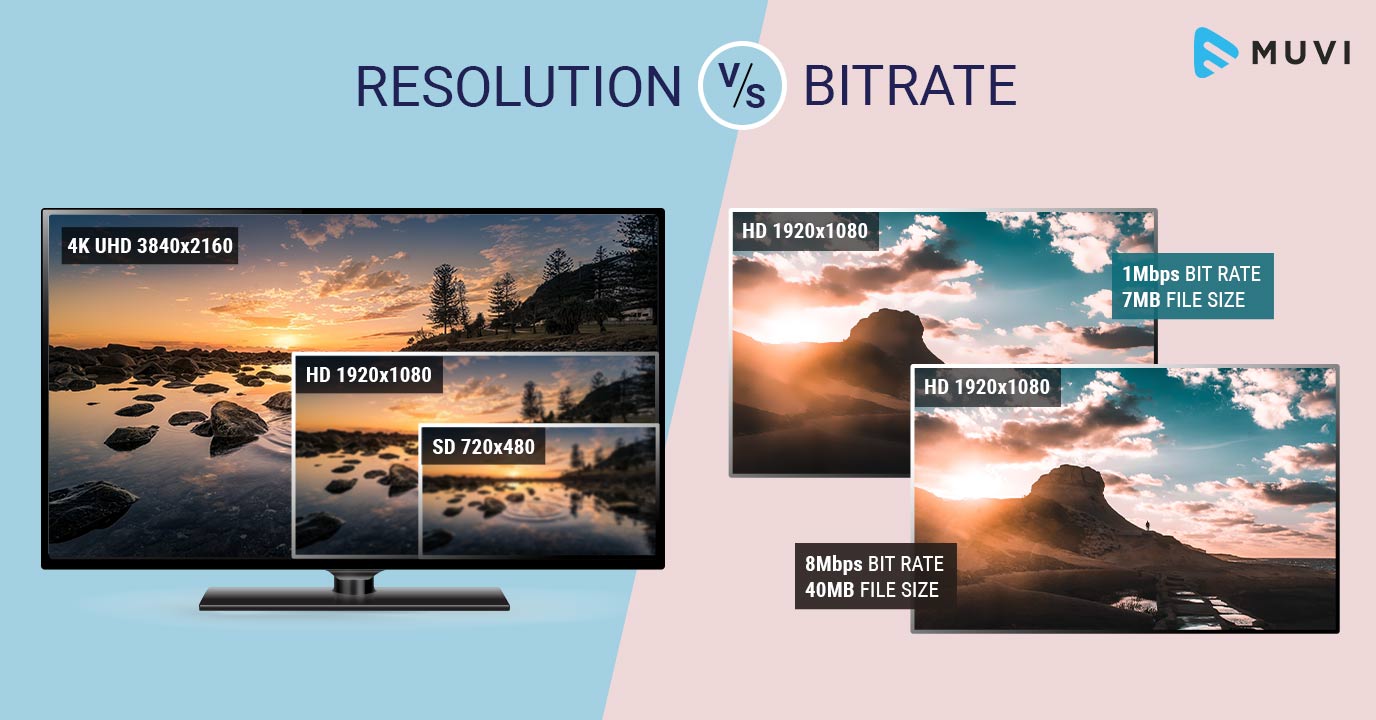
The higher the bit rate, the better the picture and sound quality.
If the bit rate is high, the network and the playback terminal will be overloaded.
Even if the bit rate is increased, the picture quality and sound quality should not be higher than that of the original video material.
It is useful to remember that.

Also, almost all video editing software, encoding software, YouTube, and other free video publishing services commonly used when creating and publishing videos have preset settings with preset codecs, resolutions, frame rates, and bit rates.

However, the image quality of the presets is not always optimal, so use this bit rate knowledge when you need to make fine adjustments.

Video distribution Advantages and disadvantages of a high bit rate

Video distribution Advantages and disadvantages of a high bit rate

Bitrate

The video bit rate is calculated separately for video and audio and added together.

Bit Rate

The sum of the video and audio bit rates is called the oval bit rate (total bit rate).

Expressed in a formula
Oval bit rate = video bit rate + audio bit rate

High bit rate benefits
The higher the bit rate, the better the picture and sound quality, and the lower the bit rate, the worse the picture and sound quality.
However, note that if the video bit rate is high, there are cases where the video bit rate is high and the image quality is good, but the audio bit rate is low and the sound quality is poor. On the contrary, there may be cases where the image quality is poor and the sound quality is good.

High bit rate video basically has the advantage of improving image quality and sound quality, but you also need to understand the disadvantages.

Disadvantages of high bit rate
The higher the bitrate, the more net bandwidth is consumed and the more playback load is applied.
For example, increasing the bit rate from 500 Kbps to 1000 Kbps doubles the net bandwidth usage and doubles the playback load or more.

It is easy to increase the bit rate for high image quality, but if you increase the bit rate too much, the CPU will become overloaded and you may not be able to reproduce it well, so be careful.

Especially when the radio wave of the smartphone is bad or the band is limited, it may not play smoothly at a high bit rate.

Even if the bit rate is increased, the image quality and sound quality do not improve above a certain level.
In fact, increasing the bit rate does not mean that the image quality and sound quality will increase without an upper limit.

For example, if the image quality of the original video material shot by the camera is 100, even if it is converted at a high bit rate by video editing software or encoding software, a high-quality video with a quality of 100 or more image of the original video will be created. You can not.

No matter how high the bit rate is, if the quality of the original video material is poor, the quality will not be better.

Detailed explanation of bit rates for video and music files

Detailed explanation of bit rates for video and music files

CBR (Constant Bit Rate)

Bitrate is an unavoidable experience in video editing and music production.

VBR

The word bit rate sounds a bit complicated, but of course, video and audio files. It is also often found in various situations, such as mobile phones and internet lines.

What is the bit rate? It’s surprisingly useful to remember it sensually, so remember it.

I think the person who visited this page is a beginner asking “What is bitrate?” , So I would like to explain it in the easiest and simplest way possible.

Bit rate basics
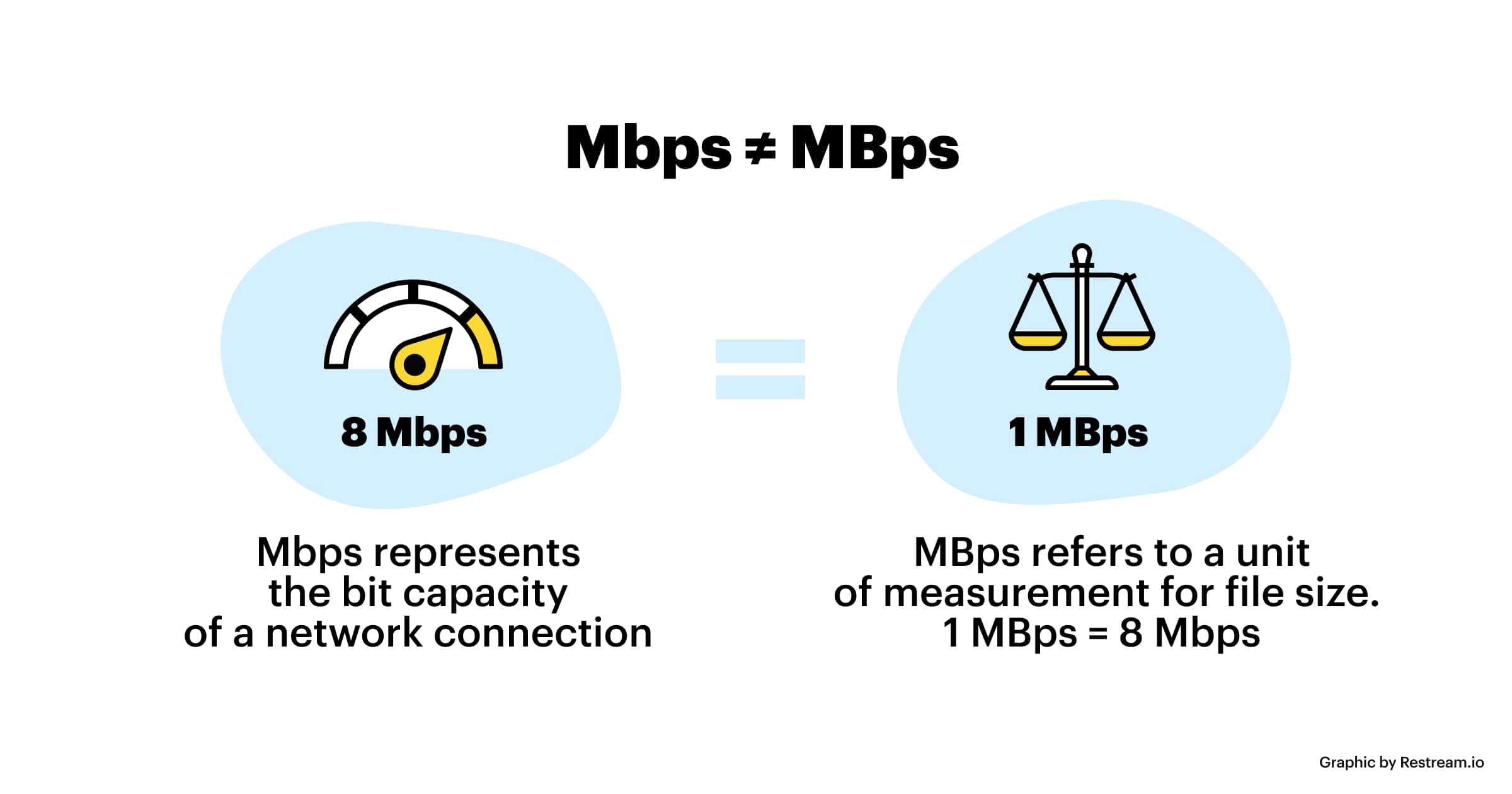
To briefly explain the bit rate, it refers to the amount of data per second for communication, such as video files, music files, and the Internet.

The so-called reproduction and communication are data streams. This stream uses a unit called bps (bit per second) to indicate how many bits flow in one second (per second).

I think it is easy to understand if you can imagine the road that a car passes by. The car is the data and the data stream is the road.

Taking into account that a road with many cars carries many people and luggage, it can be said that a lot of data (information) flows. This is called high bit rate.

On the contrary, if there are few cars in motion, it can be said that little data (information) flows. This is called a low bit rate.

A state in which the amount of data is large and the bit rate of the stream is high

A state in which the amount of data is small and the bit rate is low

Should the bit rate be high?
A high bit rate means a large amount of information. If there is a lot of information, it sounds great, like high image quality for videos and high sound quality for music, but it has a big disadvantage.

The disadvantage of a high bit rate is that it increases the data capacity of a single file. If the data capacity is too large, it can take time to send data to someone or move data between hard drives, making it difficult to manage.

Therefore, the codec was developed to reduce data capacity while maintaining high image quality and high sound quality. I’ll talk about codecs another time, but you need to set the bitrate keeping in mind the balance between image quality, sound quality, and file capacity so that the data capacity is easy to handle.

How to check the bit rate
You can check the bit rate by looking at the detailed information of video files and music files on both Windows and Mac.

How to check bitrate in Windows 10
Click Properties in the context menu of the video or audio file for which you want to check the bit rate.

Variable bit rate

Variable bit rate

Variable Bit Rate

Variable bit rate

Variable Bit Rate

The bit rate fluctuates in a video or music data file. More efficient compression is achieved by increasing the bit rate (large amount of data) in the large change part (vigorous movement) and decreasing (decreasing the amount of data) in the small change part. You can expect the effect of reducing the amount of data while maintaining the quality or the effect of improving the quality while maintaining the amount of data, but it is generally used for the first purpose.

⇨  Bit rate
Source: Asahi Shimbun Publishing Co., Ltd. “Books to open when you have problems with your computer” Information on books to open when you have problems with your computer

Explanation of the ASCII digital glossary.jp “Variable bit rate”
Variable bit rate
Bit rate at which the amount of data changes per unit of time. With the variable bit rate, the bit rate per unit of time can be adjusted according to the state of use of the line and the amount of data to be transmitted, so that the data can be transferred efficiently. Also, when compressing video to mpeg, etc., a compression method by changing the bit rate value according to the video.

Digital Daijisen “Variable Bit Rate” explained
Kahen-Bitrate [Variable Bit Rate]

“Variable bit rate” used in a system, for example, when compressing audio and video data. By changing the bit rate, it corresponds to the amount of data in the scene. VBR. VBR control. → Constant bit rate

What is the difference between CBR / VBR / ABR in audio / video conversion? 

What is the difference between CBR / VBR / ABR in audio / video conversion? 

CBR vs VBR vs ABR

Bit rate is an index that determines the quality of compressed video and audio. Bit rate is the number of bits per second, and generally the higher the bit rate the higher the quality. However, the file size will increase accordingly.

ABR vs CBR vs VBR

The compression method is the behavior of the bit rate at the time of compression, which is the constant bit rate method (CBR), the variable bit rate method (VBR) or the average bit rate method (Averate Bit Rate, ABR). be classified

Constant Bit Rate (CBR) functions

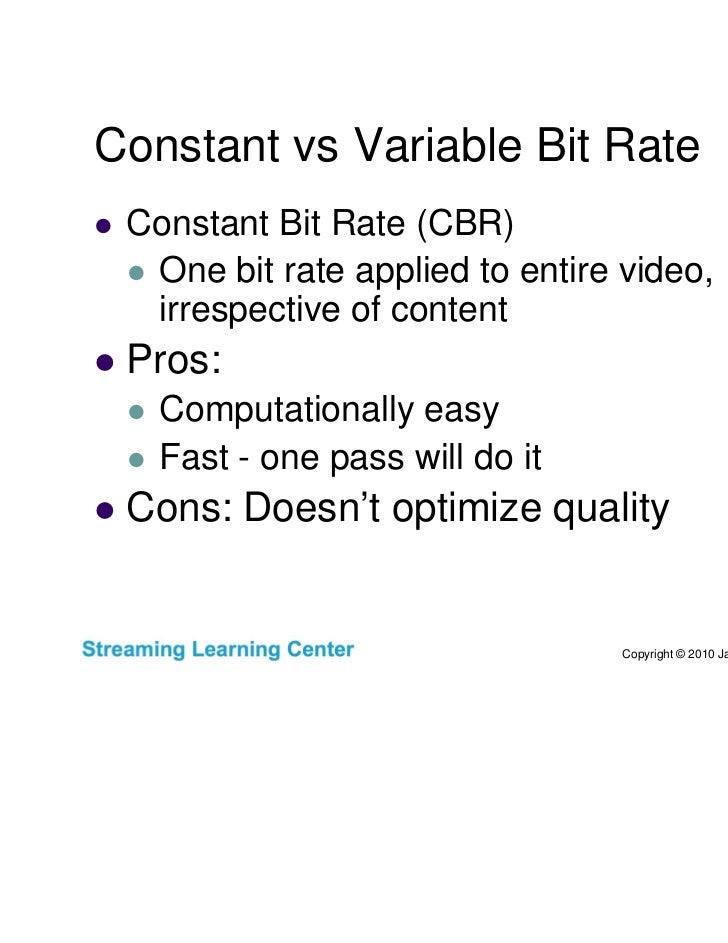
The compression method with a constant bit rate is called the constant bit rate (CBR) method. Since the bit rate is fixed, it is not only easy to predict the file size after compression, but it is also possible to search for the playback position at high speed. However, in the video there are scenes with little movement and scenes with a lot of movement. problems with such as quality change.

WAVE and uncompressed AIFF are also CBR.

advantage
It is possible to predict the size of the file after compression.
You can search the playback position at high speed.
Disadvantage
Quality tends to vary
Variable Bit Rate (VBR) Features
The compression method by changing the bit rate is called the variable bit rate (VBR) method. The VBR scheme places the jitter data with a high intense bit rate, the jitter is compressed by lowering the loose position, in its entirety the quality is kept constant can be compared with the CBR can be compressed with high quality if it is said. However, the size of the compressed file is unpredictable because the bit rate changes from moment to moment. Also, it takes longer to find the playback position than CBR.

advantage
Easy to control quality
High quality

Disadvantage
Difficult to predict compressed file size
It takes time to find the playback position.
Average Bit Rate (ABR) functions
Although the bit rate is variable, the compression method with a constant average bit rate is called the Average Bit Rate (ABR) method. Although the bit rate fluctuates with this method, the size of the final file can be predicted to some extent because it is compressed so that the average bit rate of all data is constant. This allows you to keep the quality as VBR and predict the file size as CBR. However, it takes longer than other methods because the data must be scanned at least once before compression.

advantage
It is possible to maintain quality to a certain extent.
File size can be predicted to some extent
Disadvantage
The compression process takes time

How to get the correct bitrate

How to get the correct bitrate
appropriate

bit rate

Here’s a simple way to get the correct value:

Bit Rate

Don’t increase the frame rate too much
Change the codec type
Check the resolution
If you’re taking up too much CPU on your computer with high-bit video, try the following.

Don’t increase the frame rate too much
Don’t lift too much

Since the frame rate is edited with basically the same settings as the frame rate when recording a movie, if you don’t increase the frame rate too much at the shooting stage, you can naturally keep the bit rate low and reduce the amount of data. may. Even if the resolution is a bit high, if the frame rate is low, like 24fps, there is no problem even if the value is low.

Change the codec type
Change type

By changing the type of program called a codec that compresses and converts audio and video data, it is possible to save high-quality videos even at low values. The codec type can be configured at encoding time, and the recommended codec is determined by the medium the video uses, so try switching to a better performing codec within the recommended encoding and range.

Check the resolution
check

Unless you have a specific purpose, the quickest way to lower the bitrate is not to edit with high image quality, such as 4K video. High-resolution videos have a large amount of information, so it is only natural that the bit rate is high.

So if lowering the resolution doesn’t reduce viewer comfort, try lowering the resolution a bit.

abstract
In this article, I explained the term bitrate, which is a must for anyone editing video. It seems a bit difficult compared to frame rate and resolution, and you should be able to set the proper bit rate by referring to this article.

By setting a suitable bitrate, you can create a video that is easy to handle with a small amount of data while maximizing the quality of the video.

The following article explains in detail how to edit videos.

[Video Editing Guide] Explains how to edit videos in 7 steps

Anyone can easily create video ads and video content. It acquired the number one share in the advertising and media industry for the second year in a row. (* 1) It has been introduced in more than 400 companies, mainly large companies, advertising agencies and production companies.