Why isn’t “high resolution audio” worth promising higher quality than CD?


Free Download Mp4Gain
picture

In recent years, Neil Young has been the most outspoken advocate of “high resolution audio” or HRA. These are huge audio files that in theory sound much better than any other digital file. To put this sound in everyone’s hands and ears, he created the PonoPlayer, a portable device that promises the highest fidelity.

He is not alone. Last week at CES, Sony announced a series of new products with high-resolution audio. The main one: an absurdly expensive $ 1,200 Walkman, with hardware that supposedly optimizes the playback of songs recorded on it.

PonoPlayer

At the most basic level, the desire for high-resolution audio is based on reality. We sacrifice audio quality for convenience by adopting digital formats like MP3 and lossy encoding from streaming services like Spotify. A music lover should be concerned with improving audio quality using better files.

This is fair! But from there, the arguments for high-resolution audio crumble.

There are no scientific bases

Although the term “high-resolution audio” is freely used, it generally refers to music that has been digitally encoded at a high sampling rate and bit depth. Specifically, we are talking about higher rates than the CD-quality digital standard, adopted for decades.

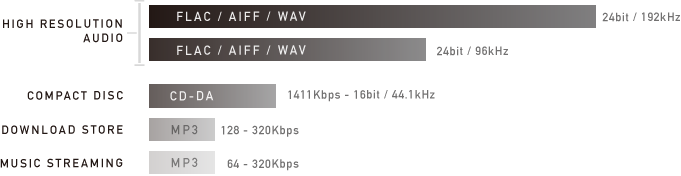
Below is a Pono chart that describes various levels of audio quality. At the bottom, we have lower quality files for streaming; in between, we have the CD-quality 44.1 kHz / 16-bit standard; And on top, we have absurdly high resolution files that are 192 kHz / 24 bit encoded.


High Resolution Audio

The logic behind HRA is that by maximizing the sample rate and bit depth, you also maximize the sound detail and dynamic range of the music you are listening to. This sounds great in theory, but in practice it is an absolute fantasy.

The CD quality standard, which is insufficient for the Young and HRA defenders, has not been adopted at random. It is not a number taken from the air. It is based on sampling theory and the real limits of human hearing. For the human ear, audio above 44.1 kHz / 16 bit does not show an audible difference.

Still, this does not prevent people from claiming that they can hear the difference in the highest quality audio. The “proof” that PonoPlayer is superior begins with a testimonial video, posted on Pono’s Kickstarter page. Young used his connections to the music industry to fill the PonoPlayer with high definition audio tracks and bring it to famous musicians. They, of course, say they got goosebumps and say that Pono is the best they have ever heard.

This proves nothing. I am not calling Norah Jones and Dave Grohl liars, but I am saying that they are succumbing to confirmation bias, that natural urge to see what you want to see, or hear what you want to hear. If Neil Young pushes a device into his hands and says, “Listen to this, man, you won’t believe it,” you will probably hear exactly what Neil Young wants you to hear.

There is a scientific way to overcome confirmation bias, called a double-blind test, in which two alternatives are presented at random, so you have no idea which is which. There are some issues with the double-blind test, but it’s generally accepted as a good practice, especially when it comes to evaluating something as elusive as the audio quality.

Young and Pono do not cite studies of this type on the benefits of high audio rates or their music player. But there were those who investigated this problem: in a study published in 2007 in the Journal of the Audio Engineering Society, Brad Meyer and David Moran did a double-blind test with a large sample of “serious” listeners. In it, the 44.1 kHz audio was compared to “the best high-resolution discs we could find.” The goal was not to show which one was better, but to find out if you could tell the difference.

“None of these variables showed a correlation with the results, and there was no difference between the responses and the results of tossing a coin,” they write in the conclusion. I mean, people couldn’t figure out what the high-resolution audio was and what the CD-quality audio was.

In general, expensive hardware is unnecessary for music to sound good, especially if it promises a quality that human ears cannot perceive.

Neil Young even upholds a commendable principle: We should be listening to higher quality music, but high-resolution audio promises more than it has to offer.


Free Download Mp4Gain
picture


Mp4Gain Main Window
picture


Mp4Gain Features
picture


Free Download Mp4Gain
picture

HIGH RESOLUTION AUDIO: HOW TO LISTEN TO MUSIC WITH THE HIGHEST QUALITY

Many of our clients, simple music fans or professionals in the sector, constantly seek perfection. Some are willing to spend even thousands of euros to assemble a high-quality hi-fi system. Many come to us for advice, and we are happy to accommodate them. First, however, it is good to gain some (really few) insights into the world of music and the media through which we generally hear it.

Sony High-Resolution Audio

We will start from the beginning.

Digital music is distributed in many formats. Some are compressed, others are not compressed. However, all files are nothing more than a sequence of bits whose value can be 1 or 0. These bits are grouped into bytes, that is, words of 8 bits each. A series of bytes forms a file or an audio track that we can listen to.

High resolution audio: recording and playback

Once recorded, to be played by us, this digital music file is sent to an analog-to-digital converter (DAC), converted to an analog signal, and finally sent to an output circuit, either a preamplifier or analog output

The quality of the file to be reproduced is given by two factors: resolution and sampling frequency.
Resolution is expressed in bits, while the sampling value is expressed in kilohertz (kHz).

Word length (bit)
= resolution Dynamic range Reproducible tones
12 bit 72 dB 4,096
16 bit (CD) 96 dB 65,536
24-bit (DVD) 144 dB 16,777,216
32 bit 192 dB 4,294,967,296

In simple terms, all this means that the denser the digital information, the closer the “digital” version of the signal gets closer to the original analog signal.

“The highest possible quality is the closest to the original as it was produced.”

For example, if you have digital music on CD in 16 bit / 44.1 kHz, this corresponds to a dynamic range of 96 dB with 65,536 gradations. However, music is rarely written to CD under these conditions, because the recording was originally made in only 16 bits (other recording defects may further reduce the signal).

Today, however, recordings are made at 24-bit / 192 kHz (in part also at 32-bit / 384 kHz), which means that the length of the information is significantly longer (and therefore has a greater dynamic range) and a higher sampling rate thus increasing the bandwidth.

The higher the resolution of the audio file, the higher the sample rate and the better the final audio signal.

Please note that the increase in “information content” resulting from higher resolution / sampling is exponential: consequently, the qualitative difference between a 16-bit audio file and 24-bit recordings could be so subtle that only be perceived by a trained ear and obviously well equipped.

HIGH DEFINITION: COMPRESSED AUDIO FORMATS AND UNCOMPRESSED AUDIO FORMATS

Audio files can be compressed (with or without loss of quality) and uncompressed (without loss of quality).

Some examples:

Uncompressed audio formats

WAV – Waveform Audio File Format (.wav)
AIFF – Audio Interchange File Form (.aiff, .aif or .aifc)

Compressed audio formats (no quality loss)

ALAC: Apple Lossless Audio Codec (.mp4 or .m4a)
FLAC: Lossless Audio Codec (.flac)

Compressed audio formats (with loss of quality)

MP3: MPEG-1 or MPEG-2 Audio Layer III (.mp3)
AAC: Advanced Audio Coding (.aac, .mp4, or .m4a)

To make a “visual” example and clarify the concept, let’s take a photograph: on the left, the original version, in good resolution; On the right, the same photo, saved in compressed format, which reduces its quality:

high rsolution audio

music in high definition, example of maximum quality

In summary: CDs (compact discs) offered good quality (not maximum) and a certain “portability”, but their capacity was limited.
Mp3 files certainly helped share music over the network, at the price of a substantial loss in terms of playback quality.

HIGH DEFINITION SOUND: A SMALL GLOSSARY TO BETTER UNDERSTAND

Bit rate

The bit rate is the amount of data per second required for a transfer from A to B. The bit rate is always expressed in kilobits (Kbps) or megabits (Mbps) per second. For example, an mp3 plays an audio track from 96 to 320 kbps; a FLAC file can exceed 5000 kbps.

Bit depth (resolution)

This value describes the number of bits recorded in a single audio sample. Therefore, it is equivalent to termination. An example: the quality of a CD (compact disc) supports up to 16 bits; An audio DVD supports up to 24 bits.

What is high-resolution audio?

High Red Audio

With more accurate analog sound sampling, this technology promises better digital sound than traditional audio CDs.
Marketing requires manufacturers not to miss the opportunity to put beautiful acronyms on their devices to indicate the presence of new “revolutionary” technologies. Therefore, in recent months, some headphones and speakers have blossomed, especially the labels “HD audio” or “high-resolution audio”. What does “high resolution audio” (or high definition) mean? In particular, it is a digital sound of at least 24 bits / 96 kHz, so it offers better quality than the 16 bits / 44.1 kHz of the audio CD. If we synthesize too much, we could say that it is a sampling gap similar to that which can separate Blu-ray from DVD.

How is it possible ? To fully understand it, it is important to go back to the beginnings of digital sound. Originally, the sound is analog data, such as the variation in air pressure or an electrical signal over time. To digitize the sound, samples are regularly taken and encoded in a series of bits. When creating the audio CD, manufacturers agreed on 16-bit encoding and sampling at 44.1 kHz, or 44,100 times per second. Therefore, one minute of mono sound requires about 5.3 MB of data and 10.6 MB of stereo per minute. When the first audio CDs were released in 1984/85, vinyl fans cried as a betrayal, accusing the digital sound of not reproducing the warmth of analog sound from the former 33rpm.

Is there really a difference?

We had the opportunity to test the entire high-resolution audio system multiple times: 192 Hz FLAC audio files, on a NWZ-A compatible high-resolution player and MDR-1A headphones, also Hi-Res. The reproduction is of course very good by ear and it seems that the songs on our test album (Play MemoriesDaft Punk) have been given precision. Even when the volume is pushed to the limit of the maximum threshold, the reproduction is still excellent and well detailed. But we also listened to the same MP3 album, in a (relatively) high 320 kbit / s sample, even with Sony’s portable music player and high-resolution headphones. And it is clear that the difference was frankly not clear. Our perception of representation was just as good. We continue the experience by listening to the MP3 version of the Daft Punk album, this time with less high-quality headphones than the Sony MDR-1A. And there the register was even worse: muted, less accurate in the treble and less powerful in the bass. Result: By ear sampling of the file had less influence on the reproduction because the quality of the products used to reproduce the sound, ie the player and the headphones. So a question about everything from a material order. For the right choice, go to our helmet department and our two specific comparisons:

– Comparison of headphones for less than 100 euros
– Comparison of headphones for more than 100 euros

What is high-definition audio?

Most digital audio systems encode analog sound, ie perceived sound, in digital form for archiving and transmission using a system called pulse code modulation. The quality of the digital recording is determined by two factors: Bit depth and sampling rate: The bit depth determines the number of “passes” available to describe the sound: the more bits used, the greater the dynamic range (the difference between the loudest and the lowest Sound) to be recorded.

high resolution audio

At the same time, the higher the sampling rate (ie how often a “snapshot” of the sound is recorded per second), the more precisely music can be analyzed and converted into digital data. The sampling rate refers to the frequency range of the audio from the lowest to the highest pitch that can be stored.

The higher the bit depth and the higher the sampling rate, the more information can be saved.

The CD uses 16-bit / 44.1 kHz encoding, which was best available at the time the CD was introduced in the early 1980s. However, progress has been made since then, and it is now possible to record and distribute music at bit depth and bit rates at higher sample rates. These formats have been used for recordings and recordings for several years, but are now also available to all households.

high resolution formats

High Resolution Audio (HRA) is any format that goes beyond the standard 16-bit / 44.1 kHz CD, and HRA recordings generally use 24-bit encoding, which enables a very dynamic range. wider than CD and sampling rates up to 192 kHz, which is the maximum level for commercial HRA recordings. All of this aims to achieve a sound that is as similar as possible to that of the recording studio.

High resolution audio formats

There is a wide range of HRA formats, so it is important that the HRA team supports them as fully as possible. Technics products are compatible with all common HRA formats (some are still in the introductory phase) and will ensure simple, practical and sustainable HRA reproduction in the future as the market develops.

CD quality music is also available in various formats. Below is a list of the most common formats used for CD quality music as well as music with loss of quality and for HRA playback.

FLAC: Studio Master sound quality (24 bit) and CD quality (16 bit)

Most music files available online (HRA and CD quality) are in FLAC (Free Lossless Audio Codec) format (the format is free, no music). 24-bit FLAC files are generally available in 96 kHz and 192 kHz, although some albums are in 24-bit / 44.1 kHz or 24-bit / 48 kHz format. These 24 bit / 192 kHz are usually the best files available and identical to the Studio Master version.
Unlike MP3, which reduces size at the expense of content, the FLAC format is lossless and works like a zip file on your computer. It is unpacked “on the fly” during playback and offers exactly the same data as in the file before compression.
Apple has its own format that means no loss: Apple Lossless (ALAC) works like FLAC, but is compatible with iTunes. Some companies that provide Studio Master downloads offer these in FLAC and ALAC formats.
An additional advantage of the FLAC and ALAC formats is that they store information about music in the form of metadata, including general parameters such as artist, album title, title / track number, music genre, composer, catalog number, etc.
This information is contained in Studio Master or HRA files that can be purchased online or added when creating a personal CD: the burning software uses a search in the Internet database to identify the hard drive to be archived and provides all the information. You can also edit this data or enter it manually.

WAV / AIFF: uncompressed file

You can also copy CDs as files without compression, e.g. B. as a direct copy of data to the hard drive. Windows computers save them as WAV files (Waveform Audio File Format), Macs as AIFF (Audio Interchange File Format), but the two formats are interchangeable and, of course, Technics systems are both reproduced.

High resolution audio: how to listen to music with the highest quality

High resolution audio: how to listen to music with the highest quality

Many of our clients, simple music fans or professionals in the sector, constantly seek perfection. Some are willing to spend thousands of euros to put together a high-quality hi-fi system. Many come to us for advice, and we are pleased to accommodate them. First, however, it is good to gain some (really few) insights into the world of music and the media through which we generally hear it.

high resolution quality

Let’s start from the beginning.

Digital music is distributed in many formats. Some are compressed, others are not compressed. However, all files are nothing more than a sequence of bits whose value can be 1 or 0. These bits are grouped into bytes, that is, words of 8 bits each. A series of bytes forms a file or an audio track that we can listen to.

High resolution audio: recording and playback

high resolution audio

Once recorded, to be played by us, this digital music file is sent to a digital-to-analog converter (DAC), converted to an analog signal, and finally sent to an output circuit, either a preamplifier or analog output

The quality of the file to be reproduced is given by two factors: resolution and sampling frequency.
Resolution is expressed in bits, while the sampling value is expressed in kilohertz (kHz).

Word length (bit)
= Resolution Dynamic range Playable tones
12 bit 72 dB 4,096
16 bit (CD) 96 dB 65,536
24-bit (DVD) 144 dB 16,777,216
32 bit 192 dB 4,294,967,296

In short, this all means that the denser the digital information, the closer the “digital” version of the signal gets closer to the original analog signal.

“The highest possible quality is the closest to the original, as produced.”

For example, if you have digital music on CD in 16 bit / 44.1 kHz, this corresponds to a dynamic range of 96 dB with 65,536 gradations. However, music is rarely written to CD under these conditions, because the recording was originally made in only 16 bits (other recording defects may further reduce the signal).

Today, however, recordings are made at 24-bit / 192 kHz (in part also at 32-bit / 384 kHz), which means that the length of the information is significantly longer (and therefore has a greater dynamic range), and the higher sampling frequency thus increasing the bandwidth.

The higher the resolution of the audio file, the higher the sample rate and the better the final audio signal.

Please note that the increase in “information content” resulting from the higher resolution / sampling is exponential: accordingly, the qualitative difference between a 16-bit audio file and 24-bit recordings could be so subtle as to be perceived only by a trained ear and obviously well equipped.

HIGH DEFINITION: COMPRESSED AUDIO FORMATS AND UNCOMPRESSED AUDIO FORMATS
Audio files can be compressed (with or without loss of quality) and uncompressed (without loss of quality).

Some examples:

Uncompressed audio formats

WAV – Waveform Audio File Format (.wav)
AIFF – Audio Interchange File Form (.aiff, .aif or .aifc)

Compressed audio formats (no quality loss)

ALAC: Apple Lossless Audio Codec (.mp4 or .m4a)
FLAC: Free Lossless Audio Codec (.flac)

Compressed audio formats (with loss of quality)

MP3: MPEG-1 or MPEG-2 Audio Layer III (.mp3)
AAC: Advanced Audio Coding (.aac, .mp4, or .m4a)

To make a “visual” example and clarify the concept, let’s take a photograph: on the left, the original version, in good resolution; On the right, the same photo, saved in compressed format, which reduces its quality:

music in high definition, example of maximum quality

In summary: CDs (compact discs) offered good quality (not maximum) and a certain “portability”, but their capacity was limited.
Mp3 files certainly helped share music online, at the price of a substantial loss in terms of playback quality.

HIGH DEFINITION SOUND: A SMALL GLOSSARY TO BETTER UNDERSTAND
Bit rate

Bit rate is the amount of data per second required for a transfer from A to B. Bit rate is always expressed in kilobits (Kbps) or megabits (Mbps) per second. For example, an mp3 plays an audio track from 96 to 320 kbps; a FLAC file can exceed 5000 kbps.

Bit depth (resolution)

This value describes the number of bits recorded in a single audio sample. Therefore, it is equivalent to termination. An example: the quality of a CD (compact disc) supports up to 16 bits; An audio DVD supports up to 24 bits.

What is Hi-Res sound and how it differs from normal audio

In recent times, many manufacturers of audio products have begun to add Hi-Res products to their catalogs, an acronym that comes from the English «High-Resolution», and indicates that the device is ready to play the audio with it quality that has been recorded, which is synonymous with maximum fidelity. But what features does Hi-Res sound have and why is it different from normal audio?


What is the Hi-Res sound?

The sound that is recorded in the studios – whether music, cinema, dubbing or whatever – is raw audio, without compression, and the recording is done in an analog way, because as you know the sound is formed by waves . Logically, for this audio to be heard on our televisions, smartphones, consoles and others, it is necessary to convert it to digital, and for that to be possible we must first be able to measure the waves so that they can then be recreated in the device that is going To emit the sound.

To measure these waves, a series of periodic samples are taken, and this is what is called the sampling rate. This sampling rate cannot be infinitely, logically, but the higher, the greater the fidelity of the audio we are converting to digital, and that is why we set some scales or minimums for each quality.

Thus, for example, the audio sampling frequency of a normal music CD is 44.1 Khz, which means 44,100 samples are taken from the waves per second. For Hi-Res sound, the standard is set at 96 Khz, or 96,000 wave samples per second, so you will be collecting many more nuances of the original sound, being much more faithful to it.

Hi-Res sampling rate comparison


As for the sound we reproduce in our equipment, there is another factor to consider: compression.

The normal sound, when recorded, is done in a pure format and without compressing anything. But this type of sound has the disadvantage that the size of the files is very large, so it becomes complicated to store them in multimedia playback devices. This is especially true if we think that most users use our mobile or tablet to play audio files.

To reduce the size of these files, sound file compressors were created, such as the MP3 format, which try to give a more or less authentic approximation to the original sound source, but with a considerably smaller file size. For example, if an MP3 file with a compression of 256 kbps has a size of about 3 megabytes, that same file, without compressing, can have more than 30 MB.

What does Hi-Res sound bring to normal audio?

When the sound is compressed, or as we have seen when it is converted from analog to digital, many audio frequencies are lost, among which are many subtle details of the sound, which give it much more body. As we explained before, Hi-Res sound tries to get closer to the original audio, setting its quality standard with a sampling frequency and bit depth much higher than normal audio.

Currently, the Hi-Res sound formats that exist are: WAV, FLAC, ALAC, DSD and MQA. Of all of them, probably the best known for PC are the WAV format and the FLAC. The WAV format is usually used to record the original audios, but their files take up a lot of space because it is still uncompressed audio. The FLAC format is a type of compression that also falls within the Hi-Res sound quality and sufficiently compresses the sound source so that the loss of quality is absolutely minimized.

What do we need to hear Hi-Res sound?

Since the audio we will have in hand has certain special characteristics in terms of frequencies and formats, we will need an audio player that is capable of dealing with these compression formats, since not all players are capable of doing so. However, virtually any modern PC sound card, including those integrated into the boards, as well as many smartphones on the market (not televisions), are already capable of handling Hi-Res sound. According to the Japanese Audio Society, who created the Hi-Res audio standard, the DAC (the analog-to-digital converter) must be able to process audio at 96 KHz and 24 bit.

What is the HI RES AUDIO

Everything you wanted to know about Hi-res and didn’t dare to ask.

With the Walkman’s return to our lives, we saw that a trend that had sounded since 2012 made another call to consumers: Hi-Res Audio. High-definition sound will be one of the striking themes that, like UHD on television, could change the demands that consumers want in their products.

However, many only know this type of audio by some yellow sticker attached to a device. But what is Hi-res Audio? Is it as good as they say? Here we tell you.

To clean your ears well

Since the arrival of digital formats, audio recordings have maintained a quality standard whose measurement point is an audio CD. The quality of this format is 16-bit / 44.1 kHz.

To understand these two measurements you have to understand how music is digitized from similar sources. The scanning programs convert the sound waves into bits, and for that they must take a limited number of audio samples and convert them into information. The second number (44.1 kHz) indicates the number of samples per second that are taken to make the conversion, and is called the sampling rate. The first number (16-bit) indicates how much information is captured from each sample. Simplifying a bit, the more bits an audio file has, the more information it receives, the more faithful it is to the original analogue and the better quality it has.

However, files of this quality are very heavy for a computer and other devices that served as audio players from past decades, so .MP3 was born as a format that compresses information and offers sufficient audio quality for most of consumers.

But with the advent of new technologies, and the revival of some old ones, consumers began to worry again about audio. Now we buy the soundbar because we want to hear our Spotify stream perfectly, or we look for the best home theater to feel like in a movie theater. And that we have created those needs are driving new formats (which have been around for a long time, but were recently popularized) But, to validate these new formats, a standard was needed, and thus the definition of Hi-res Audio was born:

“Audio without loss of quality that is capable of reproducing the total sound range of recordings that have been finalized from better quality music sources than a CD.”

As WhatHiFi reports, this definition was given by the Digital Entertainment Group (DEG) together with the Consumer Electronics Association (CEA) and the Recording Academy. This group was joined by companies such as Sony Music Entertainment and Universal Music Group. And by the way, they defined the formats of high resolution audio sources:

MQ-A: That comes from an analog source.

MQ-P: That comes from a PCM master source (48kHz / 20-bit or greater, such as 96/24 or 192/24)

MQ-D: That comes from a DSD / DSF master source, which are formats used in studio audio editing.

MQ-C: That comes from a CD.

And under a more popular definition, high-resolution audio is the one that can make you feel your hair bristling when the ‘Stairway to Heaven’ solo sounds, or the solo La rebellion ’piano solo by Joe Arroyo. A feeling that is not achieved when the format is not able to reproduce the entire sound spectrum that moves our guts.

So if you want to have songs of good quality, the first thing that should be fixed is that the store that sells them offers Hi-Res formats (the Sony music store, HD Tracks, PonoMusic, Gimell, etc …), and usually what they will download will be a file type .FLAC, .DSD, .AIFF, .WAV or .ALAC. In terms of image, they would be like the RAW of the audio. These types of files take up much (much) more space than a .MP3, so be prepared in case the flies.

Great sound requires great machinery

In order not to lose money or effort, it is necessary to have a good team that is capable of reproducing high quality audio. At home we must have a sound system with high quality speakers. Some cell phones such as the LG G3, the Sony Xperia Z3 and the Samsung Galaxy Note 4 have the power to play Hi-Res audio without buying headphone amplifiers. Other cell phones such as the iPhone 6 need an amplifier to give the headphones enough power to reproduce the high resolution audio. And, precisely, to be able to hear these files it is necessary that the player and the speakers that emit the sound are of high quality and can reproduce the entire spectrum.