HEVC: what is it


Free Download Mp4Gain
picture

HEVC: what is it

HEVC

Since last year, users have regularly come across a new video format called HEVC. In this article, we will tell you what HEVC format is, why it is better than old video encoding formats than watching HEVC files, and also how to go back to old formats if you have an iPhone.

HEVC

HEVC Logo The abbreviation HEVC stands for High Efficiency Video Coding, which can be translated into Russian as High Efficiency Video Coding. It is a format designed to compress video up to 8K (UHDTV, 8192 × 4320 pixels). Another name for the format is H.265, so HEVC and H.265 are one and the same.

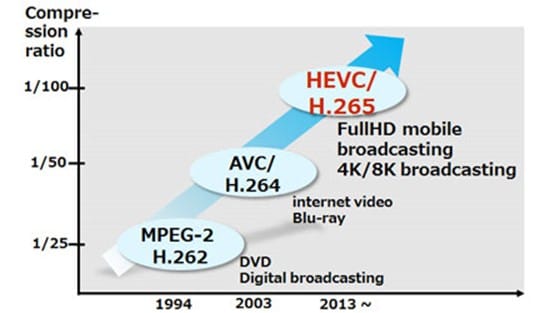
HEVC was designed to replace the outdated H.264 / MPEG-4 AVC format. Work on the new standard began in 2004, when the Video Coding Experts Group (VCEG) began looking for new technologies that could form the basis for the new standard. This project was later given the temporary names H.265 and H.NGVC (Next Generation Video Coding). The main requirements for the standard being developed are: reducing the video bit rate, maintaining current image quality, and maintaining current computing power requirements.

development of video encoding formats

Development has continued since 2012, when this format was officially approved. But, after the launch, the format did not receive much popularity, it was used in IP cameras, television broadcasts and other specialized areas. The HEVC format became known to common users in late 2017, when iOS 11 was released.

Why HEVC is better than older formats
With the launch of the macOS High Sierra and iOS 11 operating systems, Apple began actively implementing new formats for videos and photos. So for photos the HEIF format is now used, which we already talked about, and for videos, the HEVC format.

The transition to the HEVC format occurred for two reasons. First, this format provides a higher quality image. And second, this type of video takes up less memory space and requires less network bandwidth when streaming over the Internet. Simply put, HEVC video provides a significant improvement in image quality while maintaining the same file size and bit rate. According to Apple, using the HEVC format can save up to 40 percent of memory.

Several new approaches have been taken to achieve this improvement in video compression. One of these approaches is the increased block size into which the encoded file is divided. When encoding video in H.264 format, said block is 16 by 16 pixels (256 in total), while when using HEVC, said block can be 64 by 64 pixels (4096 in total). This block enlargement shows particularly good results on high-resolution videos, which is very useful, because the HEVC format supports video up to a resolution of 8192 × 4320 pixels.


Free Download Mp4Gain
picture


Mp4Gain Main Window
picture


Mp4Gain Features
picture


Free Download Mp4Gain
picture

The battle of the codecs: H.265 vs VP9 vs AV1

The battle of the codecs: H.265 vs VP9 vs AV1

VP9 vs HEVC (h265)

In this post, we are going to try to shed some clarity on a fundamental question: which codec is better?

AV1 vs VP9 vs H.265

There are numerous studies that focus on analyzing in detail the performance of video coding systems and, in Digital-Content.es, we are going to try to summarize some of their results to clarify the battle between the H.265, VP9 and AV1.

At the beginning of this decade, work on high-efficiency video coding with standards such as H.265 (MPEG-H Part 2 or HEVC, High Efficiency Video Coding) or VP9 saw the light. In recent years, the Alliance for Open Media has focused on the development of AV1. As we already commented from this blog, “AV1 aspires to become the industry standard, displacing VP9 and competing directly with HEVC / H.265, being more efficient than this and, also, open source” (Why should you start to use the AV1 codec?).

The questions that arise are: is it true that AV1 is much better than the rest of the standards? … And, between H.265 and VP9, ​​which one is better?

Regarding the bit rate, according to a study entitled “Comparison of Compression Efficiency between HEVC / H. 265, VP9 and AV1 based on Subjective Quality Assessments”, it is shown that the AV1 and H.265 codecs account for 28% and a 27% bitrate savings respectively compared to VP9. However, the same analysis specifies that, although it is true that H.265 assumes a bitrate gain in relation to VP9, ​​the differences are not very significant when working with very high bit rates. For its part, the fight in this regard between AV1 and H.265 is served, with very similar performances, although slightly favorable to H.265, largely conditioned to the audiovisual content used for encoding.

In terms of encoding time, another study titled “Future Video Coding Technologies: A Performance Evaluation of AV1, JEM, VP9, ​​and HM” reveals that AV1 requires more time to achieve greater efficiency in video compression. In this sense, the analysis specifies that AV1 requires approximately 58 times more execution time than VP9. For its part, the research entitled “Study on H.265 / HEVC against VP9 and H.264: On Space and Time Complexity for Codecs” concludes that VP9 consumes approximately 35-45 times more encoding time than its competitor H.265 .

Following the data of these two parameters in the studies presented, the H.265 codec clearly outperforms its competitors. If we analyze the visual distortion generated by these encoders, according to parameters analyzed in “Comparison of Compression Efficiency between HEVC / H. 265, VP9 and AV1 based on Subjective Quality Assessments”, we can determine, based on objective and subjective metrics, that AV1 contains lower distortions than H.265 and VP9. This same analysis clarifies that at very high bit rates, the differences between all of them are not significant. AV1 and H.265 are subjectively perceived as very similar, so they compete strongly.

Therefore, taking into account the three factors that we have determined in this analysis and following the studies presented, we can consider H.265 as the winning codec in this battle. We trust in the evolutionary power of AV1, especially considering that it is an open and royalty-free solution.

The H.265 War vs. AV1 is still open!