What is digital video?


Free Download Mp4Gain
picture

What is digital video?

Digital Video

Digital video is a set of technologies for recording, processing, transmitting and storing images and sound from digital television. The main difference from analog video is that the video signal and sound are encoded and transmitted not in their original form, but after analog-digital conversion into video and sound data streams. In most cases, digital video is compressed to reduce the amount of data that is transmitted and stored. Digital video can be delivered to various video media through digital interfaces in the form of streams or files.

Digital Video

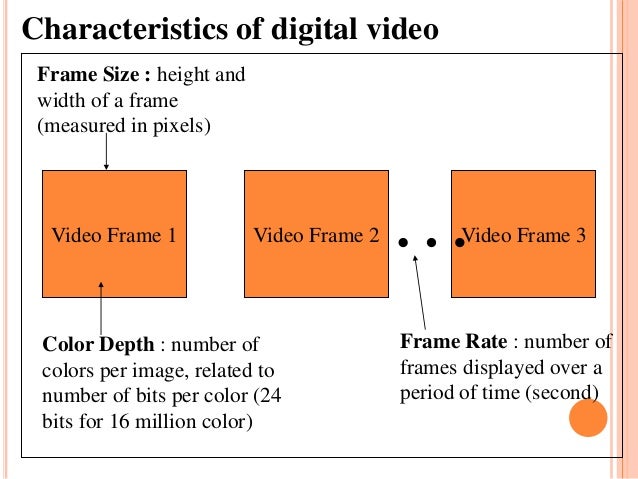
Digital video has five main characteristics: screen resolution, frame rate, color depth, bit rate (video transmission width), and image quality.

Screen resolution (resolution): indicates the number of dots (pixels) horizontally and vertically that make up the image (video frame) on the screen.
When recording the resolution, the value of the number of dots per line (horizontal resolution) is indicated first and then the number of lines involved in the image (vertical resolution).
For example, for the European PAL video standard, the frame size is 720×576 pixels, for the North American NTSC standard – 720×480, for high definition video (HD 720p) – 1280×720, and for the new HDTV standard (Full HD) – 1920×1080 pixels.
As you probably understand, the higher the screen resolution, the better the video quality.

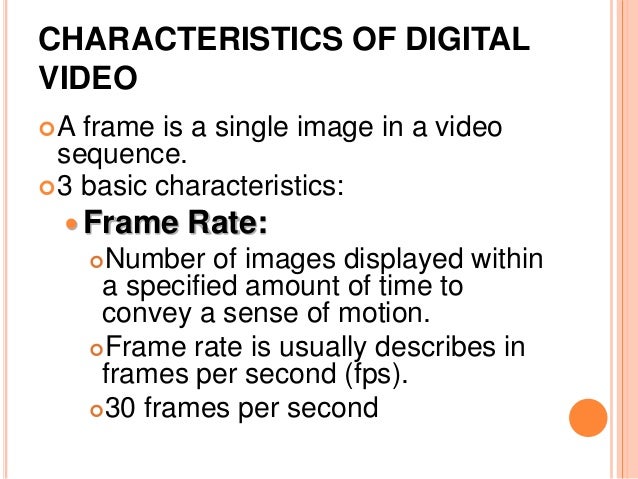
Frame rate, frame rate (frames per second (FPS), frame rate, frame rate): the number of frames per unit of time in television and cinema. The concept was first used by photographer Edward Muybridge, who carried out chronophotography experiments of moving objects with multiple cameras in a row. The generally accepted unit of measurement is frames per second.
– 24 – the world standard for the frequency of filming and projection;
– 25 – the filming frequency used in the production of films and television reports for their translation to the European decomposition standard 625/50;
– 30 – Standard video playback speed.

Color depth (color resolution) is a characteristic that indicates the number of colors that can participate in the formation of a video image.
The number of colors in digital video is measured in bits. So 1 bit can take two different values ​​(0 or 1) and it only allows encoding two colors (usually black and white), respectively. With two bits, you can encode 4 colors (22 = 4), with three bits – 8 colors (23), four – 16 (24) and so on.
Typically, color resolution is described by special color models. In computer technology, the RGB (red-green-blue) model is used, which can be represented by the following most common color depth modes: 8 bits (256 colors), 16 bits (65,536 colors) and 24 bits (16,777. 216 colors). By the way, the human eye, according to various opinions, can perceive 5-10 million shades of color.

A pixel is the smallest element in a digital image in bitmap graphics. It is square in shape. “Pixel” is a word made up of the words “image” and “element”. The physical size of a pixel is not set by the user, but is determined by the characteristics of the display device. The more pixels a display device has, the finer details in the image can be displayed.

Video bit rate is the amount of information transmitted per second. From this it follows that the higher the video bit rate, the better it is, the clearer the image, the less artifacts, etc. And it takes more hard drive space to store this video and consequently more time to transfer it over the network.

Image quality is a characteristic designed to evaluate the quality of the processed video compared to the original and is determined by a set of values ​​for resolution, color depth, and video transmission speed.

HD. High definition video. Most of the HD formats in use provide a resolution of 1920 x 1080 or 1280 x 720. There is a significant difference between the 1080 and 720 standards: the former uses 2.25 more pixels per frame.
This difference significantly increases the demands of 1080 data processing in terms of compression time, decompression speed, and size of the storage area. All 720 formats are progressive. The 1080 format is a combination of progressive and interlaced frame types. Computers and their monitors are inherently progressive, whereas television broadcasts


Free Download Mp4Gain
picture


Mp4Gain Main Window
picture


Mp4Gain Features
picture


Free Download Mp4Gain
picture

Digital video characteristics

Digital video characteristics

digital video characteristics

Frame Rate.

DIGITAL VIDEO CHARACTERISTICS

The standard video signal playback speed is 30 frames / s (for cinema this figure is 24 frames / s). Each frame consists of a certain number of lines, which are drawn not sequentially, but after one, resulting in two half-frames, or the so-called “fields”. Therefore, each second of an analog video signal consists of 60 fields (half frames). This process is called interlaced video. Meanwhile, the computer monitor uses the “progressive scan” method to draw the screen. (progressive scan), in which the lines of the frame are formed sequentially, from top to bottom, and the full frame is drawn 30 times every second. Of course, this method is called non-interlaced video. This is the main difference between computer and television method of video signal formation </p>

Color depth (Color Resolution).

This metric is complex and measures the number of colors displayed simultaneously on the screen. Computers process color in RGB (red-green-blue) format, while video uses other methods. One of the most common color models for video formats is YUV. Each of the RGB and YUV models can be represented by different levels of color depth (maximum number of colors) The RGB color model usually has the following color depth modes: 8 bit / pixel (256 colors), 16 bit / pixel (65,535 colors) and 24 bit / pixel (16.7 million colors). For the YUV model, the following modes are used: 7 bits / pixel (4: 1: 1 or 4: 2: 2, approximately 2 million colors), and 8 bits / pixel (4: 4: 4, approximately 16 million colors)

Screen resolution (Spatial Resolution).

Another characteristic is the screen resolution, or, in other words, the number of dots that make up the image on the screen. Since PC and Macintosh monitors are typically designed for native resolutions, many consider this to be the standard format. Unfortunately, it is not. There is no direct connection between the resolution of analog video and computer display & nbsp; Standard analog video provides a full-screen image without the size limitations often associated with computer video. Television standard NTSC (National Television Standards Committe), developed by the US National Television Standards Committee. Used in North America and Japan, it has a resolution of 768 by 484. The PAL standard (Phase Alternative), which is common in Europe, has a slightly higher resolution – 768 by 576 pixels

Since the resolution of analog video and computer video is different, when converting analog video to digital format, sometimes you have to scale and reduce the image, which leads to some loss of quality

The era of digital video

The era of digital video

Digital Video

In 1989, the Svema factory produced the last batch of amateur film in 8mm format. Five years ago the last laboratory for the development of this film was closed, and soon after, all the necessary chemicals disappeared from the sale … Thus, before our eyes, the era of home cinema ended and the era of amateur video began. . However, the latter, in turn, existed even fewer and, it seems, exactly the same fate awaits you: video is moving to digital formats.

Digital Video

So if you have a computer, buying an analog video camera and a board to digitize an analog signal (even a relatively cheap one, like MiroVideo DC20 / 30) seems at least a pointless waste of money today. The age of analog video is irrevocably a thing of the past, and we recommend that our magazine readers, before it’s too late, sell outdated analog hardware. Today, you can still get a third of the price for them, and if you’re lucky, even half …

Also, the same fate awaits television. For example, the state standard for high-definition color television (1,125 lines per frame), adopted in the United States in late 1996, has been successfully introduced into regular television broadcasting for the past three years. Inexpensive set-top boxes were launched for existing 525-line analog color televisions, and a decision was made in 2006 to stop broadcasting in analog format entirely.

All these innovations will gradually lead to the fact that fans of traditional videotapes will have to say goodbye to their clumsy “video boxes”: current alternative technologies are of much better quality, and moreover, they have a constant tendency to become cheaper. (Potentially, with increasing popularity, they will cost even less, than analog formats that have already reached their “ceiling”).

The excellent quality of DVD video recorded in MPEG-2 format is already capable of encouraging the average viewer to switch. The only limiting factor at the moment is that DVDs cannot yet be burned at home.

The hurdle is quite serious: many of us like to shoot home videos on amateur camcorders, rewrite movies, and play around with video editing. Furthermore, even with the massive proliferation of DVD-RAM in the foreseeable future, camcorders are unlikely to switch to new media (although Sony has already released digital cameras that use MD discs as media).

However, in addition to digital video DVDs, the MPEG-2 compression algorithm (albeit somewhat simplified and modified) is used in modern digital video in DV format (as opposed to the classic MPEG algorithm with I, B and P frames, in DV the data is recorded on cassettes using compression based on I-frames only). Furthermore, in the DV format, unlike Motion-JPEG, both intra-frame compression, in which each frame is compressed by itself, without taking into account the information of adjacent frames, and inter-field compression, which applies analyzing still images in adjacent frames using the same background. These compression algorithms produce very few artifacts. At the same time, video in DV (I-MPEG) format looks much better than the current de facto standard for non-linear editing systems: M-JPEG (Motion-JPEG) and,

For storing large amounts of video data at 500 TVL (TVL) resolution in component format with separate chrominance and luminance signals (Y, RY and BY) and 4: 1: 1 sampling (4: 2: 0 ) on small media, DV format uses 5: 1 compression (fixed stream – 3.6 MB / s). At the same time, Sony experts say that the quality of DV images is not inferior to the modern professional standard Betacam SP used in studio video equipment (differences appear only in the case of additional video processing as a result of compression image and some loss of color information during sampling). Professional modifications to the DV standard are also being successfully introduced: Sony’s DVCAM and Panasonic’s DVCPRO (in the latest implementations of these formats, the same 4: 2: 2 sampling is used as in Betacam SP).

Excellent consumer digital cameras already exist on the mass market.