
Digital video characteristics
Frame Rate.
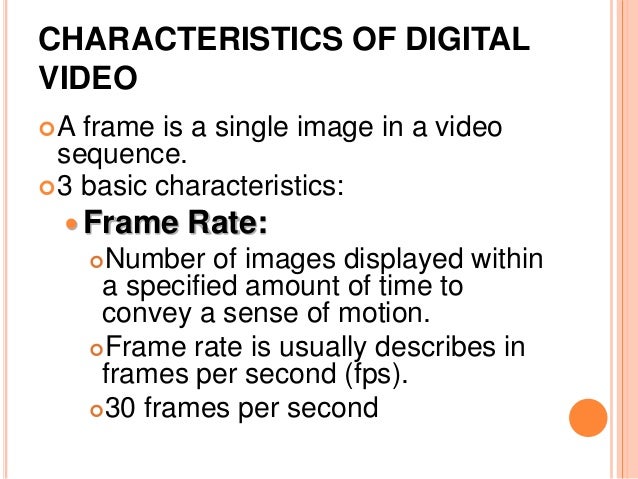
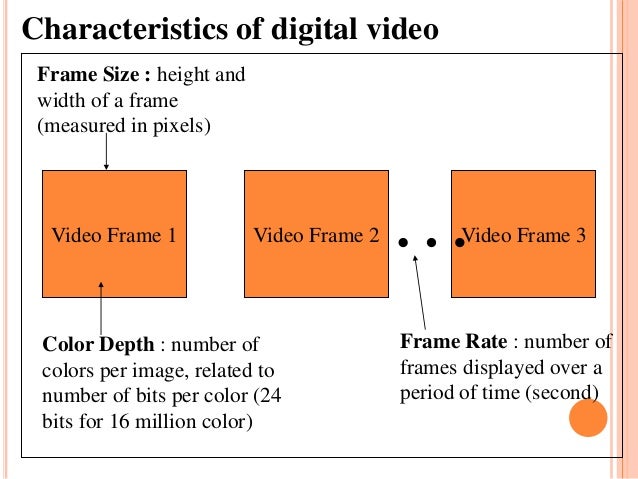
The standard video signal playback speed is 30 frames / s (for cinema this figure is 24 frames / s). Each frame consists of a certain number of lines, which are drawn not sequentially, but after one, resulting in two half-frames, or the so-called “fields”. Therefore, each second of an analog video signal consists of 60 fields (half frames). This process is called interlaced video. Meanwhile, the computer monitor uses the “progressive scan” method to draw the screen. (progressive scan), in which the lines of the frame are formed sequentially, from top to bottom, and the full frame is drawn 30 times every second. Of course, this method is called non-interlaced video. This is the main difference between computer and television method of video signal formation </p>
Color depth (Color Resolution).
This metric is complex and measures the number of colors displayed simultaneously on the screen. Computers process color in RGB (red-green-blue) format, while video uses other methods. One of the most common color models for video formats is YUV. Each of the RGB and YUV models can be represented by different levels of color depth (maximum number of colors) The RGB color model usually has the following color depth modes: 8 bit / pixel (256 colors), 16 bit / pixel (65,535 colors) and 24 bit / pixel (16.7 million colors). For the YUV model, the following modes are used: 7 bits / pixel (4: 1: 1 or 4: 2: 2, approximately 2 million colors), and 8 bits / pixel (4: 4: 4, approximately 16 million colors)
Screen resolution (Spatial Resolution).
Another characteristic is the screen resolution, or, in other words, the number of dots that make up the image on the screen. Since PC and Macintosh monitors are typically designed for native resolutions, many consider this to be the standard format. Unfortunately, it is not. There is no direct connection between the resolution of analog video and computer display & nbsp; Standard analog video provides a full-screen image without the size limitations often associated with computer video. Television standard NTSC (National Television Standards Committe), developed by the US National Television Standards Committee. Used in North America and Japan, it has a resolution of 768 by 484. The PAL standard (Phase Alternative), which is common in Europe, has a slightly higher resolution – 768 by 576 pixels
Since the resolution of analog video and computer video is different, when converting analog video to digital format, sometimes you have to scale and reduce the image, which leads to some loss of quality


