
Audio Basics
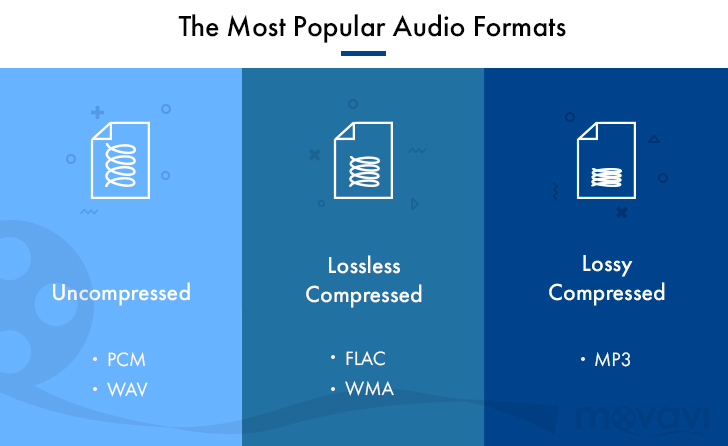
Common audio formats
Audio file format specifically refers to the file format in which the audio data is stored. There are many different formats.
The general way to get audio data is to sample (quantize) the audio voltage at a fixed time interval and store the result at a certain resolution (eg CDDA is 16 bits or 2 bytes per sample). The sampling time interval can have different standards, such as CDDA adopts 44100 times per second, DVD adopts 48000 or 96000 times per second. Therefore, sample rate, resolution, and number of channels (for example, 2 for stereo) are key parameters for audio file formats.
There are two main types of audio file formats:
Lossless formats like WAV, PCM, ALS, ALAC, TAK, FLAC, APE, WavPack (WV)
Lossy formats like MP3, AAC, WMA, Ogg Vorbis
The lossy file format is based on a model of acoustic psychology that removes sounds that are difficult or impossible for humans to hear, such as a very loud sound followed by a very low sound. MP3s fall into this category of files.
Lossless audio formats (such as FLAC) have a compression ratio of around 2:1, no data/quality loss when decompressed, and the data produced by decompression is exactly the same as the uncompressed data. If you need to keep the original quality of your music, you should choose a lossless audio codec. For example, with the free FLAC lossless audio codec, you can store the equivalent of 20 music CDs on a DVD-R disc.
The development history and technical characteristics of the audio format are briefly presented below. Specifically they include: WAV, MP3, WMA, RA, APE, AAC, etc.
WAV audio format
Introduction to the WAV audio format
WAV is a sound file format developed by Microsoft, it is used to save the audio information resources of the WINDOWS platform and is supported by the WINDOWS platform and its applications. The “*.WAV” format supports various compression algorithms, such as MSADPCM, CCITT A LAW, and supports a variety of audio bits, sample rates, and channels. The standard format for WAV files is the same as the CD format, with a sample rate of 44.1K and a rate of 88K/sec, 16-bit quantization.
On the Windows platform, WAV based on PCM encoding is the best supported audio format. All audio software can support it perfectly. Because it can meet higher sound quality requirements, WAV is also the preferred format for music creation and editing. Suitable for storing musical material. Therefore, WAV based on PCM encoding is used as an intermediate format and is often used in the conversion of other encodings, such as MP3 to WMA.
Characteristics of the WAV audio format
Advantages of the WAV audio format include: simple encoding/decoding (almost direct storage of the signal from an analog-to-digital converter (ADC)), universal acceptance/support, and lossless storage.
The main disadvantage of the WAV format is the required audio storage space. This can be a significant issue for small storage limitations or low bandwidth applications.

