
Converting mp3 to flac or wav in audio is useful? Improve sound quality?
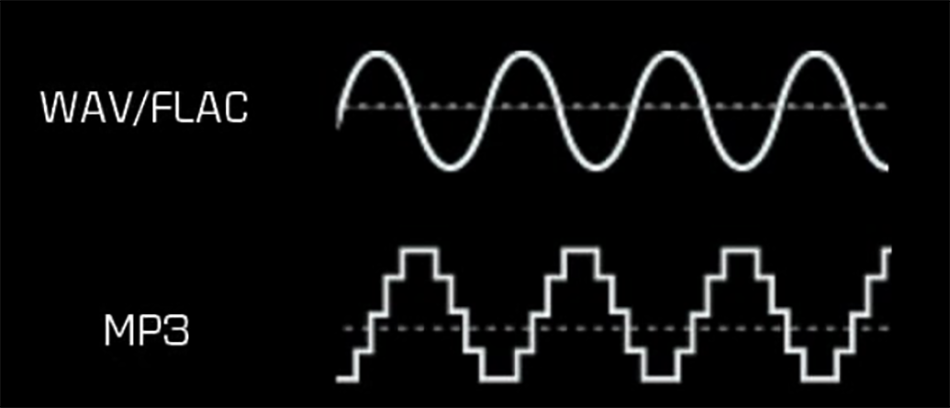
We know that sound is produced by the vibration of objects, and sound propagation must occur in a given medium.

The propagation form of sound in the medium is a wave, and the sound wave is a kind of mechanical wave.
In order to store sound waves, the analog medium was invented. Vinyl records and magnetic tapes essentially simulate mechanical waves through electromagnetic waves. If we put the groove of the record under a microscope, we can see the original waveform of the sound, which is continuous.
The shortcomings of analog media are obvious, such as large size, difficult to transport, and little interference during the transmission process (analog TV snow spots, transmission noise, etc.). So, in the 1980s, Sony and Philips jointly developed the CD. CDs are a completely new form of storage. Its principle is to sample continuous waveforms, that is, to replace continuous waves with discrete points in the waveform (think of the tiny particles and pixels seen after a photo is enlarged many times).
The main concepts in the sampling process are as follows:
1. Bit depth
Obviously, the more points we put into it, the finer the (binary) sampling will be. We can understand it this way, assuming the sample rate is 1 bit, then the converted audio track has only two points, 0 and 1, i.e. we are using a square wave to represent a sine wave. Sure, the high points, the low points and the mid points are lost, we lose the dynamic range. 1bit = 6.02db of dynamic range. The sampling rate of the CD is 16 bits, that is, there are 2^16 = 65536 points. This music is difficult for most human ears to distinguish, and the dynamic range reaches 96db. However, in the actual listening environment, due to noise, etc., it cannot reach this range. So there is 24-bit or even 32-bit music.
2. Sampling rate
If we place the waveform in the coordinate system, the bit depth is equivalent to the fineness of the ordinate. The fineness of the abscissa is called the sampling frequency. Imagine a sound wave vibrating 20,000 times per second, if we can only collect 10,000 times per second, then we lose 10,000 vibrations and lose information. The frequency that the human ear can hear is between 20 and 20,000 Hz. According to Shannon’s sampling theorem (also known as Nyquist’s theorem), when the sampling frequency is greater than or equal to twice the highest frequency of a waveform, we can express this without waveform segment distortion. The CD sample rate is 44.1 kHz = 44100 > 20000 * 2. As for why it’s 44.1 instead of 40, on the one hand it leaves some room for the anti-aliasing filter, and on the other hand it supports PAL and NTSC video formats.
3. Bitrate
Finally, use bit depth * sample rate * number of channels to get the bit rate (bit rate) of a piece of audio, which is the number of bits passed per second. Taking a CD as an example, 16 * 44.1k * 2 = 1411.2 (kbps)
Our usual decoder (DAC) actually reverses the analog-to-digital conversion process of this sample, that is, the digital-to-analog conversion.
As for the music format, wav is a format jointly designed by Microsoft and IBM to store waveforms. The standard wav format is the same as the CD format, so we often call it lossless music (in fact, this statement is not rigorous), of course, wav can also store music with a lower bit rate.
The biggest disadvantage of wav is that it is too big. For small storage devices in the early days, wav is obviously not ideal. So, people developed various compression algorithms, like mp3, wma, etc. The mp3 format can compress a lot of space, but some of the information is removed during the compression process, so this process is called lossy compression, which corresponds to what we call lossy mp3 music. (Common bit rates are 128 kbps and 320 kbps)
When everyone’s hard drives are getting bigger and bigger, many people are not satisfied with the sound quality of mp3 compression, but at the same time they still feel that the wav is too big. Appear. The so-called lossless, because wav doesn’t lose any information when compressed into flac. This process is lossless compression, and flac can be decompressed into wav intact. Imagine that we compress the file in zip or rar, obviously no information is lost during the decompression process.


