
How digital sound works (Part 2)
What is sound?

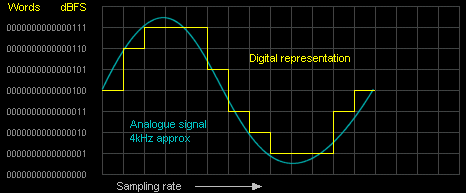
If we talk about sound, then it is actually a wave that is transmitted through a certain physical medium, in our case it is air. This wave is almost impossible to visualize, since it is three-dimensional and propagates in all directions with a fairly complex geometry. To display a wave graphically, a sine wave is usually drawn. It is important to understand here that a sine wave is NOT a wave, it is just a sine wave. It shows the state of a wave at a certain point in space at a certain moment in time and nothing else. We see only part of the wave that passed through this point at any one time. However, this is more than enough to fix the properties of the wave, such as its frequency.
24nnoeb.jpg
The same value that is shown in the sine wave, in the physical sense, is the pressure that the sound wave exerts on a microphone or a person’s ears. This pressure is measured in micropascals, and it is very important to understand that any sound, and also music, are oscillations of a wave with a certain frequency (in the case of music, with a changing frequency), but not a value of separate pressure taken at a given time. It’s just that air pressure is not sound and does not carry any sound information to the human brain. When the pressure fluctuates from one value to another, say with a frequency of 15 kilohertz, it creates a high-pitched, “screeching” sound. The specific pressure value during such fluctuations determines the volume: the higher the pressure, the greater the volume. When the pressure is too high
Therefore, I repeat, the pressure value at a given moment does not contain any information about the sound, and if there is no oscillation, any value corresponds to silence.
3. What are decibels?
After we discover the physical nature of sound (I hope), it’s time to talk about something as mystical as decibels. Decibels are “just” a unit of measurement for something, the same as megabytes and others, to put it simply.
The problem for many people is that decibels are not a constant unit of measurement, and the unit in which each step grows exponentially compared to the previous one. That is, suppose we have 1 decibel of something. Then we got 2 decibels. If you decompose these two decibels and represent them in the form of a ruler measuring centimeters, it turns out that the first decibel occupies only one centimeter, while the second occupies two whole centimeters, so the total value will be 3 centimeters. This is because the second decibel has grown exponentially compared to the first. If you add a third decibel, then it will already take 4 centimeters on this ruler and the total value will be 7 centimeters. (This is just an example to show exponential growth,
If you are far from engineering, then you may be wondering why such a unit of measure is needed. The answer to this question is beyond the scope of this post, and if anyone is interested, I suggest they watch this video:
I’ll keep talking about sound. In our case, we can use decibels for volume and nothing else. That is, 0 decibels for us will correspond to absolute silence (empty), while, let’s say, 140 decibels literally kill; this is such a loud sound. The main thing to remember is that even though we are measuring volume in decibels, this unit continues to grow exponentially. A sound with a volume of 140 decibels is not 140 times louder than a 1 decibel sound, but millions of times (8,912,655 times, to be precise).
Also, some may wonder what negative decibels are, like -40 decibels, etc. So this is the same, it’s just that in many audio devices, engineers take a certain value, say 80 decibels, for the “standard” volume value, and from it they measure a lower volume and a larger one. The default value itself is 0 decibels on the local system of this device. In some cases, 0 decibels is generally the maximum volume and the sound is measured exclusively downwards on such equipment.
We will not use these negative decibels, and for us, absolute silence will always be 0 decibels.
4. Bit depth
Now that we’ve cleared up or remembered all the basics of the basics, it’s time to move on to how digital audio is recorded. Sound is recorded by a microphone, a device that captures the vibrations of a sound wave and converts it into an electric current, the voltage of which fluctuates in proportion to the vibrations of the sound wave, so that its sinusoid is the same.


