
Analog Audio and Digital Audio
A sound wave is a kind of complex function, the dependence of the amplitude of a sound wave on time.

The information contained in the acoustic wave is not determined by the parameters of the medium in which the elastic wave propagates, and the oscillation parameters (amplitude and frequency, tone and harmonics).
Any form of recording (mechanical and Skye, magnetic, optical, laser) is based on the previous conversion of the sound wave into an alternating electrical current with the same parameters of the oscillations (via microphone).
Analog sound is represented on the device as a continuous electrical signal.
Sound quality depends on the fidelity of the waveform, which is very difficult to maintain.
Until 1982, the world was consuming “canned music” only from analog media: vinyl records and magnetic tapes.
Good vinyl records, played with good equipment, offered excellent sound quality, which unfortunately deteriorated a little with each listening due to mechanical wear as the stylus moved along the sound groove and into the dust that permeated everything.
Tape recorders required precision read heads and high tape feed speeds to reproduce smoothly. Over time, the tape demagnetized, the magnetic layer crumbled.
But the main disadvantage of analog audio recording is the inevitable loss of quality when copying.
The mystery of trigonometry
According to the theory of the mathematician Jean Baptiste Fourier, a sound wave can be represented as a spectrum of frequencies included in it.
The frequency components of the spectrum are sinusoidal oscillations (pure tones), each of which has its own amplitude and frequency.
According to Kotelnikov’s theorem, any vibration, even the most complex shape (for example, a human voice), can be recovered unambiguously and without loss from its discrete samples taken with a frequency equal to its doubled maximum frequency.
Vladimir Aleksandrovich Kotelnikov (1908-2005) – a prominent Soviet and Russian scientist in the field of radio engineering, radiocommunication and radio astronomy.
Observation . The finite duration signal has an infinitely wide spectrum. Therefore, when a signal with a finite duration is sampled, it is impossible to recover it from the samples without loss of quality.
Digitization of audio information
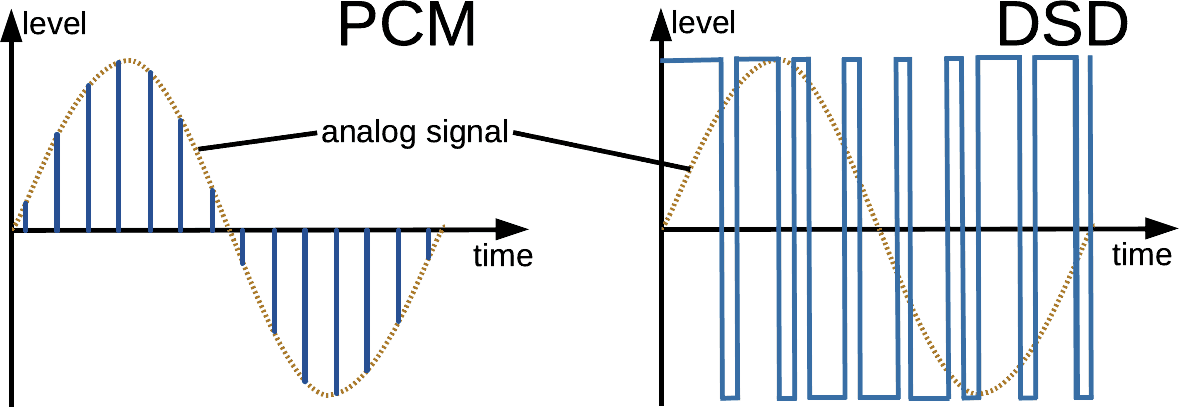
The digitization of sound is the recording of the amplitude of the signal at certain intervals and the recording of the amplitude values obtained in the form of rounded digital values.
Any computer includes a motherboard, an audio adapter (sound card).
Sound cards include: ADC (analog to digital converter), synthesizer, mixer, DAC (digital to analog converter) amplifier s, MIDI interface port for gaming devices.
To record digital sound, the ADC produces:
temporal sampling of a continuous signal (determines the value of the amplitude of the signal with the frequency necessary to recreate its original shape = twice the maximum frequency of the sound wave);
quantization by the levels of the measured signal values (determines the number of fixed values (levels, gradations) of the amplitude of the signal);
signal coding (writing in a binary number system).
The reverse operation is performed by the DAC (digital to analog converter).
Bitrate
Bit rate (bit rate): literally bits of information of the transmission rate.
The bit rate is the effective information transmission rate through the channel (the transmission rate of “useful information”, in addition to the service information) expressed in kilobits per second (kilobits per second, kbps).
In lossy compression video and audio transmission formats, the bit rate parameter expresses the degree of compression of the stream and thus determines the size of the channel for which the data stream is compressed.
P-mode compression data stream:
with constant bit rate (constant bit rate, CBR) – The required bit rate is initially set, which does not change throughout the file. It makes it possible to predict the final file size quite accurately, but it does not provide an optimal size / quality ratio for musical works, the sound of which changes dynamically over time.
with variable bit rate (VBR): the codec changes the value of the bit rate based on the desired quality level according to the psychoacoustic model. It offers the best quality of the output file, but its size is unpredictable (it may differ several times).
with an average bit rate (ABR): a hybrid of constant and variable bit rates: the user sets the bit rate in kbit / s and the program varies it within certain limits.


