
The rule of thumb for choosing the sampling frequency … of signals in data acquisition systems.

Information that constantly changes over time is analog information. Computers are digital devices and therefore, to work with information, they must receive information converted from analog to digital format.
The concept of analog-to-digital conversion is simple in principle: an analog-to-digital converter (ADC) samples (samples) the input analog signals at a specific frequency and converts each sample into a digital code, and then transfers these codes to a computer to represent a time-varying analog signal. signal.
A similar process is used in hardware data acquisition and control systems, where analog signals need to be isolated at the physical layer. Signal isolation is often required to eliminate grounding and noise problems, in such situations “sampling” (signal sampling) is used to carry the analog signal across a physical barrier.
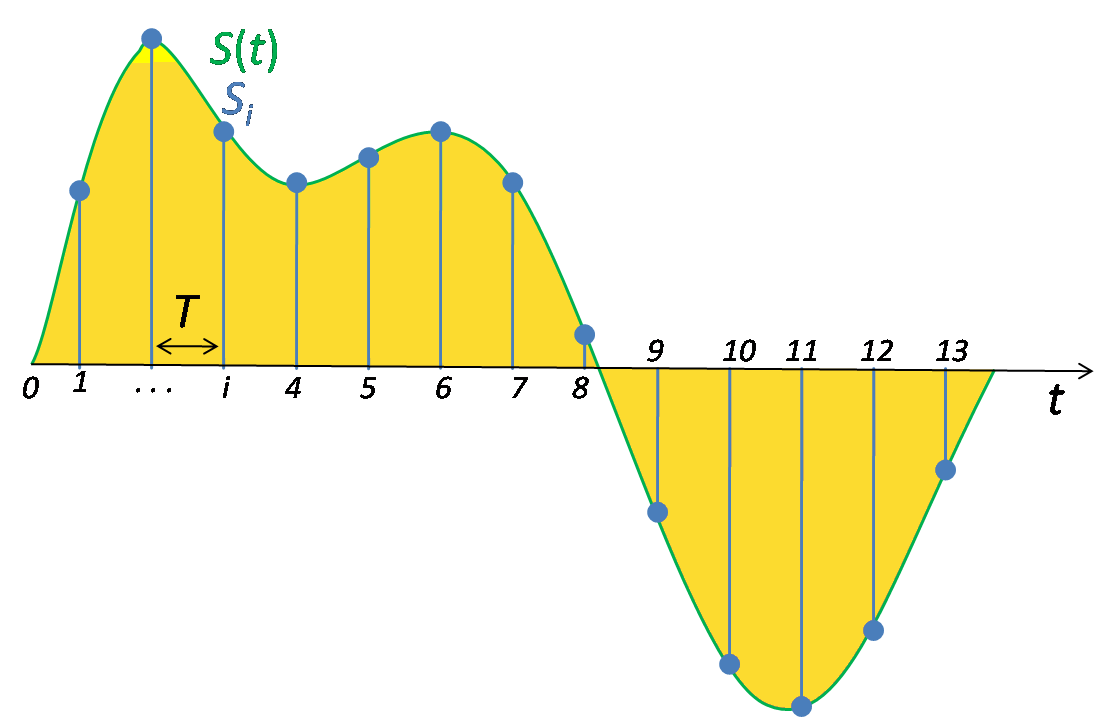
Regardless of where sampling is used, you must choose the correct sample rate. The signals reconstructed from these samples must adequately represent the original analog signal. Obviously, too slow sampling (for example, a 10 Hz signal polled every 30 minutes) can result in the loss of valuable information, while too fast sampling (a 10 Hz signal polled at 300 MHz) will create serious circuitry. Problems. Fortunately, there is an answer to the question about the sample rate. Figure 1 shows a typical sampling process.
Regardless of its original characteristics, data in modern collection systems is stored digitally. Therefore, the analog information must first be converted to digital format using an analog-to-digital converter (ADC). In this type of system, the sampling frequency MUST be higher than the highest frequency contained in the input signal. This is not a wish, but a law! In fact, the Nyquist test (part of the law) requires that we sample at a rate at least twice as high as the highest frequency in the signal fed to the ADC. This is to avoid creating aliases, which can cause serious errors.
(Original signal (a), sample signals (b), input signal samples (c))
The Nyquist criterion defines the minimum sampling frequency required to obtain meaningful information about the content of the signal’s frequency properties. Fourier analysis provides the tools necessary to obtain the relationship between the amplitude of each frequency component and a given waveform. Given this information and the correct processing of the signal, it is possible to ensure the restoration of the original amplitude and shape of the original signal in time (time domain).
Typically, software products are designed to display time-domain data in its original, raw form. As a result, sinusoidal waveforms can be distorted by triangular shapes. This is a presentation problem, not a raw data problem. In these cases, the accuracy of the representation can be improved by using a sample rate that does not meet the Nyquist criterion.
Sometimes the basic physical properties of the input converter determine its maximum frequency response. In other applications, the Nyquist criterion is implemented by applying a low-pass filter to the input of the ADC to block out unwanted high frequencies. In either case, all signal frequencies above half the sample rate must be attenuated so that they are below the ADC quantization step.


