How to play “high resolution sound source” using a PC?


Free Download Mp4Gain
picture

How to play “high resolution sound source” using a PC?

High-Resolution Audio

What kind of audio equipment do you use when listening to music at home?

HiRes Audio


Until a long time ago, it could have been a component stereo or a CD / MD radio cassette player, but today, I believe that music data is often imported to mobile players such as PCs and iPhones / iPods for listening. So this time, I would like to introduce you to how to play “high resolution sound sources” that make it easier to listen to higher quality music on a PC. When it says “high resolution playback on a PC” it seems like some difficult adjustments are required, but now the threshold is not that high and you can easily play high quality music with a simple device. (* Of course, if you try to master it all, the equipment will be expensive and a little difficult story will come out …) Here, basically, aiming at those who want to play “high resolution sound source” on a PC for the first time . I will speak from the beginning. Regarding high-resolution audio sources, the first column, “What is a high-resolution audio source that brings sound quality close to recording quality?” I would appreciate if you could read. First of all, why not experience superior sound quality than CDs on your regular computer?

Equipment required to reproduce “high resolution sound sources” with a PC

This is a system that inputs analog audio signals from a USB DAC (mainly stationary type) to an amplifier with an RCA cable and outputs them from a speaker. If the USB DAC has a built-in amplifier, it is possible to bypass the amplifier (see connection example 2).

To play high-bit / high-sample high-resolution audio sources on a PC, there are some devices that need to be freshly prepared. That’s the device named USB DAC (Yuesubi Daku) in Connection Example 1. This is a device that has the function of converting a digital signal output from a PC via USB cable into an analog signal (D / A conversion) and has a great effect on the sound quality. Currently, in addition to basic functions such as USB DAC, each manufacturer sells various products, such as those with built-in amplifiers (including headphone amplifiers) and products that can perform A / D as well as D / A, The price is widely sold from various thousands of yen to more than one million yen.

Also, to audition with headphones / earphones only as in connection example 2, you can use a portable headphone amplifier (Potaan) with a USB DAC function to build a simple and compact high-resolution playback system. With this system, you can enjoy high-resolution audio sources even on the go. See also the following columns for Potaan and headphones / earphones.
■ Potaan: 12th “Challenge high resolution playback easily with the” Potaan “theme!』
■ Headphones: 8. Recommended for smartphones! Enjoy high-quality music with headphones! 』
■ Headphones: 4th, 5th

Why do you need a USB DAC?
So why do we need a USB DAC? Many PCs on the market today are equipped with a device called a “sound card (chip)” that converts D / A digital signals to produce sound from the built-in speakers. However, most of them only support sample rate / bit conversion up to CD quality (16 bit / 44.1 kHz). In other words, even if you play the “high resolution sound source” as it is on a PC, it will degrade to a grade of CD quality and output, and will not be able to fully bring out the appeal of the high resolution sound source. .

To avoid this, the appeal of high-resolution sound sources is achieved by taking a digital audio signal out of the PC’s USB port via a USB cable and sending the signal to a USB DAC capable of bit D / A conversion. high / high sampling You can reproduce the sound that is extracted. Also, many noise-causing devices are installed inside the PC. Therefore, it is possible to convert the signal with lower noise by performing a D / A conversion externally.

There are devices that have the same functionality as the previous one, but they are compatible with interfaces such as FireWire and Thunderbolt that are used in Mac, but not so many, and USB is now common. You can also enjoy high-resolution sound sources by substituting the audio interface used for recording in place of the USB DAC, but many products have a phone or XLR terminal as the output terminal and connect to a general audio amplifier. You need to convert it to an RCA terminal.


Free Download Mp4Gain
picture


Mp4Gain Main Window
picture


Mp4Gain Features
picture


Free Download Mp4Gain
picture

I will tell you the lies and high resolution truths │ What is high resolution?

I will tell you the lies and high resolution truths │ What is high resolution?

Hi-Res Audio

How is it different from a CD?

Hi-Res Audio

They often ask me, so I will answer first.

Does the high resolution sound source really sound?

Something good even there

What is the difference between high resolution headphones and those that are not high resolution?

There is no difference, the high resolution mark on the headphones has no meaning.

Sometimes

“Use high resolution audio equipment for high resolution audio sources.”

Listen to that.

This is a lie.

I affirm.

Strictly speaking, there are no audio devices that do not admit high resolution. (Excluding digital scenarios such as DAC and PLAYER)

This article is recommended for people like this.

Does high resolution sound really good? Those who suspect
What is high resolution in the first place? Those who say
All high resolution is hidden! Some people say that.

However, if high resolution does not make sense, that is not the case.

It’s just a personal opinion.
Of the conclusion

The high resolution analog scenario reproduction device is a hidden.
High resolution audio sources are certainly different, whether you can notice the difference or not. It makes sense.
Well, I’ll explain it to you.

What is high resolution in the first place?

Let’s look at authorized persons and general definitions.

View of Sony, a leading expert in high resolution
Sony was the first to say high resolution.

As he has seen, that high-resolution mark is a trademark of Sony.

↓ It is a mark on the top left. An example is Yamaha.
High resolution brand example

Let’s look at Sony’s explanation.

https://www.sony.jp/high-resolution/about/

Short summary

The amount of data that can be recorded on a CD is limited.

High resolution can record even sounds that do not fit on a CD.

High resolution is approximately 6 times more information than a CD.

The CDs exist for quite some time.

Is it really obsolete in the digital world?

But what is high resolution? But I do not know the strict definition.

General definition of Wikipedia
Wikipedia is not always right, but it is often not out of the ordinary.

Now, let’s ask the Wiki teacher.

Specifically, one of the sampling frequency and the number of quantification bits exceeds the CD-DA specification (44.1 kHz, 16 bits or DAT specification (48 kHz, 16 bits)) (and the other also exceeds, or the same. Grade ).

Quote: Free encyclopedia “Wikipedia”

In other words, if the amount of data is even a little greater than that of a CD, it means high resolution.

That said, I do not think the SACD and the DVDs are called high resolution, so I think it’s a bit different.

High resolution definition in Japan cited by the Audio Association of Japan
Next, let’s look at the opinions of Japan’s audio association.

<Analog system>
(1) High frequency performance of the recording microphone: 40 kHz or more is possible.
(2) High frequency playback performance of the amplifier: 40 kHz or more is possible.
(3) High frequency playback performance of speakers / headphones: 40 kHz or more is possible.
<Digital system>
(1) Recording format
: a FLAC or WAV file of 96 kHz / 24 bits or higher is possible
(2) I / F input / output
: 96 kHz / 24 bits or higher is possible.
(3) File reproduction
: The FLAC / WAV file of 96 kHz / 24 bits must be compatible.
(Self-training and rewritten can only be done with FLAC or WAV.)
(4) Processing of
Signal: 96 kHz / 24-bit or higher signal processing performance is possible.
(5) Digital to analog conversion
: 96 kHz / 24 bits or higher is possible.
3 Surely the auditory evaluation is carried out in the production or responsibility of sales.
(1) The auditory evaluation is carried out based on the evaluation criteria of each company, and the final judgment is that the product is suitable for “high resolution”.

Quote: Audio Association of Japan

What is high resolution?

What is high resolution?

Hi Res

Audio of “high resolution” and is an “high resolution” audio abbreviation, since the word “that” high (high) · Resolution (resolution) of audio data refers to. A music CD (CD-DA) is the objective of comparison of what is a “higher” resolution.

Hi RES Car Audio

Therefore, in general, the data that has a greater size and are recorded in more detail than those that are recorded on a music CD are called high resolution audio. According to the definition of the Association of Information Technology and Electronics Industries of Japan (JEITA), it is linear PCM data with a resolution greater than 16 bits / 48 kHz. Normally, the music CDs are 16 bits / 44.1 kHz and the DVD-Video linear PCM Audio tracks are 16 bits / 48 kHz, making it easy to understand sensually if it considers it as data with higher resolution and density that the music data that he usually listens. I think.

However, according to the definition of the Japan Audio Association, high-resolution audio is defined as linear PCM data and data in DSD format with a slightly higher resolution of 24 bits / 96 kHz or higher. By the way, the DSD format is a format developed by Sony for SACD (Super Audio CD), which became popular a long time ago. Then, in fact, SACD was of high resolution.

Here, the resolution is two-dimensional, considering the linear PCM data, the sound stage (= dynamic range) and the tone step (= sampling frequency) when the “sound at a given moment” is cut. The matrix, expressed as a fine stage or determined by it. Mosaic of vertical and horizontal representations of two-dimensional imaging data in pixels to look like.

For CD, 2 16 square (= 65536) Dynamic range representation of steps and 44.1k Hz (second 44100 times the sampling frequency of recording (sampling) reproducible to a height sound of approximately 20 kHz per) Therefore, these data with a resolution of 16 bits / 44.1 kHz.

For information on how to get high resolution audio sources, see this article “How to download and buy high resolution audio sources intelligently”.

Anyone can easily enjoy high resolution by car (automobile audio)

Anyone can easily enjoy high resolution by car (automobile audio)

Hi Res Automobile

Technique of use of high resolution sound sources

Hi Res automobile

It is said that a good high resolution audio sound quality, but it is, and effectiveness and high-resolution capacity for a decent introduction of the automotive audio system, such as, for example, full digital as 100 percent extraction, Also up to 100,000 A 1 million yen is required. Will finish.

However, as the portable music player walkman and the smartphone, even “feel free to” enjoy hi-res now became current, the car in the same way also the audio of the car in the way “feel free “To enjoy the high resolution that even if there is, is not it?

Here, I will write concretely how to enjoy “easy and easily” high resolution with automobile audio at the car.

At the end of 2013, Sony, an important team-related team company, launched a high resolution compatible walkman. The launch of this high-resolution walkman was one of the beginnings, and the diffusion of high-resolution audio began immediately from the perspective of hardware and software.

In particular, 2014 is sometimes called the “first year of high resolution” as the first year in which the propagation of high resolution accelerated.

After 2015, high-resolution High Walkman-end models until then have been expanded constantly, and one after another emblematic models have been launched as NW-ZX1, ​​NW- ZX2, NW-WM1A, NW- WM1Z. and important companies have been launched such as the Xperia Z series and the Galaxy S series. High resolution audio is generalized step by step, with smart phones that support high resolution audio and high resolution audio source titles are expanding gradually.

Surround sound battle is fierce

Surround sound battle is fierce

High-Res

Apple’s goal of betting on “spatial audio”, not lossless or high resolution

Hi-Res Audio

Apple’s “Apple Music” finally supports Hi-Res Audio, Lossless Audio, and Spatial Audio. First, let’s review the content

of this ad. First of all, it is important that all the songs in the catalog, some 75 million songs, are not lossy. Lossless normal sound quality can be selected from 44.1 kHz / 16 bit to 48 kHz / 24 bit. It also offers lossless high resolution of up to 192 kHz / 24-bit.

Furthermore, it revealed that it will distribute spatial audio using Dolby Atmos on Apple Music. Spatial audio is an immersive surround technology that Apple has been developing little by little for some time. Compatible with iPhone, iPad, Mac built-in speakers, and AirPods Pro / AirPods Max.

We will add this many new services at once starting in June, but the price will remain unchanged and the monthly fee will be 980 yen (for the regular plan). Personally, what surprised me the most was this behavior on a large scale.

■ Spatial audio is the “next dimension of audio”

By the way, among these new services, Apple’s strongest launch was not high resolution or lossless, but spatial audio with Dolby Atmos. When looking at press release titles, spatial audio comes first and then all catalogs are lossless.

If you show roughly the degree of stress on each track in proportion, it would be roughly 60% for spatial audio, 30% for lossless audio, and roughly 10% for high resolution. No, the high resolution may be lower. In the press release, it was only mentioned as a bonus, and I feel a bit lonely as a person involved in audio-related media.

At the same time, the promotional video released within the Apple Music app also makes spatial audio + Dolby Atmos a huge draw as “the next dimension of audio after stereo.”

Apple Music already has a promotional video for spatial audio

The songs corresponding to spatial audio + Dolby Atmos have been announced as “thousands of songs” when they are released in June. It is said that it will steadily increase after that, but the absolute number is still small.

On the other hand, lossless support covers all titles of around 75 million songs. In general, this has a greater impact on general users. And even more so because there is no additional cost.

It seems unnatural to heavily appeal to spatial audio, but it makes sense given the corresponding hardware and other conditions.

■ New AirPods do not

announced There was a rumor that the new AirPods will be announced at the same time as the new Apple Music service this time. If the rumors were correct, I also wrote a column on how to achieve lossless audio and Hi-Res Audio streaming to AirPods.

But this time, the new AirPods weren’t announced. Bluetooth streaming to existing AirPods is the same as before, and no new technology has emerged that takes advantage of high-quality, lossless sound. If you limit it to playback on iPhone + AirPods, there should be little benefit from the absence of losses.

Not that much. If you use Apple Music on your Android smartphone, there is a high chance that you can play high quality sound with LDAC or aptX HD compatible smartphones and headphones. It will bother sending salt to smartphones, headphones, and helmets made by other companies.

In the future, Apple believes that it is very possible that it will create a new technology to transmit lossless sound quality and launch AirPods with it, but so far nothing has been seen.

■ Spatial audio enhances the value of AirPods

On the other hand, for spatial audio, many of Apple’s flagship products such as AirPods and Beats earphones / headphones equipped with H1 or W1 chips, and the latest iPhone, iPad and Mac integrated speakers are used for playback.

In particular, the point is that spatial audio can be used with headphones / earphones equipped with the W1 chip. Until now, AirPods Pro or AirPods Max equipped with the H1 chip were required to reproduce spatial audio, but this time, the compatible headphones will expand to the first AirPods equipped with the W1 chip at the same time.

Of course, Apple will want to increase the profitability of Apple Music alone, but AirPods should be overwhelmingly bigger as a business. Some speculate that AirPods sales reached $ 12 billion in 2019. Increasing the added value would be judged to contribute to the overall profit expansion.

Also, when considering the future, it is important to promote spatial audio + Dolby Atmos.

What is high resolution?

What is high resolution?

“HiRes Audio”

High Resolution Sound Source is an abbreviation for “High Resolution Audio” and is defined as high quality sound source data with more information than a CD.

High-Res Audio

* 1 The
Music recorded in the studio is recorded by cutting a portion of the data to burn to a CD.
Since the high-resolution sound source is a sound source that records the recorded data as is without cutting it, you can experience the atmosphere of the studio and even the breath of the artist.
High-resolution audio sources can be downloaded from a dedicated distribution site or purchased as data saved to a USB stick, DVD, etc.

Difference between CD sound source and high resolution sound source
High resolution sound source file format
Enjoying a High-Resolution Sound Source

Difference between CD sound source and high resolution sound source
Now, I will explain the specific difference in the “amount of information” between a CD sound source and a high resolution sound source.
Music files, such as CD sound sources and high-resolution sound sources, are digitized original signals (analog sound sources).
This job is created using the “sampling” and “quantization” steps, and its values ​​are expressed in units of “sample rate (Hz)” and “number of quantization bits (bit)”.

“Sampling” that determines the width of the range
“Sampling” is expressed by the number of times the original signal is digitized in one second.
In the case of a CD, it means that you are recording at a speed of 44.1 kHz = 44,100 Hz per second, that is, 44,100 times (Fig. 1).
When it comes to high-resolution audio sources, the sample rate increases, so more data can be collected (Fig. 2).

“Quantization” that determines the fineness of the volume
The “quantization” digitizes the changes in the volume of the sound and, in the case of a CD, the original signal is decomposed into 16 bits (2 to the 16th power = 65,536) and recorded (Fig. 3).
If this number of bits is low, small sounds will be treated as noise, but as the number of bits increases, details will be reproduced exactly as “sound” (Fig. 4).

Reproducibility determined by “sampling” x “quantification”
The results of combining the vertical “sampling” line and the horizontal “quantizing” line are shown in Fig. 5 and Fig. 6. By comparing the CD sound source (Fig. 5) and the sound source high resolution (Fig. 6), it is evident that the high resolution sound source has a curve closer to the current signal.
In this way, the higher the sample rate and the number of quantization bits, the higher the sound quality of the original song in the studio and the more realistic and airy it can be expressed on a CD.

High resolution sound source file format
Now, I will explain the specific difference in the “amount of information” between a CD sound source and a high resolution sound source.
Music files, such as CD sound sources and high-resolution sound sources, are digitized original signals (analog sound sources).
This job is created using the “sampling” and “quantization” steps, and its values ​​are expressed in units of “sample rate (Hz)” and “number of quantization bits (bit)”.

WAV if you are interested in sound quality, FLAC if you also want convenience
WAV is an advantageous format in terms of sound quality because it converts the sound source into data without compressing it. However, consequently, the data capacity will be very large.
Also, you cannot write metadata such as cover photos and artist names.
FLAC, on the other hand, is called lossless compression, which applies compression processing when converting data, but is a mechanism for playing while restoring the original sound source state during viewing.
Therefore, the data capacity can be reduced to about half that of WAV.
Generally, it is said that there is no change in sound quality due to compression / restoration, but there is an opinion that the WAV (uncompressed) sound source sounds better because there are fewer processing steps.
It is also attractive that FLAC can write metadata such as cover photos and even display lyrics.

We recommend buying WAV if you are interested in sound quality and FLAC if you are also looking for convenience. However, a specific player application is required to play high-resolution audio sources.

What is high resolution sound source and high resolution support?

What is high resolution sound source and high resolution support?

Hi-Res AUDIO

Easy to understand explanation of “meaning and difference”

High-Resolution Audio

The word “high resolution” is often found in new audio-related products, such as digital audio players and headphones. What does it show exactly? Is it possible to hear high resolution with the minicomponent system that I am using now? Let me explain the basics to you. At the same time, let’s introduce Sony’s high-resolution headphones and earphones, as well as recommended players.
High resolution means “high quality equipment and sound source”
“High Resolution” is an abbreviation for “High Resolution Audio”.
Translated into Japanese, it means “high definition, high resolution audio”, but if you roughly correct it in an easy-to-understand way, it is not a mistake to think that it is audio with a higher sound quality than above.

Audio is enjoyed by combining a device (hardware) for playback and a sound source (software) that is the music itself, but there are devices that support high resolution and sound sources recorded in high resolution.

Since the word high resolution itself is almost synonymous with “high sound quality”, it is difficult to understand the range that will be displayed, but many of today’s audio devices have a high resolution logo and you can tell at a glance which is a compatible high resolution product …

This is the high resolution definition decided by the Japan Audio Association, which is an industry group, that is, the logo displayed on audio equipment that meets the required specifications.
If you choose a product with this high resolution logo, you can enjoy high resolution.

This high-resolution logo is displayed on audio equipment that meets the definition set by the Japan Audio Association and serves as a guide for product selection.

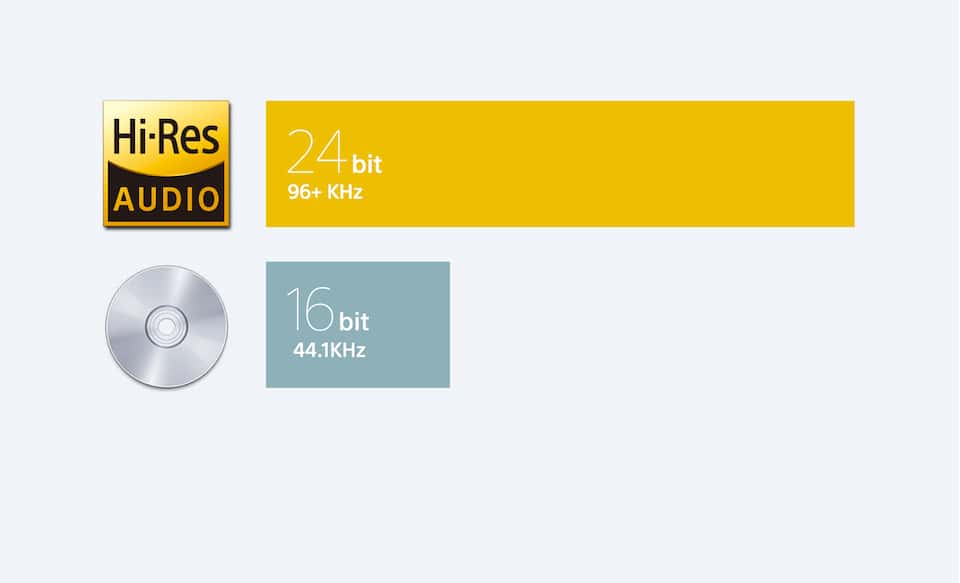
Specifically, a digital device, such as a player, can play a WAV / FLAC sound source with a sample rate (sample rate) of 96 kHz or higher and a quantization bit rate of 24-bit or higher.
Since this is the minimum standard, some logo acquisition products cover even higher levels, such as 192 kHz / 24-bit support and 384 kHz / 24-bit support.

High resolution with higher sound quality than a CD
The sample rate and the number of quantization bits are originally numerical values ​​that indicate the “fineness” when converting an analog “sound” digitally, and it can be considered that the higher these numbers, the higher the sound quality.

A CD is an easy-to-understand comparison target.
The standard for CD is 44.1 kHz / 16 bit. In other words, it is easy to think that high resolution, requiring 96 kHz / 24-bit or higher, is audio with a sound quality superior to that of a CD.

Of course, in order to enjoy a high resolution, it is necessary that “the sound source is also recorded in high resolution.”
It is possible to play sound sources other than high resolution, but the sound quality is basically the same as non-high resolution. Currently, Hi-Res Audio sources can be purchased through Music Distribution.

How to play “high resolution sound source” using a PC?

How to play “high resolution sound source” using a PC?

Hi-Res audio

What type of audio equipment do you use when listening to music at home?

Until a long time ago, it could have been a component stereo or CD / MD radio cassette player, but today, I believe that music data is often imported to mobile players like PC and iPhone / iPod for listening. So this time, I would like to introduce you to how to play “high resolution sound sources” that make it easier to listen to higher quality music on a PC. When I say “hi-res playback on a PC”, I feel like some difficult adjustments are required, but now the threshold is not that high and high-quality music can be easily played with simple devices. (* Of course, if you try to master it all, the equipment will be expensive and a bit difficult story will turn out …) Here, basically, aiming at those who want to play “high resolution sound source” on a PC for the first time . I will speak from the beginning. Regarding high-resolution audio sources, the first column, “What is a high-resolution audio source that brings sound quality close to recording quality?” I would appreciate if you could read. First of all, why not experience superior sound quality than CDs on your regular computer?

Equipment required to reproduce “high resolution sound sources” with a PC

This is a system that inputs analog audio signals from a USB DAC (mainly stationary type) to an amplifier with an RCA cable and outputs them from a speaker. If the USB DAC has a built-in amplifier, it is possible to bypass the amplifier (see connection example 2).

To play high-bit / high-sample high-resolution audio sources on a PC, there are some devices that need to be freshly prepared. That is the device named USB DAC (Yuesubi Daku) in Connection Example 1. This is a device that has the function of converting a digital signal output from a PC via USB cable into an analog signal (D / A conversion) and has a great effect on the sound quality. Currently, in addition to basic functions such as USB DAC, each manufacturer sells various products, such as those with built-in amplifiers (including headphone amplifiers) and products that can perform A / D as well as D / A, The price is widely sold from various thousands of yen to more than one million yen.

Also, to audition with headphones / earphones only as in connection example 2, you can use a portable headphone amplifier (Potaan) with a USB DAC function to build a simple and compact high-resolution playback system. With this system, you can enjoy high-resolution audio sources even on the go. See also the following columns for Potaan and headphones / earphones.

Why do you need a USB DAC?

So why do we need a USB DAC? Many PCs on the market today are equipped with a device called a “sound card (chip)” that converts D / A digital signals to produce sound from the built-in speakers. However, most of them only support sample rate / bit conversion up to CD quality (16 bit / 44.1 kHz). In other words, even if you play the “high resolution sound source” as it is on a PC, it will degrade to the level of CD quality and output, and will not be able to fully bring out the appeal of the high resolution sound source.

To avoid this, the appeal of high-resolution sound sources is achieved by taking a digital audio signal out of the PC’s USB port via a USB cable and sending the signal to a USB DAC capable of bit D / A conversion. high / high sampling You can reproduce the sound that is extracted. Also, many noise-causing devices are installed inside the PC. Therefore, it is possible to convert the signal with lower noise by performing a D / A conversion externally.

There are devices that have the same functionality as the previous one, but they are compatible with interfaces such as FireWire and Thunderbolt that are used in Mac, but not so many, and USB is now common. You can also enjoy high-resolution sound sources by substituting the audio interface used for recording in place of the USB DAC, but many products have a telephone or XLR terminal as the output terminal and connect to a general audio amplifier. You need to convert it to an RCA terminal.
What is the “high resolution audio” you often hear on music devices? What are the benefits? [Explanation]

What is the “high resolution audio” you often hear on music devices? What are the benefits? [Explanation]

High-resolution audio

More and more music players, headphones, earphones, and recently televisions and sound bars (speakers with amplifiers) claim to support “high-resolution audio.”

Hi-Res Audio

What exactly is “high resolution” on these sound devices? What are the benefits of Hi-Res Audio when listening to music?

“High resolution” was originally a personal computer term

The word “resolution” may have come to the fore, but high resolution was originally a term used to indicate that a computer can display a screen with a screen resolution (pixels / dot count) higher than the system standard.

The old personal computer had 640 x 400 pixels for the NEC “PC-9800 series” (now the NEC personal computer), and 640 x 480 pixels for the “PC / AT compatible”, which is the source of most of the current personal computers. It was a standard resolution. A personal computer equipped with a graphics (drawing) function that can display resolutions higher than these resolutions was called a “high-resolution personal computer.”

Currently, high resolution displays such as Full HD (1920 x 1080 pixels) and 4K (3840 x 2160 pixels) have become “natural” instead of HD (1280 x 720 pixels / 1366 x 768 pixels), so the screen resolution. “High resolution” as a term for “” has become a dead word indeed.

High resolution
A catalog excerpt from the factory “FC-H98 Model 100” personal computer that was once sold by NEC. You can see the word “high resolution mode” (Source: NEC)
commercial

The “high resolution” in sound devices is “more than a CD”
“High resolution” in sound devices is simply used as a term for sound quality that exceeds that of music CDs or DATs (digital audio tapes).

In a digitized sound source, the “sample rate” (unit: kHz), which indicates how many times a second is sampled (sample metering) when digitizing analog audio, and the “quantum”, which indicates the amount of information contained in that of the signal. the number of digitized bits (unit: bits) greatly affects sound quality. Specifically, the sample rate affects the “expressible range (pitch range)”, and the number of quantization bits affects the “volume and fineness of the sound”.

Compare the difference between bit, khz and kbps! High resolution doesn’t make sense? Part 2

Compare the difference between bit, khz and kbps! High resolution doesn’t make sense? Part 2

High Resolution Audio

If it is less than bit or kHz, it will not be high resolution.

High-Resolution Audio

However, if one of the values ​​is the same as the CD specification and the other exceeds the CD specification, it will be high resolution.

However, “96 kHz / 24 bit” and “192 kHz / 24 bit” are the main sources for high resolution audio.

Sponsorship

Over the limits of human hearing! High resolution doesn’t make sense?
What is the limit of the ability to discriminate human sounds?

Although there are individual differences, the human audible range is said to be 20 Hz to 20 kHz.

<Reference: Hearing-Wikipedia>

The sampling frequency of the CD is 44.1 kHz.

In theory, this value can be reproduced up to 22.05 kHz of the original sound, so it can sufficiently cover the human audible range.

In that case, the question arises that high-resolution sound quality, which has higher specs than CDs, may not be audible to the human ear.

Actually, there are many negative opinions from a scientific point of view, and it remains controversial.

<Reference: High Resolution Audio-Wikipedia>

However, the sound is highly dependent on experience, so if you are interested, you should give it a try.

Necessary environment to enjoy high resolution
Whether it makes sense or not, there are a few things you need to prepare for to enjoy high resolution.

The required environment is as follows.

High resolution sound source
High-resolution compatible headphones / earphones / speakers
High resolution compatible terminal
Let’s explain each environment.

High resolution sound source
There are various media for high resolution audio sources.

The easiest of these is probably the Hi-Res Audio source that is delivered online.

If you are a high resolution distribution site, you can get many sources of sound.

Note that listening with high-resolution headphones will not result in high-resolution audio.

High-resolution compatible headphones / earphones / speakers
In addition to high-resolution audio sources, prepare items such as compatible headphones and earphones.

It is quick to check if there is a high resolution mark on the product package to see if it is compatible.

Please note that most wireless headphones do not support high resolution playback because they compress data during transmission.

In the case of wireless technology, only aptX / aptX HD compatible items or SONY LDAC compatible devices support high resolution.

In any case, the high resolution brand is a milestone.

High resolution compatible terminal
In the case of the iPhone, it does not support the output of high-resolution sound sources.

Therefore, it is necessary to prepare a headphone amplifier equipped with a DAC that supports high resolution.

In the case of Android, there are terminals that support high resolution such as Xperia.

To enjoy high-resolution sound quality, you need to check whether the terminal that plays music is also compatible.