About the maximum bit rate of the audio lossy compression format


Free Download Mp4Gain
picture

About the maximum bit rate of the audio lossy compression format
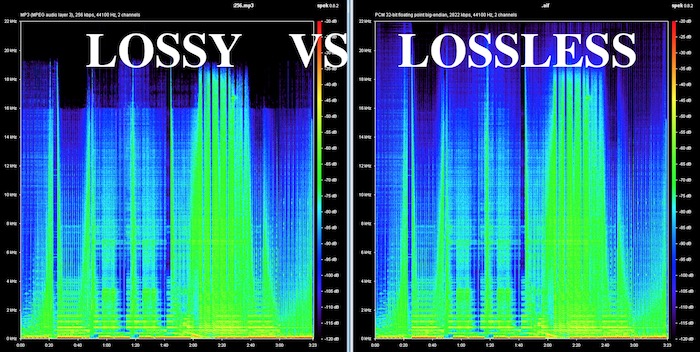
Lossy Audio

According to him
standard [MP3], the maximum bit rate is set to 320 kbps.

lossy audio

MP3 compresses audio into units called frames. A frame is determined to have 1152 samples, and if the sample rate is 44.1 kHz, a frame is 1/44 100 x 1152 ≒ about 0.026 seconds.
MP3 can take any of the 14 default types of bit rate values ​​(32,40,48,56,64,80,96,112,128,160,192,224,256,320kbps for MPEG1) for each frame, and all frames have the same bit rate. It’s called CBR (Fixed Bit Rate), and what’s different for each frame is called VBR (Variable Bit Rate).
Therefore, the maximum bit rate is 320 kbps for all frames in CBR and the highest sound quality is achieved.

Also, the lame encoder can create MP3s of up to 640kbps for CBR only by its own extension outside of the standard (although it should not be called MP3 strictly because it is not standard). Of course, since it is out of the standard, only a small part of the software can be played. With MP3s, which are the best selling point for their versatility, messing them up may not be a good idea.

[AAC]
The upper limit of the standard is
264.6 x 2 = 529.2 kbps (in the case of 44.1 kHz 2 channels)
288 x 2 = 576 kbps (48 kHz) for 2 channels)
However, it appears that the actual encoders are “up to 256 kbps per channel” (512 kbps for 2 channels).

However, there are some strange programs for beginners like iTunes, x-app, Media Go, etc. which set the upper limit of the AAC bit rate at 320 kbps. Because of this, it seems that there are quite a few beginners who think that AAC has a maximum of 320 kbps like MP3 ^^; well maybe it’s just MP3. ・ ・ ・ Well actually 320 kbps is enough.

[Ogg Vorbis]
It seems that the upper limit is not set in particular by the standard, but in the current general encoder, it appears to be “up to 256 kbps per channel” (512 kbps for 2 channels).

[WMA] It
very difficult to understand, and personally I don’t want to use it at all, so I haven’t researched it in detail, so it may be wrong …

Microsoft’s WMA encoder has a profile (like a preset), and it basically converts according to it, but the variety of profiles is kind of weird. The profile commonly used in the WMA9.2 Std format appears to be a mysterious specification offering up to 320 kbps at 44.1 kHz, but only up to 192 kbps at 48 kHz.
Perhaps because of this, some software unifies both up to a maximum of 192kbps, and there is a section where many people think that it is a WMA standard.

320 kbps (for 44.1 kHz, 16 bit, 2 channels), 192 kbps (for 48 kHz, 16 bit, 2 channels) for normal WMA 9.2 format, 440 kbps (for 44.1 kHz, 24 bit, 2 channels ), 256 kbps (44.1 kHz, for WMA10Pro format) 16 bits, 2 channels) seems to be the upper limit (at least we could build it up to that point). Even CBR looks like this, so I’m not sure what the maximum bit rate of each frame is for VBR (which has 1-step and 2-step encoding) so I don’t know the details.

Some conversion tools that support multiple formats use FFmpeg for WMA encoding. The WMA encoding feature included in FFmpeg is based on the old WMA8, so it may be different from the above. I do not want to look for it and it is better not to use it.


Free Download Mp4Gain
picture


Mp4Gain Main Window
picture


Mp4Gain Features
picture


Free Download Mp4Gain
picture

The Truth About High Bitrate Lossy Compression

The Truth About High Bitrate Lossy Compression

Lossy compression

In the understanding of most people, the word music lover is most often associated with a person who not only loves and collects music, but also appreciates high-quality music, and not only in artistic and aesthetic terms. but also the quality of the recording. of the phonogram itself. Just think, a few years ago, an audio CD was considered the standard for music quality, whereas a computer, even in dreams, could not compete with the quality of a CD. However, time is a great joker and he often likes to turn things upside down. It would seem that quite a long time passed, one or two years and … that’s it, the CD on the PC went into the background. Don’t ask “why?” You know the answer to this question yourself. Everything is to blame for the revolution in the world of sound on a computer: audio compression (hereinafter referred to as audiolo compression which means lossy compression to reduce the size of the audio file), which made it possible to store music on the hard drive, lots of music! In addition, it was possible to exchange it over the Internet. New sound cards have been released, capable of squeezing almost studio quality out of a piece of hardware that seems useless in terms of music. Nowadays, even having a computer that is not very smart in performance, having bought a Creative SoundBlaster Live! and remembering that since Soviet times there is a good amplifier and good acoustics, you will get nothing but a high-quality music center, the sound of which is inferior only to very expensive audio equipment (average or even the highest hifi category ). Add to this the general availability of music files and you understand that you have the power at your fingertips. And then there is a revolution, and you understand that a compact disc is no longer so convenient, you are fascinated by something completely different: the magic signs of the “MP3”. You cannot eat or sleep; At first glance, the “chicken and egg” question is insoluble: how to “squeeze” and, most importantly, how to “squeeze” …

This is where I will help you. This article is the beginning of my new series of informational materials on music on the computer. For over a year developing OrlSoft MPeg eXtension and maintaining an extensive database of MP3 files, I have accumulated a great deal of research on audio compression. It is these studies that I will try to share with you. Several respected authors have written many articles on audio compression, so I will try not to write what I can easily find in other sources of information. I would like to express my position on the subject under discussion simply and clearly. We will not consider audio compression to be as compact a tool as possible put audio information on your hard drive (so that you can record so many hours of music there). Yes, compression allows you to record music more compactly, but my goal is to minimize quality loss by converting “pure” audio to compressed audio. This is why only high bit rates and qualitatively compressing encoders are considered in these modes. So it is much more convenient to work with compressed audio – instant access to any track from any album, convenient software for playback. And, of course, the financial issue has not been forgotten either.

Of the audio compression formats that exist today, three deserve attention, in my opinion: MP3 (or MPEG-1 Audio Layer III), LQT (as representative of the MPEG-2 AAC / MPEG-4 family) and the completely new OGG format (Ogg Vorbis) developed by a group of enthusiasts:

MP3 is by far the most widely used of these (mainly because it is free). Let me remind you that it was thanks to the MP3 format that the victorious procession of compressed audio took place. However, as is often the case with pioneers, little by little it is losing ground and giving way to new and better formats.
The second format, LQT, is a representative of a new direction of audio coding algorithms, a representative of the AAC family. This is a fairly high quality, but commercial and highly classified format.
OGG became widely known to the public this summer and is currently developing rapidly, soon (with the release of the Encoder and Decoder) it should beat MP3 with better sound quality with smaller file size.
I will not give a detailed description of technologies and formats here, you can easily find them yourself. There will only be facts, conclusions and recommendations. I plan to present my research separately for each format in separate articles.