What is the difference between “high resolution”?
What are the advantages and disadvantages?

The keyword “high resolution” suddenly increasing its presence due to the proliferation of downloadable sound sources.
Even if you know that “high resolution” = “high sound quality”, there are not many people who really understand what is different from the conventional.
In this article, I will introduce how to listen to Hi-Res from the difference between “Hi-Res” and conventional sound.
What is high resolution?
High Resolution is an abbreviation for “High Resolution Audio” and means a high resolution sound source.
High resolution is used here to refer to “a digital sound source with an amount of information that exceeds the sound quality of a CD.”
So what does it mean to be a “digital sound source that exceeds the sound quality of a CD”?
High resolution sound source definition.
The sound quality of a digital sound source is determined by how accurately it is converted into a digital signal. The more information there is, the better the sound quality.
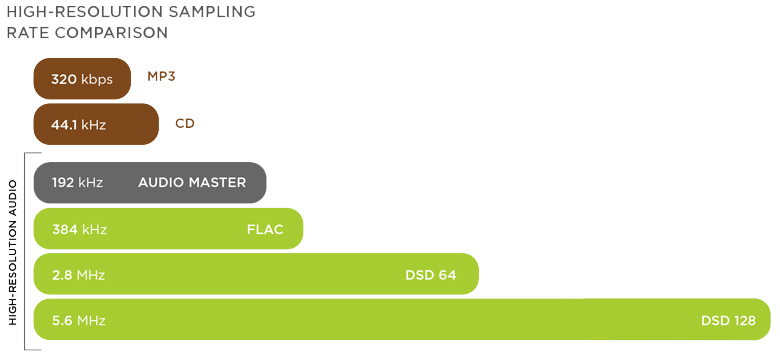
A sound source that can be called high resolution requires that the “sample rate” and “bit depth” exceed the level of the CD. I think it is an unknown word, so I will briefly explain this point.
The sound source on the CD has a “sampling rate of 44.1 kHz/s” and a “bit depth of 16 bits”.
“Sample rate” refers to “the amount of information divided per second,” and the higher the number, the smoother the sound.
On the other hand, “bit depth” refers to “data capacity per information divided”, and the larger the number, the greater the expressiveness of the sound.
Also, there is a unit called “bit rate (kbps)” when importing a CD or selecting sound quality with a streaming service.
This is the product of “sample rate”, “bit depth” and “number of channels (monaural = 1 / stereo = 2)”, and is a unit that expresses the goodness of the sound quality. Likewise, the higher the number, the higher the sound quality.