
We are currently testing Marshall London, the first smartphone from the famous English amplifier brand. It has a dedicated audio chip (Cirrus Logic WM8281), which in theory is capable of transcribing HD music with 24-bit coding and a maximum sampling frequency of 192 kHz. Audio files are happy to read these tracks, which have nothing to do, in theory with a compressed MP3 or audio CD with a 16-bit definition sampled at 44.1 kHz. But do we really need HD audio? Do you really notice a difference with standard files in practice?
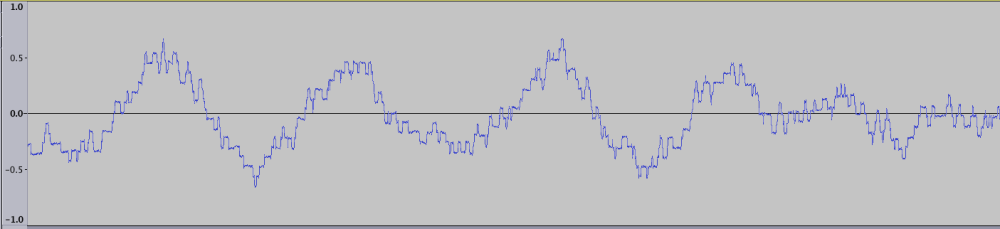
Before you go into the details of the case, a little physical explanation is required. Sound is a vibration that is propagated in the form of waves and that people feel through the ear. Young people are often said to be able to pick up sounds at a frequency between 20 Hz and 20,000 Hz. The older they get, the less they hear the top of the spectrum (hence the treble). To record music, you need to capture these vibrations and even the fastest (sharpest).
TESTING AND HERTZ
This is where the term sampling comes in. For convenience, sampling is the amount of information retrieved in a second when digitizing an audio signal. The unit is Hertz: a Hertz means to retrieve information per Second. On an audio CD, the sampling is 44.1 kHz, which means that we will be able to collect 44 100 times per minute. The second vibrations and therefore, in theory, a high-pitched sound with a maximum frequency of 44.1 kHz. But it gets a little trickier as you have to record a sound with a frequency of 20 kHz, you have to double the sampling frequency (according to the Nyquist-Shanon sampling theorem), which produces 40 kHz. When creating the audio CD, Sony decided to increase it to 44.1 kHz to leave some space and be compatible with the video standards of the time.
DEFINITION IN BITS
As for the definition of music, it is expressed in bits and corresponds to its coding. In fact, it is the number of numeric values that can exist between an inaudible sound and the loudest sound. At 16 bits, each sample (44,100 with 44.1 kHz sampling) can take 65,536 different volume values. With 24 bits, that number rises to 16,777,216 different values. The 24-bit definition has long been considered useful only for working on music to avoid loss of manipulation. In fact, one can think that with the 65,536 different 16-bit values, this definition is enough to listen. This is not necessarily true, as this figure is used only under ideal conditions and when the unit volume is maximized.
MORE HERTZIOS = BETTER QUALITY?
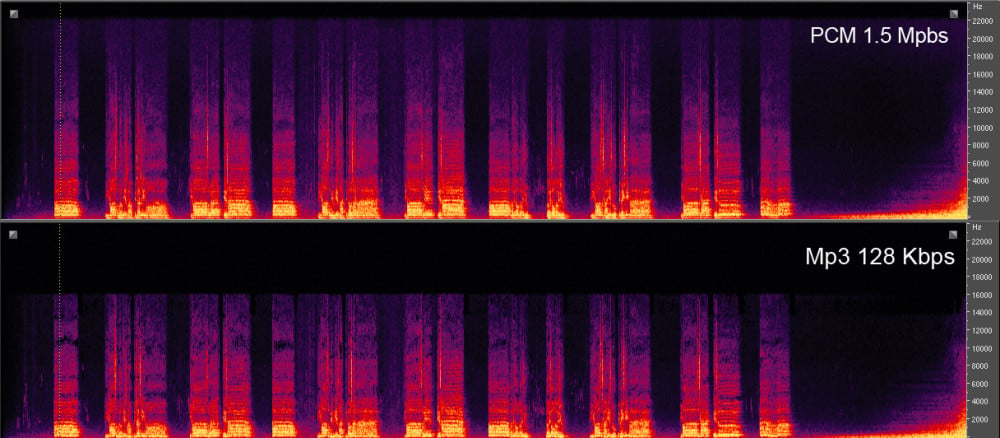
First, let’s look at the sample. On some media such as DVD-Audio or streaming / download platforms such as Qobuz, it is possible to enjoy 192kHz sampled music. Each music frequency is captured 192,000 times per Second, it is theoretically possible to record and transcribe a sound with a frequency of 96 kHz, well above the theoretical hearing limit, set to 20 kHz. So what’s the point of capturing the sound “so far”? Some people think they can hear sounds above 20 kHz. Others find that the harmonics of the instruments (which rise very high in frequencies) should be preserved for a more natural sound, even if the ears do not hear them directly.
A few months ago, the Le Monde site conducted an interesting experiment by blindly listening to two different versions of the same uncompressed song: in 24-bit / 96 kHz and in 16-bit / 48 kHz. Three famous musicians heard the piece (an audio technician, a pianist and a jazzman) blindly in an attempt to discern the difference in two portable players sold for 1,000 euros, a Sony and an Astell & Kern with Sennheiser HD650 headphones. In the end, it was impossible to distinguish the HD song each time from the standard version each time. Maybe with a team of tens of thousands of euros, this would have been possible, and even more … Jazzman Médéric Collignon also clarified: “If there’s a difference, it’s really small. At least I don’t like HD version. “

