The best YouTube video format


Free Download Mp4Gain
picture

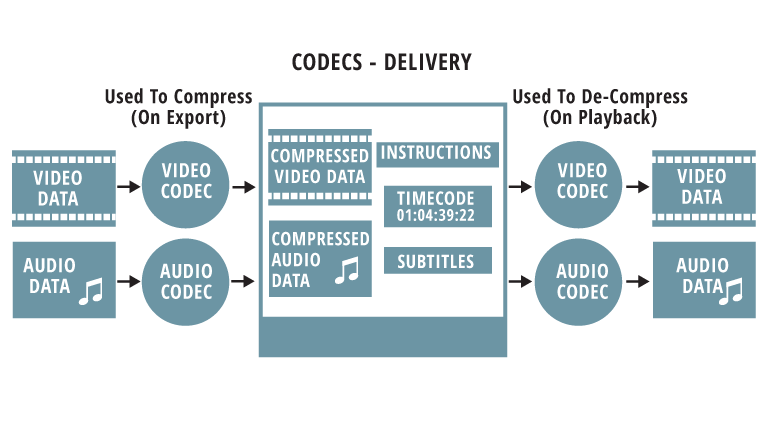
The best format for YouTube videos is codec. The codec is the part of the software that deals with the encoding and decoding of the information that make up the transmission of audio or video. The newer codecs also deal with compression and decompression. Therefore, when coding and decoding the signal, they use mathematical algorithms that can save space at the cost of quality.

HD video

compression

When playing video files, compression is performed using mathematical functions that reduce the number of frames per second or the resolution of the pixels that make up the image. In audio files, compression is done by removing the frequencies that cannot be fully perceived by the human ear and the number of bits that make up the sound information.

Container

The best option for the extension is mp4. The frame rate should match the recorded and edited one. The most popular container formats are MKV or AVI.
codec

Video formats

Youtube uses the HD 1080p streaming format and MPEG-2 Steam supports the DVD format and is saved with an .MPG extension. If you cannot send the video in MPEG-2 format, select MPEG-4 format.

MPEG-2
Audio codec: MPEG Layer II and Dolby AC-3
Audio bit rate: 128 kbps or higher
MPEG-4
Video codec: H.264
Audio codec: AAC
Audio bit rate: 128 kbps or higher

Minimal audiovisual duration

The minimum duration is 33 seconds, excluding black and static images on the video channel and silence and background noise on the audio channel.

Frame rates

Videos must have the native frame rate without resampling. For film originals, a progressive master with 24 or 25 frames per second delivers the best results. Frame rates are typically set at 24, 25, or 30 frames per second.

It is not advisable to use resampling techniques as they vibrate the images and often result in poor video quality. Examples: Sampling and transmission like “Telecine Pulldown”.

Dimensions

Videos must use native aspect ratios, and uploaded videos should never contain the black letterbox and pillarbox stripes. The YouTube player uses frames that allow you to view videos correctly without cutting or stretching images.

Video resolution

YouTube wants high-definition videos.

For videos intended for sale and rental, you must specify a minimum resolution of 1920 x 1080 with an aspect ratio of 16: 9.
YouTube does not require a minimum resolution for free content or advertising content, but recommends a resolution of at least 1280 x 720 for videos with an aspect ratio of 16: 9 and a resolution of at least 640 x 480 for videos with an aspect ratio. 4: 3.
If the videos are of poor quality, they will not be visible to the public on YouTube and will be used as a reference for the content ID. These videos generally have a “quarter” (320 x 240) resolution. However, the videos must contain more than 200 lines to create effective references.

Bit rate

The bit rates depend on the codec. This is the number of bits per unit of time (attention! We are talking about bits, not bytes), which is generally measured in kilobits per second. With more format, the quality or resolution of the film or audio, the higher the more information per second. Videos should be optimized based on frame rate, aspect ratio, and resolution, not bit rate.


Free Download Mp4Gain
picture


Mp4Gain Main Window
picture


Mp4Gain Features
picture


Free Download Mp4Gain
picture

WMA – Everything about WMA (2)

Windows Media Audio Professional: Also known as WMA Pro is a more advanced WMA-based lossy codec. Like traditional WMA it has a 24-bit sample size but uses a maximum sample rate of 96000Hz, instead of 48000 from WMA, and up to 8 channels (thus enabling 7.1 sound) instead of 6 from WMA. It also incorporates DRC (dynamic range compression). In addition, as of version 9 of WMA Pro there is a version of WMA Pro with low bitrate and another with low delay for bidirectional applications.

Despite being superior to WMA and belonging to the giant Microsoft WMA, it has little commercial support. Except for the products of Microsoft Xbox 360 (video game console) and Zune (portable player) and the latest Toshiba and Motorola mobiles, few other systems can play it. This situation is expected to change when WMV HD (Windows Media Video High Definition, a high-resolution video codec) is standardized, as WMV HD incorporates WMA Pro as an audio codec.

Windows Media Audio LossLess: Typically known as WMA LossLess is a lossless codec for audio that is therefore in direct competition with other lossless encoding systems such as FLAC, Monkey’s Audio, or Apple LossLess. To achieve this lossless encoding, a 96Khz sample rate, a 24-bit PCM sample size and a variable bitrate are used depending on the complexity of the section to be encoded. It also provides up to 6 independent channels, so you can get 5.1 surround sound (5 speakers with one audio channel each plus a special channel for lower sounds that are played on a special speaker called a subwoofer). It achieves a compression of 50% on the original audio file (in CD-Audio format), although Microsoft (its creator) states that this compression can be up to 66% (that is, the resulting file would have a size that would be 33% of the original). An interesting feature is that WMA LossLess incorporates Dynamic Range Compression (DRC), which is a technique that aims to control the volume of the audio signal. Specifically, the volume of sounds with high volume (above a threshold) is reduced, and sounds with low volume are left as is. This is done because in noisy environments, if the volume is low, the low volume sounds are inaudible, while if the volume is high, the low volume sounds can be heard but the high volume sounds will be heard with an annoying volume. Thanks to DRC the high volume and low volume sounds can be heard at the same time, since the volume of high volume sounds is reduced but not the volume of low ones, then the general volume can be increased to a point where both are Audible and loud speakers are not annoying. Furthermore, this reduces the dynamic range of the signal.

Windows Media Audio Voice: It is a voice-specific lossy compression format that was born to compete with existing ones such as CELP (Algebraic Code Excited Linear Prediction), Speex (freely distributed), G.711 or G.729. Like all voice codecs, they are designed for very low bitrates and for a bandwidth between 300 and 3400Hz (since the highest spectrum power of the human voice is in that frequency range). This in particular allows a constant bitrate (does NOT allow variable bitrate) of up to 20Kbps, a single mono channel and a sampling rate of up to 22.05Khz. It also solves a problem that most voice codecs have: If the encoded signal contains other types of sounds besides voice (since it is assumed that if a voice codec is used, it is because it is transmitting voice), such as music, encoding is not good, as music will have a broader spectrum than voice. WMA voice solves this lack by detecting which sections contain something other than human voice (music, some kind of effect …) and encodes that section with traditional WMA.

The only version available so far, WMA 9 Voice, is used in Microsoft’s online gaming service Xbox Live, on mobile devices using Windows Mobile and on BBC internet streaming radio.