Difference between digital and analog


Free Download Mp4Gain
picture

Difference between digital and analog
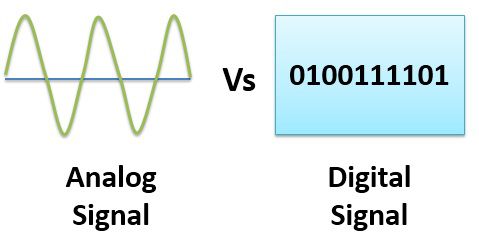
Analog vs. Digital

The sound is analog. And sound is the vibration of the air. How is this sound vibration transmitted?
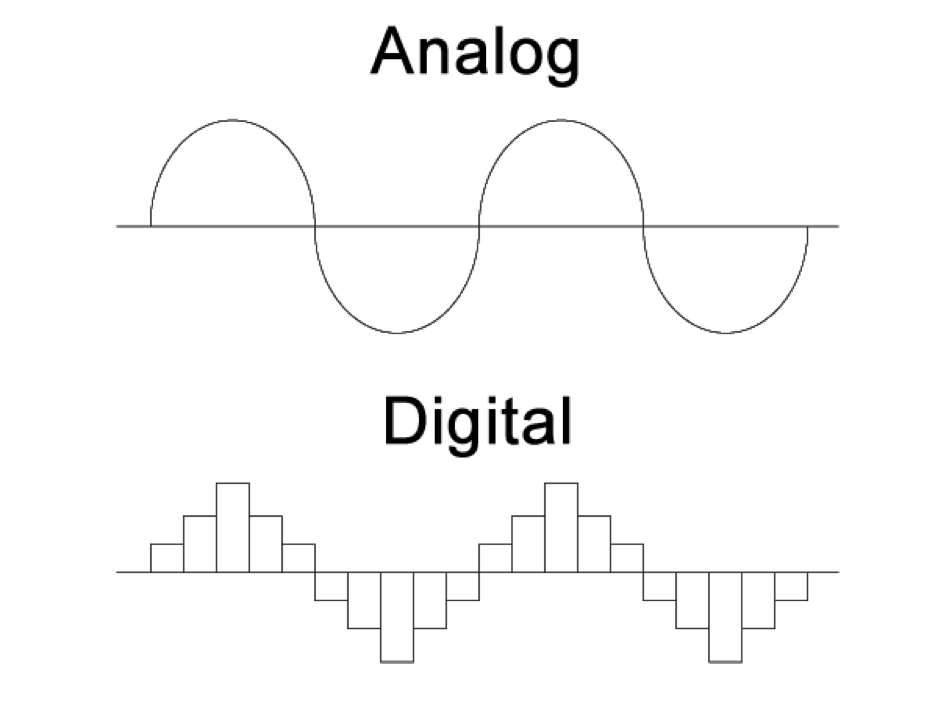
Analog vs Digital

For example, when a stone is thrown into a calm water surface, the ripples spread around it, but if
Cut in the direction of the waves and look at the cut end, the waveform is as shown in Fig.1.

Air waves spread from the point where sound is emitted even in air. Although invisible to the eye, it has a
similar waveform. This is the analog waveform of sound.

Therefore, although it is digital, when such a sound waveform is recorded or communicated by phone or wireless, as
shown in Fig. 2, the change in the analog waveform is electrically replaced with a series of numerical values ​​according to a certain promise. ..

When recording or communicating, if you handle it as analog, it is easy for noise to enter and the sound quality to deteriorate, but when trying
the waveform of the sound as digital = numerical data, you can eliminate that worry and
maintain a certain quality. You can do various processing while maintaining it.

(2) What is convenient when it is digital

Digital audio signals are convenient because they can be recorded and edited using a personal computer, for example.

In addition, 74 minutes of music can be recorded on a CD with a diameter of only 12 cm, and through digital compression processing
, music of the same length can be recorded on an MD with a smaller diameter.

Since digital signals can be compressed in this way, it is also convenient for storing large amounts of information.
Not only sound, but also video signals with a higher amount of information can be recorded and communicated at high speed through the use of compression technology.

Especially in communication, a two-way digital multiplex communication can be realized communicating multiple pieces of information with a single wire.
In addition to electrical signals, laser light can also be used for optical communication, making communication possible at extremely high speeds.

(3) What is the sampling frequency?

Digital signals are processed at predetermined fixed time intervals.
The sample rate (sample rate) indicates how many times a second is processed and is expressed as Fs or fs.

The sampling frequency unit is Hz (Hertz), and the
44.1 kHz (kilohertz) sampling rate means 44,100 pieces of data are processed per second.
(K represents 1000 times)

AD conversion converts a continuous analog signal into a digital signal,
measures the size of the signal at each moment determined by the sampling frequency (sampling) and converts
the result in a binary number (quantization).

On the other hand, DA conversion converts a digital signal into an analog signal,
It reads the digital signal in the sample rate time interval and connects it smoothly.

Since digital signals can be reproduced up to half the sampling frequency, how much
The higher the sample rate, the higher the playable frequency and the better the sound quality.
In familiar areas, 44.1 kHz is used for CD, and 48 kHz is used for DAT and B modes of satellite transmission.

In addition, recent professional equipment uses high sampling frequencies (high sampling), such as 88.2 kHz and 96 kHz,
and are designed to faithfully reproduce even higher frequency sounds to improve sound quality.


Free Download Mp4Gain
picture


Mp4Gain Main Window
picture


Mp4Gain Features
picture


Free Download Mp4Gain
picture

Important things about the quality of digital music and digital video audio

Important things about the quality of digital music and digital video audio

quality digital music

1. The file format does not play a decisive role

digital music quality

What the producer of a track does with it in the studio is a thousand times more important than in what format the result of this work will be encoded. You can’t make candy out of shit – a decent track with an artistic message, properly produced, mixed, and mastered in an acceptable dynamic range (where you didn’t go overboard with compression in the first place), even on unimportant speakers, will sound better than a dull, gray, poorly mastered track, even if you hear it in lossless format on a fancy stereo system. It is always. This should be obvious to everyone.

2. Compressing the file size by 80% does not proportionally reduce the audio quality

When you compress digital audio, you get rid of the main ballast without affecting the quality of the music audible to the human ear. This process is called lossless compression (very similar to RAR or ZIP files). If you want to reduce the size of the audio file even more radically, you will have to shred the source and its sound forever; this is already a case of the notorious “quality loss”. Yes, as a result, the track undergoes irreparable changes, but people too often create darkness, claiming that this happens indiscriminately.

It’s time to admit that most people can’t hear some of the details on the album. It’s just that our ears cannot be compared to the hearing of a dog and other animals. You can get rid of a lot of secondary information in the audio and no one will know the difference. This is psychoacoustics in action, this is how lossy audio compression works. There is a certain threshold below which the difference begins to be heard (MP3 with a bitrate of 96 kilobits per second cannot be compared with an analog of 320), but this does not mean that the myth about the relationship between the percentage of compression and the end result is true. It is a myth.

3. People make the most of life when music is far from being of the best quality.

Life story. In the 90s, the conditional hero of the article participated in an illegal rave, spent the whole night and decided that he would make DJing the profession of his life. A brave step and a fateful decision. But what happened to the sound at that party? Everything was wrong, remember. The needle flew, the EQ not tuned, and the amps periodically cut out. Has anyone fired on this? Barely.

Have you ever been to a nasty sounding party that changed your life? Danced all night by shitty announcers in a weird club and left in the morning with your future life partner? They turned on the shortwave radio in the car, and there an old hit sounded like a balm on the soul and saved him from a reckless act. Or the cork didn’t seem so boring anymore. Did you play your favorite song before the tape broke on your pocket cassette player and you decided to form a band? All bloody sweltering summer listening to the playlist on Vkontakte and remembering this time for the rest of your life? Did you play a deplorable sounding set, burning with embarrassment, and then a line of people lined up with you, saying it was the best party of your life?

Congratulations! You are 99% of real people in real life situations who have experienced something with music. And music of such quality that the remaining percentage of purists and snobs are ready to burn to ashes. These guys think you need to worry about the audio format and dynamic range of someone’s equipment. Better to live real life. After all, it is quite short.

4. The search for an ideal is harmful

Each of us wants the world and its components to be ideal; this is the axiom. Any DJ wants to have speakers in clubs connected and tuned, every track in the collection shines with quality mastering, and so on. But only the results of the work done are taken into account, each of us is forced to make commitments every day.

So interestingly, this also applies to the quality of the music. We already noted at the beginning that this is an important point, but not so much as to deny the space of options and the possibilities of making decisions, perfectionism is completely out of place here. For example, a distinctive underground producer puts out a new track at 128 KBPS, and it will definitely break the crowd. A dilemma arises: to play it or not?

Purists will answer negatively. But you have to be honest with yourself and judge by the emotions you want to convey through music. If the combined weight of the factors exceeds five minutes of not-so-high-quality sound on your computer, the question can be dismissed.