Audio Processing – Floating Point


Free Download Mp4Gain
picture

Audio Processing – Floating Point

Audio Processing

Floating-point samples are not evenly spaced, so the resolution of floating-point samples is not as simple as that of whole samples.

AUDIO PROCESSING

In floating point representation, the space between two adjacent values ​​is proportional to the value. This results in a significant improvement in SNR compared to entire systems, as the precision of high-level signals is the same as the precision of identical low-level signals. [twenty]

The trade-off between floating point and integer is that the space between large floating point values ​​is greater than the space between large integer values ​​of the same bit depth. Rounding a large floating point number gives you a greater error than rounding a small floating point number, but rounding a whole number always gives you the same level of error. In other words, integers always have a uniform rounding of the LSB to 0 or 1, floating-point numbers have a uniform SNR, and the quantization noise level is always a constant relationship with the signal level. [21] The floating point noise floor increases as the signal increases and decreases as the signal decreases, resulting in audible dispersion if the bit depth is low enough.

Audio processing

Most digital audio processing operations involve re-enticing the sample, resulting in additional rounding errors similar to the original quantization errors that occurred during analog-to-digital conversion. In-process calculations must be performed with greater precision than the input sample to avoid rounding errors that are greater than the implicit error in the ADC. [twenty three]

Digital Signal Processing (DSP) operations can be performed with either fixed-point or floating-point precision. In any case, the precision of each operation is not determined by the resolution of the input data, but by the precision of the hardware operation used to perform each step of the process. For example, on x86 processors, floating-point arithmetic is performed in 16-bit, 32-bit, or 64-bit single- or double-precision fixed-point arithmetic. Therefore, all processing performed on Intel-based hardware is done with these restrictions, regardless of the source format.

Fixed-point digital signal processors Often support specific word lengths to support specific signal resolutions. For example, the Motorola 56000 DSP chip runs with a 24-bit multiplier and 56 accumulator. Accumulate and Multiply Operation Two 24-bit samples with no overflow or truncation. [24] Fixed point results may be truncated and less accurate on devices that do not support large accumulators. The error is compounded through multiple stages of the DSP at a rate that depends on the operation being performed. For uncorrelated steps of audio data without DC offset, the error is considered random with a mean of zero. Under this assumption, the standard deviation of the distribution represents the error signal and the quantization error is proportional to the square root of the number of operations. [25] Algorithms with iterative processing such as the following require a high level of precision. Convolution. [23] Recursive algorithms like the following also require a high level of precision. Infinite Impulse Response (IIR) filter. [26] In certain cases of IIR filters, rounding errors can reduce the frequency response and cause instability. [twenty three]

Hesitate

Headroom and noise floor during the audio processing stage to compare with interpolation levels
Noise caused by quantization errors, such as rounding errors and reduced precision during audio processing, can be reduced by adding a small amount of random noise called. For dither and pre-quantization signals. Dithering eliminates the behavior of non-linear quantization errors, resulting in very low distortion but slight gain. Noise floor. The recommended ITU-R 468 noise weighting for 16-bit digital audio measured with ITU-R 468 is approximately 66 dB below the alignment level, or full scale 84 dB lower than digital, as it is comparable to the microphone and room noise levels. little effect on 16-bit audio.


Free Download Mp4Gain
picture


Mp4Gain Main Window
picture


Mp4Gain Features
picture


Free Download Mp4Gain
picture

Audio bit depth Audio

Audio bit depth Audio

Bit Depth

In digital audio using pulse code modulation (PCM), the bit depth is the number of bits in each sample of information and corresponds to the direct resolution of each sample.

bit depth

Some examples of bit depths include Compact Disc Digital Audio, which uses 16 bits per sample and can support up to 24 bits per sample of DVD-Audio and Blu-ray Disc.

In a basic implementation, bit depth fluctuations mainly affect the following noise levels: Quantization error: thus signal-to-noise ratio (SNR) and dynamic range. However, it mitigates these effects without changing the dithering, noise shape, and oversampling bit depth. Bit depth also affects bit rate and file size.

Bit depth is a digital signal that only makes sense for PCM. The non-PCM format, like the lossy compression format, does not have an associated bit depth. [to]

Binary representation

A PCM signal is a set of digital audio samples that contain data that provides the information you need. Reconstructed original analog signal. Each sample is a signal of the signal at a particular amplitude point, and the samples are evenly spaced in time. Amplitude is the only information explicitly stored in the sample and is usually stored as one of the following: Binary number encoded as integer or floating point Fixed number of digits – The bit depth of the sample, also known as word length or size word of mouth.

Resolution indicates the number of discrete values ​​that can be represented in the analog value range. The resolution of the binary integers increases as the length of the word increases exponentially. Adding 1 bit doubles the resolution and adding 2 bits doubles the resolution. The number of possible values ​​that can be represented by an integer bit depth can be calculated using. 2 n, where n bit depth. [1] Therefore, the resolution of a 16-bit system is 65,536 (2 16) possible values.

The entire PCM audio data is normally stored as follows: Two’s complement format for signature numbers. [2]

Many audio file formats and Digital Audio Workstations (DAWs) now support the PCM format with samples represented by floating point numbers. [3] [4] [5] [6] Both WAV and AIFF file formats support floating point rendering. [7] [8] Unlike integers, where the bit pattern is a unique set of bits, floating-point numbers consist of separate fields whose mathematical relationships form a number. The most common standard is IEEE 754, which consists of three fields. Sign bit This is whether the number is positive or negative, exponent, and mantissa. This is raised by the exponent. The mantissa is represented as a binary fraction based on two IEEE-based floating point formats. [9]

Quantization

Bit depth is the quantization error of the reconstructed signal at the maximum level determined by the signal-to-noise ratio (SNR). Bit depth is limited by frequency response, which does not affect sample rate.

Quantization error introduced in analog-to-digital conversion (ADC) as modeled quantization noise. This is the rounding error between the analog input voltage to the ADC and the digitized value of the output. The noise depends on the non-linear signal.

8-bit binary ann (149-inch decimal), highlighted LSB
If the quantization error is the least significant bit (LSB) and the signal has a uniform distribution that covers all quantization levels, the signal-to-quantization noise ratio (SQNR) can be calculated. Scriptstyle {pm frac {1} { 2}}

mathrm {SQNR} = 20log_ {10} (2 ^ {Q}) 約 6.02cdot Q mathrm {dB} 、!
Where Q is the number of quantization bits and the result is measured as follows: Decibel (dB). [10] [11]

Therefore, 16-bit digital audio has a theoretical maximum CD SNR of 96 dB, and professional 24-bit digital audio has a maximum SNR of 144 dB. As of 2011, digital audio conversion technology is limited to an SNR of approximately 123 dB [12] [13] [14] (effectively 21-bit) IC design due to the actual limit. [b] Still, this closely resembles the human performance of the auditory system.

What is bit?

What is bit?

BIT

bit is an abbreviation for binary digits.

Binary Code System BIT

16 bits and 24 bits in catalogs, etc. represent the number of binary digits * handled by computers, etc.

In digital audio, analog sound is converted to a digital signal,
but the number of bits determines how precisely the amplitude value is converted when it is converted to a binary number (quantization) after sampling.
In the case of 1 bit, only 1 or 0 can be judged, but in 8 bit (10001001), 2 raised to the eighth power, that is, 256 steps can be judged in detail.

Currently, the 16-bit mainstream has 65,536 steps and the 24-bit mainstream has 16,777,216 steps.
Now,
there is a part that does not match the actual waveform (analog waveform) and the quantized and sampled digital waveform. This is called quantization noise.
This noise is especially noticeable when the number of bits is small.

So simply increasing the F’s and the number of bits will improve the sound (closer to the original sound)
, but it will consume a lot of memory. Also, in the case of digital recording, it is
very important to manage the input level to bring out the high quality of the sound.
If the recording level is too low, you won’t be able to bring out its goodness.

It is important to configure it so that it is not clipping at the maximum level of the music to be recorded,
but try to increase the overall average level as much as possible to have a wider dynamic range
(recordable high and low level difference) than analog. Make the most of it and record with a good signal-to-noise (SN) ratio.

* The decimal numbers that we usually use are represented by a combination of 10 types of numbers from 0 to 9, but in
binary numbers, are represented by a combination of 0 and 1.

For example, in a 4-digit binary number,

Decimal number 0 1 2 3 Four ・ ・ ・ ・ 14 15
Binary number 0 1 Ten 11 100 ・ ・ ・ 1110 1111
You can express a number from 0 to 15 as.

(5) What is timing?

It is a state in which each device moves in harmony with each other at the same time in the system.

Digital devices use a reference signal called a word clock, and
Each device can be synchronized with a high precision that cannot be compared with analog devices.

For the configuration of each device, the device that supplies the reference word clock is set as the word clock master, and
all other devices are configured as
word clock slaves so that they can operate synchronously in response to the instruction of a unit set by this master increases.

The role of the word clock is similar to that of the conveyor belt used on factory assembly lines.

The digitized audio data is divided into small times, it is
transmitted to each device, processed and finally returned to an analog audio signal by the DA converter.
What happens if the speed of the conveyor belt changes along the way?
The data will be lost or the time will not match.

If there are devices in the system that are not synced
, problems such as loss of sound and noise mixing will occur due to the same cause.

Regarding synchronization, if each device is precisely configured and word clock transmission between each device is guaranteed,
can achieve high-performance and comfortable operation unique to digital technology.

(6) Digital recording medium

CD compact disc. Introduced in 1982.
Bonus CD A CD that can also play back photos and pictures.
CD-R A CD that can only be burned once.
CD-RW A CD that can be recorded many times.
DAT Digital audio tape. Record and play back on magnetic tape.
Maryland Mini disco. Introduced in 1991.
MP3 Achieve CD-quality sound quality on the Internet, personal computers, etc.
SACD Super Audio CD. Higher sound quality than current CD.
DVD Audio You can play videos and music.

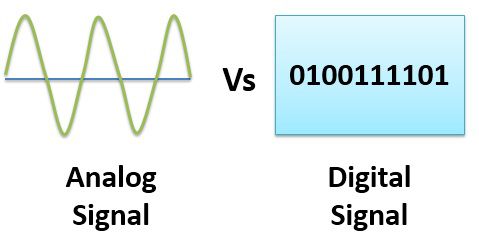
Difference between digital and analog

Difference between digital and analog

Analog vs. Digital

The sound is analog. And sound is the vibration of the air. How is this sound vibration transmitted?

Analog vs Digital

For example, when a stone is thrown into a calm water surface, the ripples spread around it, but if
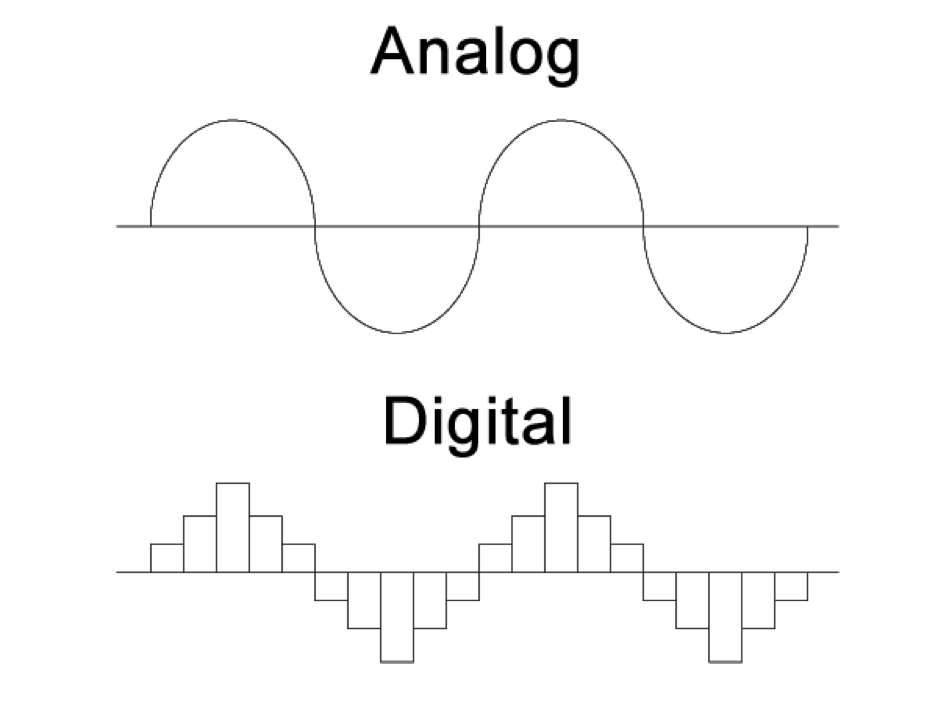
Cut in the direction of the waves and look at the cut end, the waveform is as shown in Fig.1.

Air waves spread from the point where sound is emitted even in air. Although invisible to the eye, it has a
similar waveform. This is the analog waveform of sound.

Therefore, although it is digital, when such a sound waveform is recorded or communicated by phone or wireless, as
shown in Fig. 2, the change in the analog waveform is electrically replaced with a series of numerical values ​​according to a certain promise. ..

When recording or communicating, if you handle it as analog, it is easy for noise to enter and the sound quality to deteriorate, but when trying
the waveform of the sound as digital = numerical data, you can eliminate that worry and
maintain a certain quality. You can do various processing while maintaining it.

(2) What is convenient when it is digital

Digital audio signals are convenient because they can be recorded and edited using a personal computer, for example.

In addition, 74 minutes of music can be recorded on a CD with a diameter of only 12 cm, and through digital compression processing
, music of the same length can be recorded on an MD with a smaller diameter.

Since digital signals can be compressed in this way, it is also convenient for storing large amounts of information.
Not only sound, but also video signals with a higher amount of information can be recorded and communicated at high speed through the use of compression technology.

Especially in communication, a two-way digital multiplex communication can be realized communicating multiple pieces of information with a single wire.
In addition to electrical signals, laser light can also be used for optical communication, making communication possible at extremely high speeds.

(3) What is the sampling frequency?

Digital signals are processed at predetermined fixed time intervals.
The sample rate (sample rate) indicates how many times a second is processed and is expressed as Fs or fs.

The sampling frequency unit is Hz (Hertz), and the
44.1 kHz (kilohertz) sampling rate means 44,100 pieces of data are processed per second.
(K represents 1000 times)

AD conversion converts a continuous analog signal into a digital signal,
measures the size of the signal at each moment determined by the sampling frequency (sampling) and converts
the result in a binary number (quantization).

On the other hand, DA conversion converts a digital signal into an analog signal,
It reads the digital signal in the sample rate time interval and connects it smoothly.

Since digital signals can be reproduced up to half the sampling frequency, how much
The higher the sample rate, the higher the playable frequency and the better the sound quality.
In familiar areas, 44.1 kHz is used for CD, and 48 kHz is used for DAT and B modes of satellite transmission.

In addition, recent professional equipment uses high sampling frequencies (high sampling), such as 88.2 kHz and 96 kHz,
and are designed to faithfully reproduce even higher frequency sounds to improve sound quality.