
Digital Video Compression Part 3

VDOWave or VDOLive from VDONet (VDOM, VDOW)
VDONet releases a wavelet-based video compressor included with the 32-bit implementation of Video for Windows. Microsoft uses VDOWave as part of NetShow. There are currently two versions of the VDOWave compressor:
VDOWave 2.0 is a fixed rate video codec.
VDOWave 3.0 is a “scalable” video codec.
The NetShow 2.0 standard kit only installs the VDOWave decoder. The NetShow 2.0 development tool installs both the VDONet VDOWave encoder and decoder. According to some tests, VDOWave significantly outperforms MPEG-1 and other compressors based on the block discrete cosine transform algorithm in compression, but only at low kbps rates.
MPEG-4 (MPG4)
Microsoft’s NetShow 2.0 installs the MPEG-4 compressor, which is a new international standard that, however, has not yet been officially recognized.
AVI compressor performance
To test the performance of various compressors, a series of experiments was performed on a 10-second video clip recorded at 30 frames per second, 320 x 240, in a 24-bit-per-pixel color palette.
Furthermore, this video fragment was sequentially compressed by various video compressors using Microsoft Video for Windows 1.1. The results of the comparison are shown in the table. Except for the cases mentioned, the quality obtained did not differ significantly from the original.
Legend:
FCC, fluctuating in the range of 0 .. 100 and configurable compression quality factor.
TC: The technology used in compression.
CC X: keyframe every X.
Digital video compression technologies
There are many technologies for compressing digital video, but we will focus on those that formed the basis of the most popular video compressors. Some of the compressors considered use more than one compression technology, but some combination of them. For example, both Indeo 3.2 and Cinepak use vector quantization. The international standards MPEG-1, MPEG-2, MPEG-4, H.261 and H.263 use a combined BDKP technology and motion compensation. Some modern algorithms use Discrete Wavelet Transform (DWT) technology. Other technologies include fractal image compression.
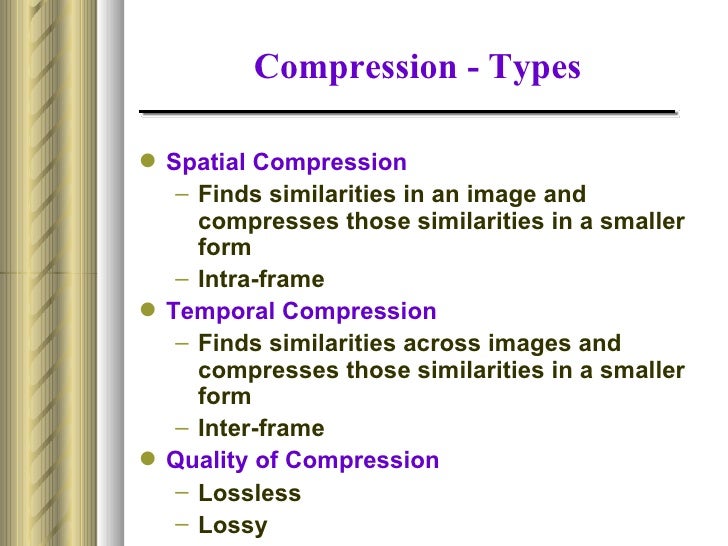
First, let’s define the term “video compression quality”. Despite all the subjectivity of this concept, we will try to conditionally divide the compression quality into the following levels (compression ratios).
Lossless compression
(1) Image compression can be performed without quality loss only if there was no data loss during the compression process. As a result, the image obtained after decompression will exactly match (bit by bit) the original. Examples of such compression are GIF for static graphics and GIF89a for video.


