
Definition of sampling bits, sampling rate and bit rate in audio (transfer) Part 2

Bitrate values compared to real audio:
16 Kbps = phone quality
24 Kbps = increase phone quality, shortwave transmission, longwave transmission, European standard medium wave transmission
40 Kbps = American standard medium wave transmission
56Kbps=Voice
64 Kbps = boost voice (best bitrate setting for cell phone ringtones, best setting for cell phone mono MP3 players)
112 Kbps = FM stereo FM transmission
128 Kbps = tape (best setting for a mobile phone stereo MP3 player, best setting for a low-end MP3 player)
160 Kbps = HIFI high fidelity (best setting for mid to high end MP3 players)
192Kbps=CD (best setting for high-end MP3 players)
256Kbps=Studio Music Studio (for music enthusiasts)
In fact, with the advancement of technology, the bitrate is also getting higher and higher, the maximum bitrate of MP3 is 320Kbps, but some formats can reach higher bitrates and superior sound quality.
For example, the emerging APE audio format can provide true audiophile lossless sound quality and smaller volume than WAV format, and its bit rate is usually 550kbps—–950kbps.
Common coding patterns:
Dynamic bit rate VBR (Variable Bitrate), ie there is no fixed bit rate. The compression software immediately determines which bitrate to use based on the audio data during compression. This is a method that takes into account the quality of the file. and file size The recommended encoding mode;
ABR (Average Bit Rate) Average Bit Rate is an interpolation parameter of VBR. LAME created this encoding mode in response to the low file volume ratio of CBR and the variable size of files generated by VBR. Within the specified file size, ABR takes every 50 frames (about 1 second for 30 frames) as a segment. A relatively low flow rate is used for low frequency and insensitive frequencies, and a high flow rate is used for high frequencies and high dynamic performance. It can be used as VBR and CBR, a compromise option.
CBR (constant bit rate), constant bit rate, means that the file has a bit rate from start to finish. Compared to VBR and ABR, the compressed file size is very large and the sound quality will not improve significantly compared to VBR and ABR.
In simple terms:
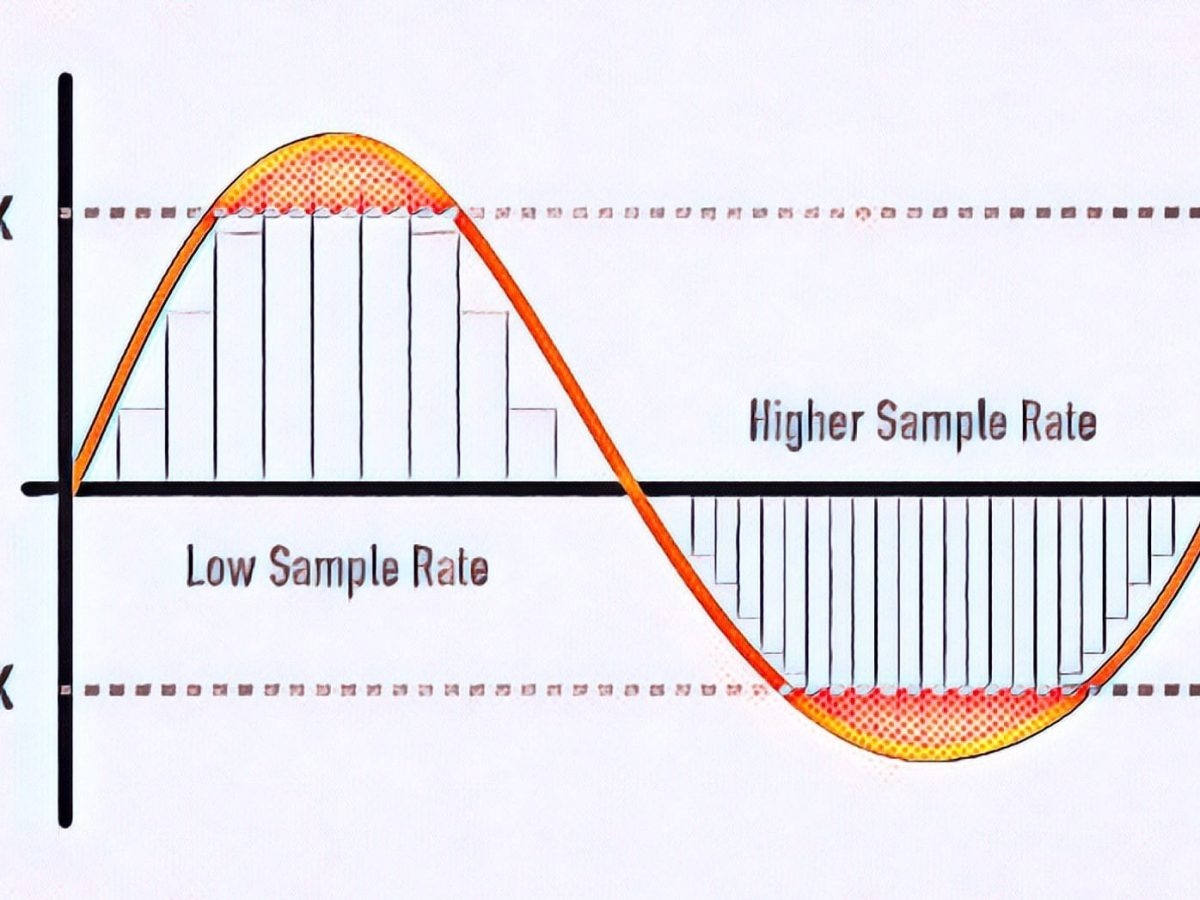
In a nutshell, sample rate and bit rate are like horizontal and vertical coordinates on the coordinate axis.
The sampling rate on the abscissa represents the number of samples per second.
The bit rate on the ordinate represents the precision when quantizing analog quantities with digital quantities.
The sample rate is similar to the number of frames of moving images. For example, the sampling rate of movies is 24 Hz, the sampling rate of PAL format is 25 Hz, and the sampling rate of NTSC format is 30 Hz. When we play back the still images sampled at the same rate as the sampling frequency, we see a continuous image. In the same way, when a CD recorded at a sampling rate of 44.1 kHz is played back at the same rate, a continuous sound can be heard. Obviously, the higher the sample rate, the more coherent the sound will be heard and the picture will be seen. Of course, the sampling rate that human auditory and visual organs can distinguish is limited, which is basically higher than sound sampled at 44.1 kHz, and most people haven’t noticed the difference.
The number of digits in the sound is equivalent to the number of colors on the screen, indicating the amount of data per sample. Of course, the larger the amount of data, the more accurate the playback sound, so as not to confuse the sound. of the teapot with the train whistle. In the same way, it is more clear and precise for the image, so as not to confuse blood and ketchup. However, limited by the function of human organs, 16-bit sound and 24-bit image are basically the limits of ordinary humans, and the highest digits can only be distinguished by instruments. For example, the phone has 7-bit sound sampled at 3 kHz and the CD has 16-bit sound sampled at 44.1 kHz, so the CD is clearer than the phone.


