
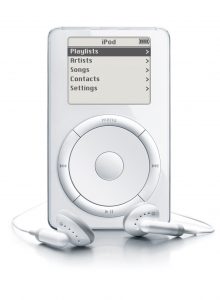
The triumphant advancement of MP3 music began with the first iPod, which was introduced by Apple on October 23, 2001.
German researchers invented the revolutionary MP3 format two decades ago. Now engineers are working on the audio technology of the future. Now they are being honored for their pioneering work.
:format(jpeg):mode_rgb():quality(90)/discogs-images/R-9550935-1532361950-2201.jpeg.jpg)
The MP3 music format is one of Germany’s most successful innovations. It is used around the world to store, transfer, and play music, audio books, and other digital audio products.
Three engineers who participated in the development of MP3 were awarded the Eduard Rhein Prize for Technology in Munich. Karlheinz Brandenburg, Bernhard Grill and Jürgen Herre share the prize, which is endowed with 30,000 euros.
Why the song “Tom’s Diner” was important to the development of MP3 and what innovations in audio technology can be expected, explains Professor Brandenburg, director of the Fraunhofer Institute for Digital Media Technology in Ilmenau.
Die Welt: Suzanne Vega’s song “Tom’s Diner” plays a special role in your career. Do you still have the song in your ears?
Karlheinz Brandenburg: Of course (hums the tune). As a doctoral student, he had developed a new method for storing music at a very low data rate. When I started writing all this, I read in a hi-fi magazine that “Tom’s Diner” is used to test high-quality music systems. I was curious what my algorithm, the forerunner of MP3, would do with this music. The result was amazing. Suzanne Vega’s voice sounded very husky and she seemed to be singing duet with herself. Very bad.
Die Welt: What consequences did that have for your doctoral thesis?
Brandenburg: I wrote it down anyway and mentioned that the “Tom’s Diner” algorithm doesn’t work. It took years to understand what was happening. However, with a few tricks it was possible to encode this song to sound perfect.
Die Welt: Several researchers participated in the development of MP3. What was your most important contribution?
Brandenburg: I am often credited with introducing a model of the psychoacoustic properties of the sense of hearing. But that already existed. My contribution was more technical – the way I converted various voice, image and video encoding algorithms and combined them in such a way that the integration of the psychoacoustic model was very easy and low bit rates were achieved for the circumstances. could.
Die Welt: How did the name MP3 come about?
Brandenburg: The official name of this data compression method is “MPEG Audio Layer 3”, a standard that has been defined by Moving Pictures Experts Group. Layer 3 is one of the three modes. Layer 2 was used in DAB digital radio, for example. Our team at the Fraunhofer Institute for Integrated Circuits (IIS) in Erlangen relied on the Internet from the beginning. The compressed music was saved on the hard drives of the PC. The Windows 3.1 operating system expected files to have three-digit extensions. So after a short consultation on July 14, 1995, we decided to add the final mp3 to the compressed audio files. There is a reference to MPEG and also to Layer 3.
Die Welt: A few years later, you could see people everywhere listening to music with MP3 players.
Brandenburg: Exactly. At first I shrugged off the name of the MP3 player, because mp3 was actually a final file. But I quickly realized that MP3 players are a good name for these devices.


