
Audio sampling
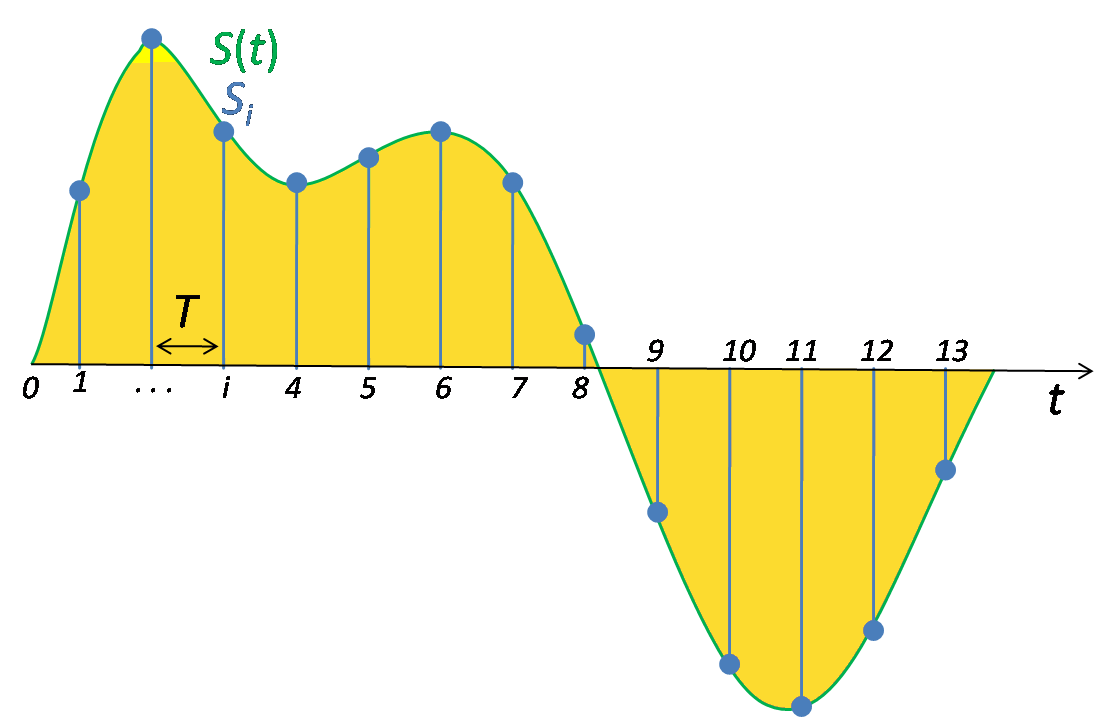
Digital audio uses pulse code modulation (PCM) and digital signals to reproduce sound. This includes analog-to-digital conversion (ADC), digital-to-analog conversion (DAC), storage and transmission.
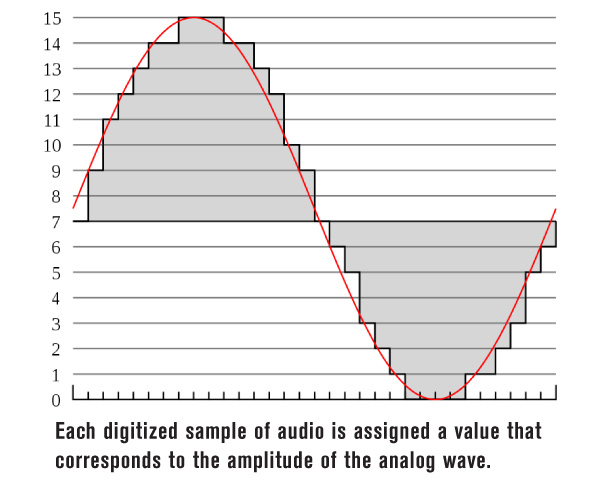
Essentially, a system commonly referred to as digital is actually a discrete time analog to the discrete level of the previous electrical counterpart. While modern systems can be quite subtle in their techniques, the primary utility of a digital system is the ability to store, retrieve, and transmit signals without loss of quality.
Sampling rate
The most common unit of measure for sample rate is Hz, which stands for Hertz and stands for “counts per second.” For example, 48 kHz is 48,000 samples per second. When it is necessary to capture sound that covers the entire 20-20,000 Hz human hearing range, such as when recording music or many types of acoustic events, sound waves are typically sampled at 44.1 kHz (CD), 48 kHz, 88.2 kHz or 96 kHz.
The approximately double bet requirement is a consequence of the Nyquist theorem. Sampling rates greater than 50 kHz to 60 kHz may not provide more useful information for listeners. For this reason, the first manufacturers of professional audio equipment chose sample rates in the 40 to 50 kHz range. There is a trend in the industry to use sample rates well above the basic requirements, such as 96 kHz and even 192 kHz. Although ultrasonic frequencies are not audible to humans, recording and mixing at higher sample rates is effective in eliminating distortion that can be caused by fallback aliasing. In contrast, ultrasonic sounds can interact and modulate the audible part of the frequency spectrum (intermodulation distortion), which affects fidelity.
One of the benefits of higher sample rates is that they can ease the low-pass filter design requirements for ADCs and DACs, but with modern sigma-delta converters with oversampling, this advantage is less significant. The Society of Sound Engineers recommends a sample rate of 48 kHz for most applications, but recognizes up to 44.1 kHz for CD and other consumer applications, 32 kHz for broadcast applications, and 96 kHz for higher bandwidth or dimmed. anti-aliasing filtering.
Both Lavry Engineering and J. Robert Stuart state that the ideal sample rate should be around 60 kHz, but since this is not the standard sample rate, 88.2 or 96 kHz is recommended for recording.
The PCM adapter will match digital audio samples to an analog video channel, such as PAL videotape with 3 samples per line, 588 lines per frame, 25 frames per second. 47 250 Hz the world’s first commercial PCM voice recorder from Nippon Columbia (Denon) 48000 Hz The standard audio sampling rate used by professional digital video equipment such as tape recorders, video servers, video switchers, etc.
This rate was chosen because it could recover frequencies up to 22 kHz and handle NTSC video at 29.97 frames per second with 25 fps, 30 fps and 24 fps systems. Systems operating at 29.97 frames per second need to process 1601.6 audio samples per frame, providing an integer number of audio samples for just every fifth frame of video. It is also used for audio in consumer video formats such as DV, digital TV, DVD, and movies. Professional Serial Digital Interface (SDI) and Serial Digital Interface High definition signals (HD-SDI) used to connect television broadcasting equipment use this audio sampling rate. Most professional audio equipment uses 48 kHz sampling, including mixing consoles and digital recorders. 50,000 Hz The first commercial digital audio recorders of the late 70’s from 3M and Soundstream. 50 400 Hz The sampling frequency used by the Mitsubishi X-80 digital audio recorder. 64000 Hz Not used frequently, but supported by some hardware and software. 88,200 Hz The sampling frequency used by some professional recording equipment when the destination is a CD (multiple of 44,100 Hz).
Some professional audio equipment uses (or may opt for) 88.2 kHz sampling, including mixers, EQs, compressors, reverbs, crossovers, and recorders. 96000 Hz DVD-Audio, some LPCM DVD tracks, BD-ROM (Blu-ray Disc) audio tracks, HD DVD (High Definition DVD) audio tracks. Some professional recording and production equipment may choose 96 kHz sampling. This sample rate is twice the standard 48 kHz.


