What are the sample rate, the number of quantization bits, and the clock? Part 3


Free Download Mp4Gain
picture

What are the sample rate, the number of quantization bits, and the clock? Part 3

Quantization

What is the “clock” on a CD?

Quantization

The CD player contains a biological clock. You may think it is true, but it is a fact. A watch is called a “clock” and it actually carries a crystal oscillator (crystal clock) that keeps accurate time. This is not for the timer. Time is important to read the information recorded on the CD, and the crystal clock, which is the body’s clock, plays an important role. Since this is an extremely high frequency pulse (clock pulse), it splits (slows down the count) and issues the necessary commands to various blocks in the player.

Let’s teach the seeds we are proud of as an ear study. “The clock is related to the pit length of the CD.” For the player to read the 0 and 1 information of the hole, it is necessary that the length of the hole and the time of the biological clock coincide exactly, but for that purpose it is not good. The length of the pit is set to an integral multiple of the clock. There are actually only 9 types of wells on the board, from the shortest (3T) to the longest (9T). You can see that T is a clock pulse and it is a well-researched format.

If the clock is wrong, the sound will be cloudy. This is because the time axis of the pasle fluctuates and jitter occurs. Therefore, the topic of discussion among fans is the external clock. If your body clock is deficient, there are other much more accurate cesium and rubidium clocks. You can use this pulse to move the player! This is why some high-end CD players have an external clock input.

Next time, let’s go over the glossary and how to read the optical disc player specifications that have come out so far.


Free Download Mp4Gain
picture


Mp4Gain Main Window
picture


Mp4Gain Features
picture


Free Download Mp4Gain
picture

What are the sample rate, the number of quantization bits, and the clock? Part 2

What are the sample rate, the number of quantization bits, and the clock? Part 2

Quantization

The bits are a binary number in digital counting. Binary numbers are a game, and as the number of bits increases, the number that can be expressed at an accelerated rate increases (number of steps = sampling precision).

Quantization

The calculation is “2 raised to the power of the bits.” For example, 3 bits would have 2 x 2 x 2 = 8 steps, but 5 bits would have 2 x 2 x 2 x 2 x 2 = 32 steps. It seems that it will be incredible if we continue like this. Yes, 16 bits is 2 to the power of 16, so multiply 2 16 times to get 65536 steps. Remember the “65,000 steps”.

Still, it’s not analog per se, but if you play it on a CD player it will play the original continuous analog wave, which is why digital is Erai. Actually, after quantization, the encoding work is done and a 16-bit PCM digital signal is obtained as “010011 … 10”.

Digital is strict and, in fact, there are some rules. It is often said that “CD has a frequency range of 20 kHz and a dynamic range of 96 dB”. This is determined solely by the format. To put it bluntly, the 20 kHz high-frequency range comes from the sample rate, while the 16-bit quantization defines the D range as 96 dB.

It’s kind of logical, but it’s called “Shannon’s Sampling Theorem (Erai scholar)”, and it can record high frequencies up to almost half the sampling frequency (fs). For quantization, there is a guideline of 6 decibels per bit, which is 6 x 16 = 96 decibels. Let’s put it on the sumikko of the head.

■ CD player sound quality enhancement technology: What are high bits and high sampling?

However, CD players have various technologies to improve the sound depending on the manufacturer. Like Denon’s AL24 processing and Pioneer’s legato link conversion. Even if the name is different for each manufacturer, it basically reproduces the subtle nuances and quirky atmosphere of the original analog audio that was cut on CD using extended technology like high bit and high sampling. It’s just a device in CD format, but when you ask, it certainly feels clear and the amount of information has increased.

So what kind of processing are you doing?

The left side of the figure is a normal CD format. The horizontal axis is incremented by fs = 44.1 kHz and the sample data is read with 16-bit precision. This is as explained above and unless there is special processing on the player side it will play as is with CD audio.

But the figure on the right is different. This is an image of the AL24 example, and the bits are expanded from the usual 16-bit to 24-bit using a dedicated chip. So a simple calculation can express a fine sound that is 2 to the eighth power, that is, 256 times. It seems that the upper and lower bits are moved and advanced things are done, but due to such bit expansion and high sampling (extending the high frequency range) like 4fs and 8fs in the direction of the horizontal axis, the squares are much smaller . Even if it is a CD, you can enjoy high-quality sound that surpasses that of a CD.

What are the sample rate, the number of quantization bits, and the clock?

What are the sample rate, the number of quantization bits, and the clock?

quantization bits

There is some format jargon that you really need to know about CDs.

QUANTIZATION

It is the “sample rate” and the “quantization bit number”. In connection with that, you will deepen your understanding if you also learn about the “clock” from the CD. Next time you learn “How to Read Specifications / Optical Discs”, it will go into your head.

■ What is the sampling frequency and the number of bits?

Digital audio recorded on a CD has a 44.1 kHz sample rate and a 16-bit quantization bit rate, right? Yes, that is correct. It has appeared several times so far, but it is the first time that we have explained it in detail from the basics.

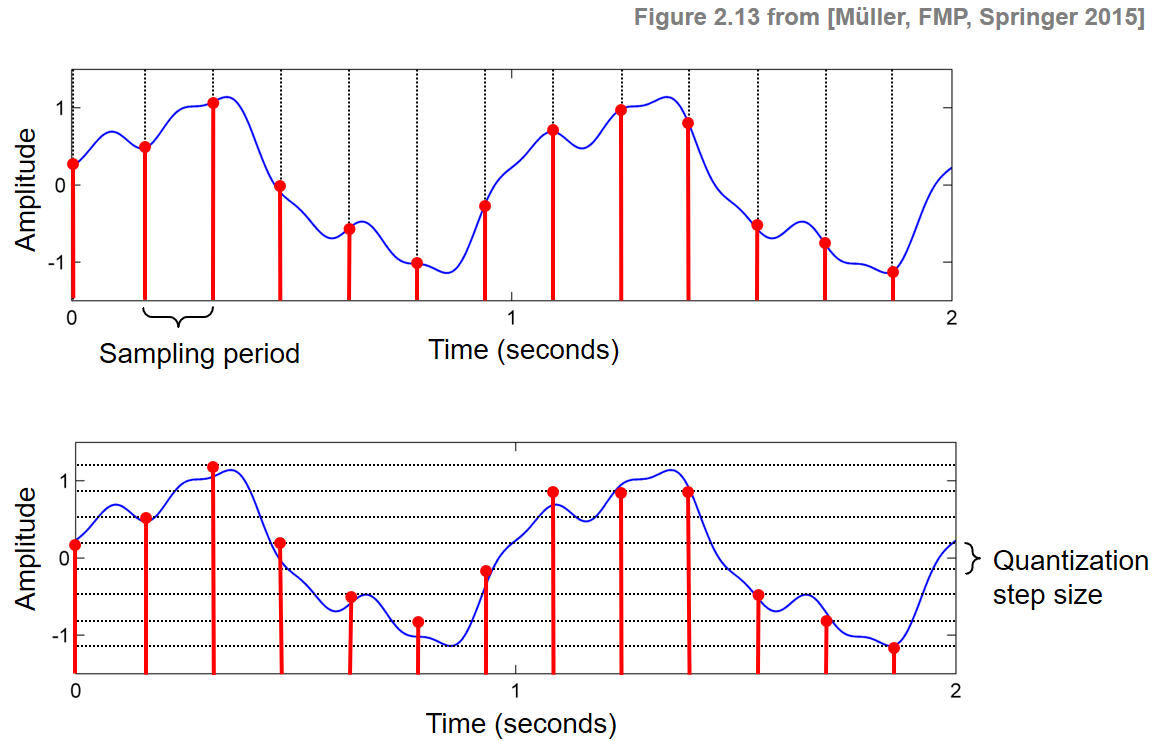
First, let’s start with the image. Just the esoteric feeling of sampling and quantizing, and the “vertical slice” and “horizontal slice” of the signals first. Think of it like cutting a radish. First of all, I’ll cut it vertically with a kitchen knife. You can make a lot of cuts, but they were originally continuous. The solid curve is the analog voice, and the first thing to do when digitizing it is the “vertical slice” = “sample” image.

Next is the quantification work. Even if the cut is a cut, it is quantified to “cross” the kitchen knife on its side. Then the radish will be divided into small squares. Did you imagine that the finer the square, the closer it is to the original analog signal?

The CD format is the rule of how fine the radish is cut (analog signal). “The sampling frequency is 44.1 kHz and the number of quantization bits is 16 bits” means that the first sampling is done at a rate of 44,100 times per second, and then the level is read with an accuracy of 16 bits (2 to power step 16). . Sampling is also called sampling, but in the first place, sampling is the norm, and without sampling, the work of quantification cannot be done.

■ PCM conversion flow

Let’s summarize how analog music signals are digitized in PCM and burned to CD. PCM is an abbreviation for pulse code modulation. In Japanese, it translates to pulse code modulation method.

The music signal is originally a continuous analog signal. A continuous waveform that ripples like a wave won’t fit in the hole of a CD as is, so test it out first. What part of the rippling wave should be used as a sample? Of course, it is necessary to have regular intervals, and in the case of CD, it is decided to sample at 44.1 kHz. kHz is a unit of frequency and is the number of repetitions per second. We’re going to sample at a tremendous rate of 44,100 times per second. The job of sampling is sampling, and it does not mean that the waves are crushed separately.

After sampling in the direction of the time axis in this way, the next step is how to read the discrete data (points) with what precision. This is the quantification. It’s not used often, but in English it’s called quantizing. Since the vertical axis of the graph is the signal level, that is, the magnitude, the precision point is how many steps to read to the highest point of the wave. The unit is the number of bits.