High-quality audio sound
In recent years, there has been a steady rise in interest in High Definition Audio (HDA).
AVR is gradually becoming a major trend in the audiophile and professional audio markets. The introduction of new formats and the improvement of their processing technologies, together with the growth in the volume of content delivery over the Internet, as well as significant efforts by the industry to make ABP the main format, indicate a interesting and promising future for the next few years. The High Resolution Audio Technical Committee supports seminars, discussions and the publication of guidance materials that highlight key aspects of ATS development for the benefit of the entire AES community.
NEW AVR FORMATS
Most notable in the last two years has been the emergence and rapid expansion of the use of DSD as a standalone encoding and distribution format for audio content. DSD is a name coined by Sony and Philips to indicate a one-bit format based on a sigma-delta transform that, along with appropriate processing, is used to store and transmit data associated with the production of SACD. Along with the original DSD 64 Fs format (64 x 44.1 kHz or 2.8224 MHz), higher sampling formats are now used: 128 F and 256 F. The main advantage of using higher frequencies is the region shift noise, which appears due to the transformation of the dynamic range in sigma-delta converters, well beyond the audible frequency range (> 60 kHz), as well as a decrease in the quantization noise level in the audio range compared with 64 Fs format. … DSD is considered to sound cleaner and more transparent at higher sample rates.
The DSD format is also related to the DXD format, the name of which is used to denote 352.8 kHz / 24 dB PCM signals, which is supported by Merging Technologies, which proposed it as an intermediate stage in obtaining DSD. Since digital processing of a single bit stream is difficult when preparing an audio recording, it is generally pre-converted to a PCM signal with a high sample rate. Some recording engineers are using DXD not only as an intermediate stage, but as a primary recording format for later release as DSD, or as an intermediate format between recording and release in DSD format, or perhaps in the future as a format. PCM 352. 8 kHz for audio release.
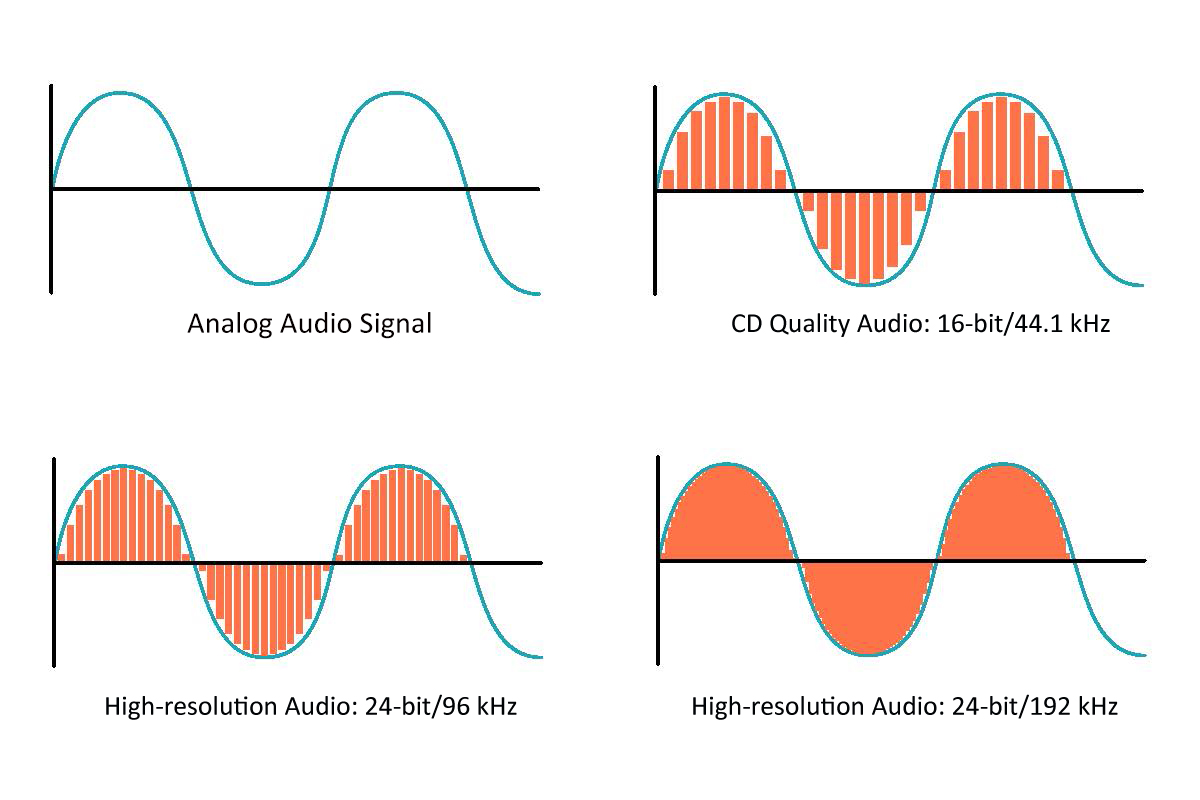
This trend toward higher sample rates in PCM and DSD formats is supported by consumer and professional equipment manufacturing. Many modern DACs and ADCs can handle PCM and DSD formats. New converters, software and even handheld devices increasingly support a variety of PCM signals from the CD level (44.1 kHz / 16 dB) to 384 kHz / 32 dB and DSD 256 Fs, while the industry continues to explore how and the degree of consumer interest in these formats. Most manufacturers have adopted an open standard for packaging DSD signals in PCM frames, known as DoP *, to facilitate DSD transfer over USB, as well as AES and SPDIF.
IMPROVEMENTS IN CONVERTERS, FILTERS AND SIGNAL PROCESSING
While high-quality sound has always been sought to find problem areas that lead to degradation associated with the processing and filtering of a digital music signal, increasingly higher resolution is becoming both the result and the driving force. of this search. High-end converter manufacturers are making efforts to address the inherent disadvantages of the higher sampling and multi-bit sigma-delta converters that are almost universally used in PCM DACs. Modernization methods include replacing microcircuits with FPGAs, increasing the sample rate in a computer, designing special filters, including filters with a minimum phase, increasing the value of bit depth during signal processing up to 64 bits with floating point and higher, using the original sigma-delta decimation and modulation schemes. Various chipmakers have developed better chips using the above techniques, improved noise shaping, jitter control, timing, and decoupling performance. These microcircuits are increasingly appearing in new ATS-compatible devices.