
Here I bring you my new post. Probably many (almost certainly all) are already tired of reading posts of this class: audio lossy vs audio lossless, but beyond some explanations and brief justifications it is concluded that the lossless formats (such as WAV, AIFF and FLAC) are better because they maintain the complete integrity of the audio file, they do not alter any characteristic of the original while retaining all the information. Advocates of lossy formats (such as MP3, AAC and OGG) say that if the coding is good, the loss of information (which in the audio is seen as loss of quality) is minimal and imperceptible to the human ear. The same confrontation happens with CDs and vinyl records: analog support vs. digital support, but I’m not going to talk about it now (maybe in a furious post, because the theme looks nice).
What I intend in this post is to dump all this information in a consistent way, in a way that nobody has ever explained it before (or at least I didn’t see it) so that we will finally banish myths and conclude if the lossy formats are worthwhile or not appreciate what is lost when encoding the most popular lossy formats.
What method are we going to use?
The method we are going to use is called phase inversion. Surely many know her and realized how I will use it throughout the post, others probably know what it is but do not know how I will take advantage of this technique and the vast majority sure is the first time you hear the finished; but the last two that do not worry that I will explain in detail and with a very simple example what is the phase inversion and how we are going to apply it in this final battle between lossless and lossy.
Suppose we have a simple sine wave, a pure and uniform tone, like the telephone tone before dialing. If we generate (or open a file with) a sine wave in some audio editor, the waveform would look more or less like this:
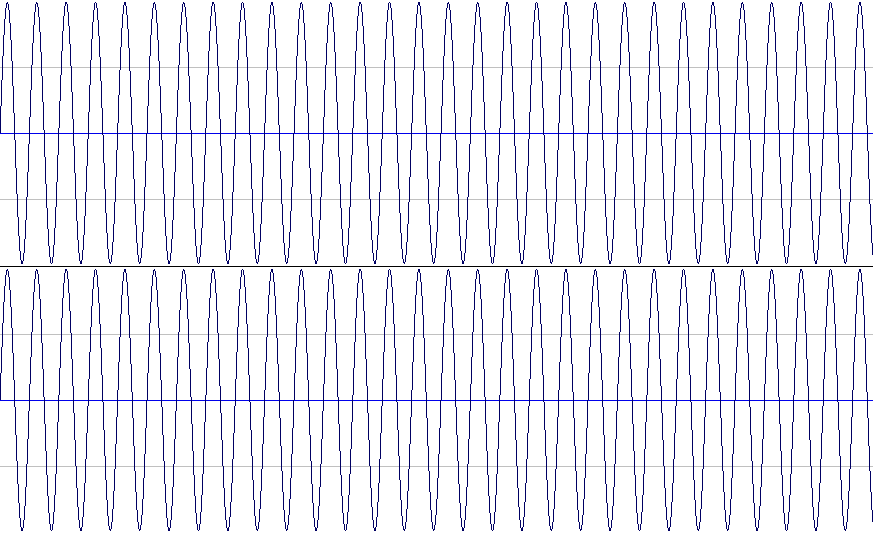
In order to explain well and to see what the phase inversion issue is like, we will need to expand the image a bit so that the wave is not so “tight” and we can more easily distinguish some of its parts:

Let’s talk a little about this wave (I hope you don’t get bored, but it is essential to understand what the phase inversion is). Starting from the left of the image, we see that the wave starts from the balance line and rises to a maximum. Then it starts to go down, crosses the balance line again and reaches a minimum. Finally, it goes back up and reaches the balance line again. This is repeated nine and a half times in the enlarged image and determines the cycle of the wave.
What interests us about this is to know and identify that every time the wave reaches a maximum point a peak or crest is formed, and each time it reaches a minimum point it describes a valley. It is also important to note that, in this case, the wave is identical because it is a simple sinusoid, therefore each peak and each valley have the same power (in physics it is called amplitude) but with different polarity, since a It goes up and the other goes down. It is like saying, for example, that -3 and +3 have the same absolute value (that is, 3) but have different signs. If we translate this into sound, the peaks compress the air and the valleys decompress it (imagine a bass drum being hit in slow motion: the patch vibrates rising and falling, compressing and decompressing the air above and below the patch, generating Sound).
Now to one of those channels (the one below) we will apply the phase inversion process. After the inversion, the waveform looks like this:
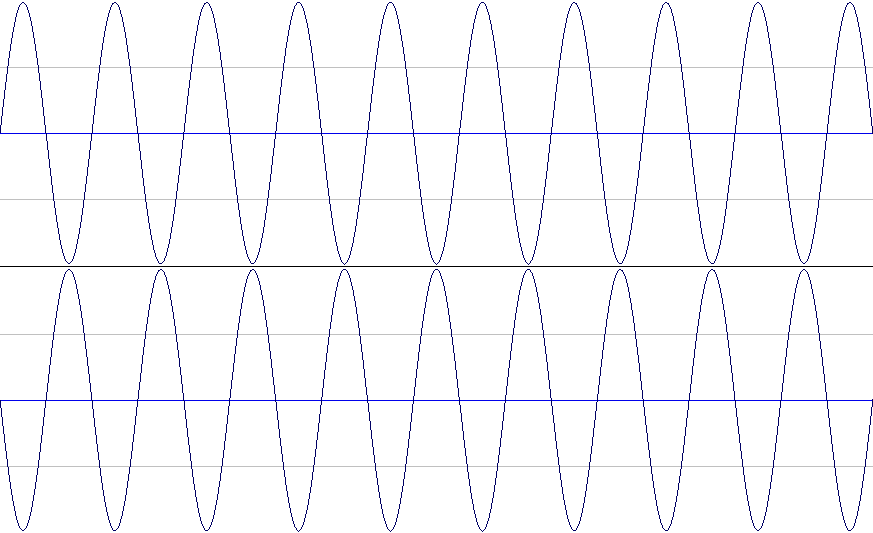
Note that the wave now remains the same but as if it were reflected in a mirror: the ridges are now valleys and the valleys are now ridges. What consequences does this bring to the sound? Recall that in the original sinusoid the two channels were identical and each valley and ridge coincided and had the same power, but now as the phase was reversed in one of them does not coincide valley with valley or ridge with crest, but they coincide valley with crest and crest with valley.
Look what happens when we mix the channels:

It is not witchcraft, much less, the thing is quite easy to understand: as the ridges and valleys have the same value but inverted, when combined they are suppressed, becoming silent. With the example we just gave, if we add +3 and -3 the result is zero (mathematically: (+3) + (-3) = 0). This technique is used by many professional modern headphones to isolate unwanted sound from the outside: the headset has a microphone that captures the external sound and generates an inverted phase for that sound, suppressing it, so that the listener only listens to the music and not external noise If you want to buy headphones like that, that feature is called active cancellation.

