Sample rate and bit rate of MP3 Part 3
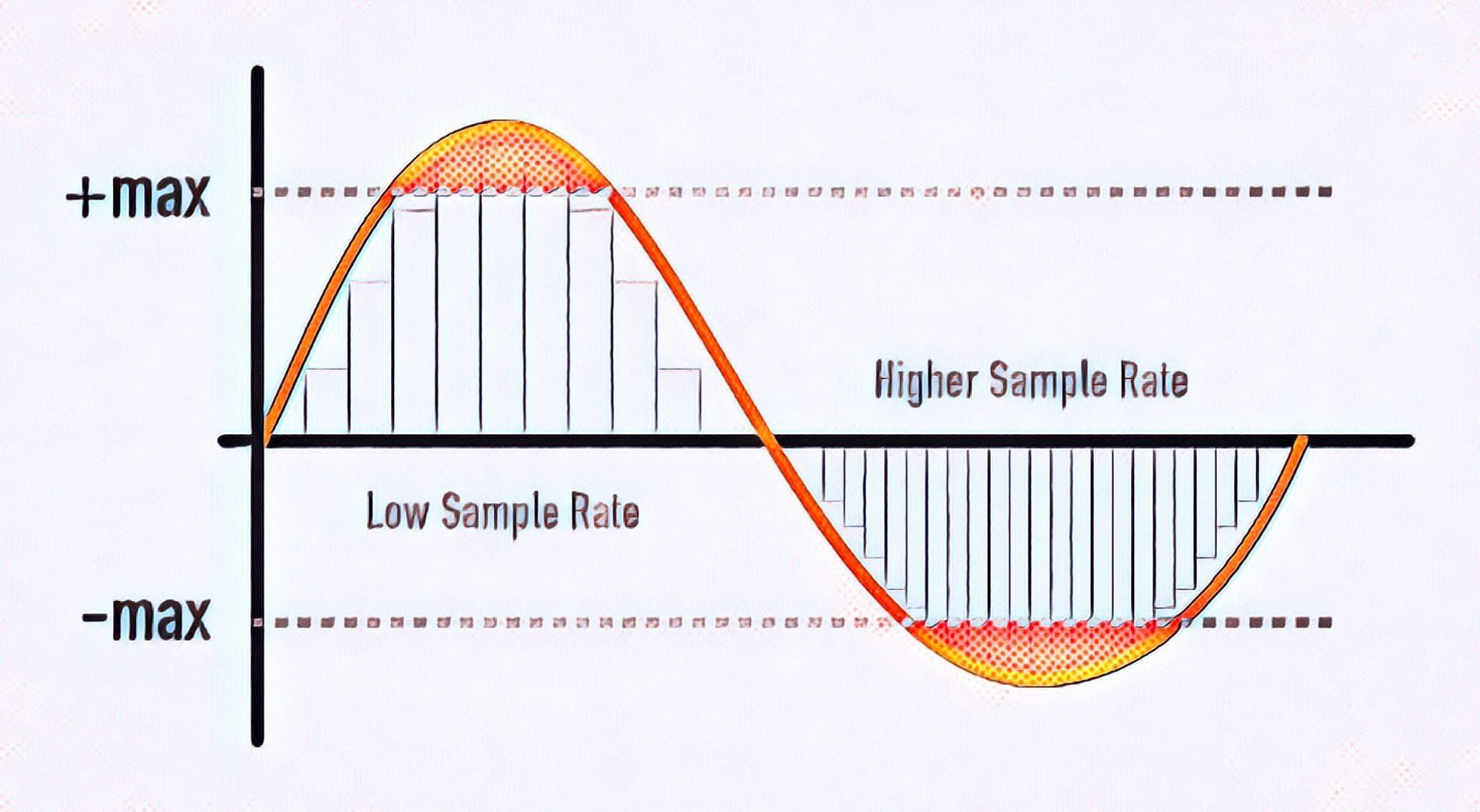
Sound is actually a type of energy wave, so it also has the characteristics of frequency and amplitude, with frequency corresponding to the time axis and amplitude corresponding to the level axis.
The wave is infinitely smooth, and the string can be considered to be made up of innumerable points. Since the storage space is relatively limited, in the process of digital encoding, the points of the string must be sampled. The sampling process consists of extracting the frequency value of a certain point. Obviously, the more points that are extracted in one second, the richer the frequency information that can be obtained. To restore the waveform, there must be two sampling points in one vibration. The highest frequency that can be felt is 20kHz, so to meet the auditory requirements of the human ear, at least 40k samples per second, expressed at 40kHz, and this 40kHz is the sample rate. Our common CD has a sample rate of 44.1 kHz. It is not enough to have only frequency information, we must also obtain and quantify the energy value of this frequency to represent the strength of the signal. The number of quantization levels is an integer power of 2, and the sample size of our common CD bit is 16 bits, that is, 2 to the power of 16. Sample size is harder to understand than bit rate. sampling, because it makes it seem abstract. For a simple example: suppose a wave is sampled 8 times, and the energy values corresponding to the sampling points are A1-A8, but we only use 2-bit sampling size, as a result we can only keep the 4 point values in A1-A8 and discard the other 4. If we use the 3bit sample size, all 8 point information is recorded. The higher the sample rate and sample size values, the closer the recorded waveform is to the original signal.
It is very easy to calculate the bit rate of a PCM audio stream, the value of the sample rate × the value of the sample size × the number of bps of the channel. A WAV file with a sample rate of 44.1 KHz, a sample size of 16 bits, and two-channel PCM encoding has a data rate of 44.1 K×16×2 = 1411.2 Kb/s. We usually say that 128K MP3, the corresponding WAV parameter, is this 1411.2Kb/s, this parameter is also called data bandwidth, it is a concept with the bandwidth in ADSL. Divide the code rate by 8 to get the data rate for this WAV, which is 176.4 KByte/s. This means storing a 1-second sample rate of 44.1 KHz, a 16-bit sample size, and a two-channel PCM-encoded audio signal, which requires 176.4 KB of space, which is approximately 10.34 M in 1 minute, which is unacceptable. For most users, especially friends who like to listen to music on the computer, to reduce disk usage, there are only 2 ways to downsample or compress. Lowering the index is not advisable, so experts have developed various compression schemes.
The minimum value of the 16-bit binary number is 0000000000000000, the maximum value is 1111111111111111, and the corresponding decimal numbers are 0 and 65535, that is, the difference between the maximum and minimum values is 65535, that is, the dynamic range of the analog quantity that quantizes The difference can be 65535, which is 96.32 decibels, so quantization accuracy is only related to dynamic range and has nothing to do with frequency response. It also makes sense to set the dynamic range to 96 decibels. The painless limit sound pressure of the human ear is 90 decibels. The dynamic range of 96 decibels is sufficient for ordinary applications. Therefore, after quantization, analog waves within the 96 decibel dynamic range will not be quantized. Clipping distortion will occur.
The number of digits in the sound is equivalent to the number of colors on the screen, indicating the amount of data per sample. Of course, the larger the amount of data, the more accurate the playback sound, so as not to confuse the sound. of the teapot with the train whistle. In the same way, it is more clear and precise for the image, so as not to confuse blood and ketchup. However, limited by the function of human organs, 16-bit sound and 24-bit image are basically the limits of ordinary humans, and the highest digits can only be distinguished by instruments. For example, the phone has 7-bit sound sampled at 3 kHz and the CD has 16-bit sound sampled at 44.1 kHz, so the CD is clearer than the phone.