
Audio compression, how it works Part 3
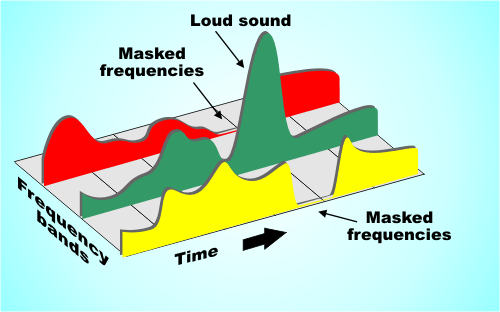
Masking in an mp3
In addition, according to the physiological and psychoacoustic phenomena of the human ear, when a strong signal and a weak signal exist at the same time, the weak signal will be masked by the strong signal and cannot be heard, so the weak signal can be regarded as a redundant signal. Do not send. This is the masking effect of human hearing, which is mainly manifested in the spectral masking effect and the time-domain masking effect, which are presented below:
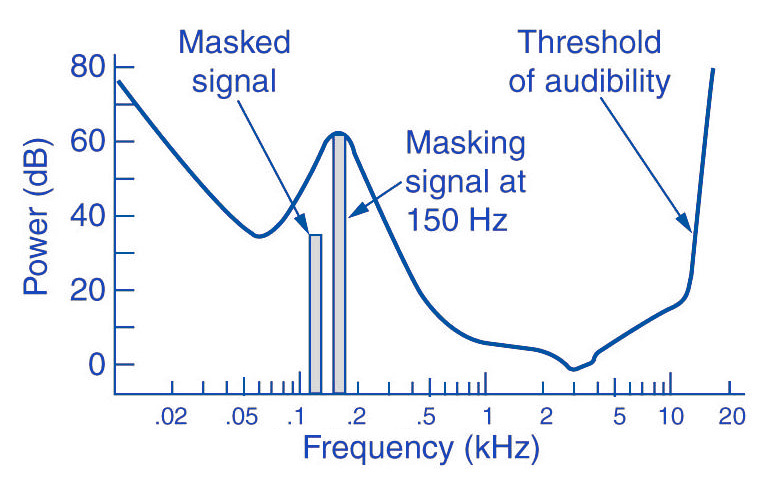
Spectral masking effects.
After the sound energy of a frequency is below a certain threshold, it will not be heard by the human ear, and this threshold is called the minimum audible threshold. When there is another sound with higher energy, the threshold value close to the frequency of the sound will increase considerably, which is known as the masking effect.
Merge albums
Combined Atlas (2)
Masking effects in the time domain.
When strong and weak signals appear at the same time, there is also a masking effect in the time domain. That is, when the two occur very close in time, the masking effect will also occur. Time-domain masking is divided into three parts: pre-masking, simultaneous masking, and post-masking. Pre-masking refers to the short time before the human ear hears a strong signal, the already existing weak signal will be masked and cannot be heard. Simultaneous masking means that when a strong signal and a weak signal exist at the same time, the weak signal will be masked by the strong signal and cannot be heard. Post-masking means that when the strong signal disappears, it takes a long period of time to hear the weak signal again, which is called post-masking. These weak masked signals can be considered redundant signals.
compression encoding methodedit stream
According to different compression principles, audio signal coding is divided into waveform coding, parameter coding, and coding forms that integrate various technologies.
(1) Waveform coding directly samples the time-domain or frequency-domain waveform of the audio signal at a certain rate, and then quantizes the amplitude samples hierarchically, transforms them into digital codes, and outputs a signal coding system reconstructed from the waveform data. , the waveform is as consistent as possible with the original sound waveform, preserving detailed signal changes and various transition characteristics.
(2) Parametric coding First, a feature model based on different signal sources, such as language signals, natural sounds, etc., is established through feature parameter extraction and coding processing, trying to that the reconstructed sound signal is as loud as possible. to keep the semantics of the original sound, but reconstructed. The waveform of the signal may be quite different from the waveform of the original sound signal. Characteristic parameters in common use include formant, linear prediction coefficient, frequency band division filter and other parameter encoding techniques, which can realize low-speed sound signal encoding, and the bit rate can be compressed at 2 Kbit/s – 4.8 Kbit/s, but the sound quality can only reach Moderate, especially the low degree of naturalness, only suitable for language transmission and expression.
(3) Hybrid coding The coding way that combines waveform coding and parameter coding overcomes the weaknesses of original waveform coding and parameter coding, and strives to maintain high quality of coding of waveforms and the low rate parameter coding, at a rate of 4 -16Kbit/s A high quality synthetic sound signal can be obtained. The basis of hybrid coding is linear predictive coding (LPC), commonly used coding methods such as pulse-excited linear prediction coding (MPLPC), planned pulse-excited linear prediction coding (KPELPC), predictive coding Codebook Excited Linear (CELPC), etc.

