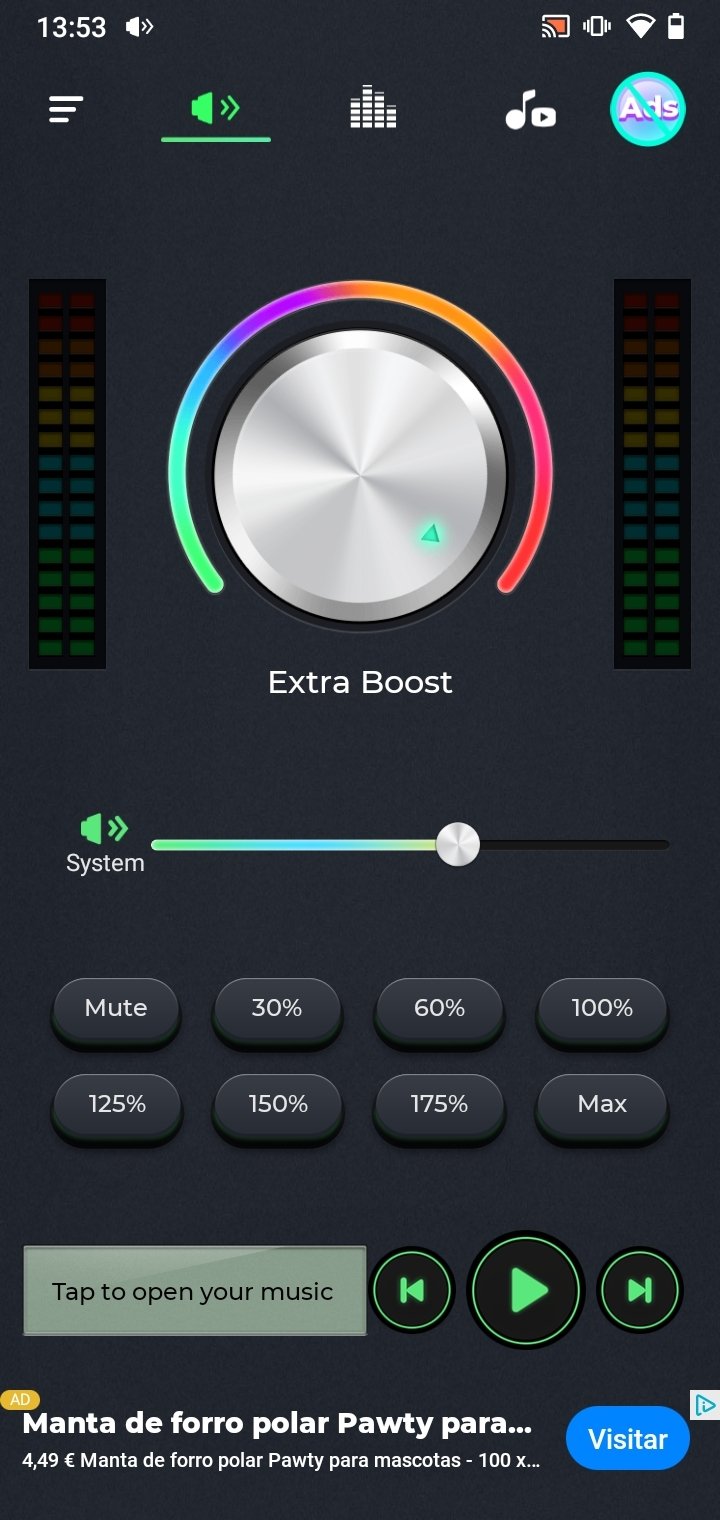
Volume Booster


Free Download Mp4Gain
picture

Volume Booster

Volume Booster
Volume Booster
Volume Booster
Volume Booster

Sound Amplifier

I’m excited to share with you the benefits of using a sound amplifier. A sound amplifier is a device that increases the volume of audio signals, allowing you to enjoy your favorite music, movies, or podcasts at a higher volume. With a sound amplifier, you can enhance the audio quality and make it more immersive. Whether you’re watching a movie with friends or listening to music on your own, a sound amplifier can take your audio experience to the next level.
A sound amplifier works by taking the audio signal and amplifying it, increasing the volume without distorting the sound quality. It can be particularly useful in situations where the audio output from your device is not loud enough, such as when watching a movie on a laptop or listening to music on a smartphone. By using a sound amplifier, you can boost the volume and enjoy your media without straining to hear it.

Audio Enhancer

An audio enhancer is a fantastic tool for improving the quality of your audio. It works by enhancing various aspects of the audio signal, such as clarity, depth, and richness. With an audio enhancer, you can make your music sound more vibrant, your movies more immersive, and your podcasts more engaging.
One of the key benefits of using an audio enhancer is that it allows you to customize the sound according to your preferences. You can adjust the equalizer settings to emphasize certain frequencies or enhance specific audio effects. For example, if you’re a bass lover, you can boost the low frequencies to make the basslines more prominent. On the other hand, if you enjoy crisp vocals, you can enhance the mid-range frequencies to make the vocals stand out.

Volume Increaser

A volume increaser is a handy tool for those moments when you need a little extra volume. Whether you’re watching a video with low audio or trying to listen to a podcast in a noisy environment, a volume increaser can come to the rescue. It allows you to boost the volume of your audio beyond the maximum level of your device, ensuring that you don’t miss out on any important details.
Using a volume increaser is simple. You can either use a dedicated volume booster app or adjust the volume settings on your device. Some volume booster apps even offer additional features like equalizer adjustments and sound presets, allowing you to fine-tune the audio to your liking. With a volume increaser, you can enjoy your favorite content at the perfect volume, no matter the circumstances.

Audio Booster

An audio booster is a fantastic tool for amplifying the sound output of your devices. Whether you’re using headphones, speakers, or even your smartphone’s built-in speakers, an audio booster can significantly enhance the volume and overall audio quality. With an audio booster, you can enjoy your music, movies, and games with a more immersive and powerful sound.
One of the great things about an audio booster is that it can work with a wide range of devices. You can connect it to your smartphone, tablet, laptop, or even your TV. Some audio boosters also come with wireless connectivity options, allowing you to stream audio from your devices without any cables. With an audio booster, you can take your audio experience to new heights and enjoy your favorite content like never before.

Loudness Maximizer

A loudness maximizer is a tool that helps you achieve the maximum volume level without distorting the audio quality. It’s particularly useful when you want to make your music or videos louder without sacrificing the clarity and dynamics of the sound. With a loudness maximizer, you can boost the volume of your audio while maintaining a balanced and enjoyable listening experience.
Using a loudness maximizer is straightforward. You can either use a dedicated plugin or software on your computer or find a standalone device that offers loudness maximization capabilities. Some loudness maximizers also come with additional features like compression and limiting, allowing you to further refine the audio output. With a loudness maximizer, you can make your audio stand out and grab the attention of your listeners.

Volume Amplifier

A volume amplifier is a device that increases the volume of audio signals, allowing you to enjoy your favorite content at a higher volume level. Whether you’re watching a movie, listening to music, or playing games, a volume amplifier can enhance your audio experience and make it more immersive. With a volume amplifier, you can bring out the details in the audio and enjoy a more dynamic and powerful sound.
One of the advantages of using a volume amplifier is that it can work with a wide range of devices. You can connect it to your smartphone, tablet, computer, or even your TV. Some volume amplifiers also come with additional features like equalizer adjustments and sound presets, allowing you to customize the audio according to your preferences. With a volume amplifier, you can take control of your audio and enjoy it the way you want.

Audio Volume Booster

An audio volume booster is a tool that allows you to increase the volume of your audio beyond the maximum level of your device. It’s particularly useful when you’re in a noisy environment or when the audio output from your device is not loud enough. With an audio volume booster, you can amplify the sound and ensure that you don’t miss out on any important details.
Using an audio volume booster is simple. You can either use a dedicated app on your smartphone or adjust the volume settings on your device. Some audio volume booster apps also offer additional features like equalizer adjustments and sound presets, allowing you to fine-tune the audio to your liking. With an audio volume booster, you can enjoy your favorite content at the perfect volume, no matter the circumstances.

Sound Level Booster

A sound level booster is a device or software that increases the volume of audio signals, allowing you to achieve a higher sound level. It’s particularly useful when the audio output from your device is not loud enough or when you want to enhance the volume for a more immersive experience. With a sound level booster, you can amplify the sound and enjoy your favorite content at a higher volume.
Using a sound level booster is straightforward. You can either use a dedicated device or software on your computer or find an app for your smartphone or tablet. Some sound level boosters also come with additional features like equalizer adjustments and sound effects, allowing you to customize the audio according to your preferences. With a sound level booster, you can elevate your audio experience and make it more enjoyable.

Volume Enhancer

A volume enhancer is a tool that helps you enhance the volume of your audio signals, making them louder and more impactful. It’s particularly useful when you want to boost the volume of your music, movies, or games for a more immersive experience. With a volume enhancer, you can bring out the details in the audio and enjoy a more dynamic and powerful sound.
Using a volume enhancer is simple. You can either use a dedicated app on your smartphone or adjust the volume settings on your device. Some volume enhancer apps also offer additional features like equalizer adjustments and sound presets, allowing you to customize the audio according to your preferences. With a volume enhancer, you can take your audio experience to the next level and enjoy your favorite content like never before.
Final Words:
In conclusion, a volume booster is a valuable tool for enhancing the volume and overall audio quality of your devices. Whether you’re watching a movie, listening to music, or playing games, a volume booster can take your audio experience to new heights. By amplifying the sound and bringing out the details in the audio, you can enjoy a more immersive and powerful sound. So, why settle for low volume when you can boost it with a volume booster? Try it out and elevate your audio experience today!



Free Download Mp4Gain
picture


Mp4Gain Main Window
picture


Mp4Gain Features
picture


Free Download Mp4Gain
picture

What is the difference between the concepts of “volume”, “level” and “loudness”? Part 2

What is the difference between the concepts of “volume”, “level” and “loudness”? Part 2

Volume Booster


And we will also find an interesting phenomenon. In high school physics, you can learn that the sound of a shrimp chewing food 100 meters from the microphone of a nuclear submarine is -80 decibels, and the sound of a normal conversation is 40 ~ 60 decibels, the sound of the engine of a airplane is 120 decibels, etc. (just an example), and if you open a DAW (digital audio workstation) or audio editor, you’ll see all negative decibels. Why?

Volume Booster

Scaling in Adobe Audition, overall audio volume is below 0dB
This brings us back to the previous sentence: dB itself isn’t even a unit. It is just a counting method and must be followed by other content to form the unit. For example, dBSPL (sound pressure level), dBFS (decibels relative to full scale), etc. Different units have different definitions. For example, dBSPL is the softest sound humans can hear as 0dBSPL, and then increases or decreases depending on the size of the sound (for example, the sound picked up by a -80dBSPL underwater microphone is inaudible to human ears, so which is a negative value), and dBFS is a way of expressing loudness on a computer. Since the operation of the computer is binary, it is necessary to sample and quantize the recorded analog audio in a binary way to calculate. And the quantization needs to specify the bit depth, which is the range of the audio from smallest to largest. Therefore, it has a full value, so the full value (maximum value) is specified as 0. Volumes less than 0dBFS are represented as negative values.

In addition to dBFS and dBSPL, there are quite a few dB that represent loudness. For example, dBV, dBu, dBm, etc. in electroacoustics they measure loudness by voltage, power, etc., which also roughly equate to “level (Level)” I won’t go into too much detail here. This also proves the diversification of the word “volume”. For professionals, it is not a word that can be used for communication and does not cause misunderstanding. You need to add some good context when using it, like: “Item A’s volume at 10s in my DAW is 3dB louder than that.” of item B”, This refers to dBFS.

4. Explain from a profit perspective:

The volume that we see the most is actually here, such as the volume adjustment of various music players, the volume adjustment of computer systems, etc. If the above English definition and actual point of view is more similar to an absolute value, from the profit perspective, the word “volume” here fully refers to a relative value, a ratio. By adjusting the volume, you can make the audio volume change as you like. It can be made from huge to silent. Loudness here refers to how much it has changed from the original, which is the explanation that best reflects the definition of the dB volume unit.

Second, the level (Level)
In the last paragraph of the 3 above, volume units such as dBV and dBu are mentioned, in fact the true master of these units is the “level”. It is an electrical engineering term that has been applied to audio with the development of electroacoustics and has become “loudness” in today’s digital audio era. In today’s world of audio processing, “level” and “volume” can be directly mixed together, and the only term that still uses the word “level” is probably the “level meter” that exists in DAWs and effects plugins.

What is the difference between the concepts of “volume”, “level” and “loudness”?

What is the difference between the concepts of “volume”, “level” and “loudness”?

Volume Booster

1. Volume

Volume Booster

The first thing to note is that volume is a widely used word with complex meanings, and it is difficult to find a single definition that can generalize such a large application scenario. Therefore, the answers to the volume in this answer are classified and contain certain subjective judgements, please eat them critically.

1. Explain from the English interpretation of the volume:

The English name of volume is Volumen, which may not be unfamiliar to friends who have access to consumer audio equipment or players in English. But in the scientific community, the word is more commonly known as “volume.” The V in the formula for finding volume, like V=Sh, which I learned in high school, is Volume. Volume is the size of the space occupied by an object, and combined with the word “volume”, it’s not hard to think that volume is actually the amount of sound. Loudness specifically refers to the object in 3D space, so loudness must also refer to the size of the space occupied by the sound in 3D space (or virtual 3D space). But sound is a kind of mechanical wave, its propagation depends on the vibration of the medium, and there is no real “size” in itself, so the word volume is also an abstract unit to describe the quantity of sound.

2. Explain from the practical meaning:

In real life, people intuitively perceive the amount of sound by hearing and feeling.

From the point of view of listening, the volume here is exactly the same as the volume (Loudness) . The loudness of the sound perceived by the human ear is the conventional “loudness” in this scene, and it is the “loudness of the sound” from a subjective perspective. Although this scene already has the word “loudness” to accurately describe the subjective feeling, but because the word “loudness” circulates too much, it is often used in the mouths of non-professionals.

From the point of view of perception, we usually experience some parts of the body due to the high energy and special frequency of certain sounds. For example, low frequencies that are too low and too loud will cause a “thumping in the chest” sensation, which essentially causes organs or cavities in the body to resonate. Therefore, when describing this phenomenon, the meaning of the word “volume” is similar to describing its energy size and frequency characteristics.

3. Explain from the units perspective:

Talking about the volume for a long time, its unit is not mentioned. Although there are many things that volume can describe, the unit is surprisingly uniform: dB (decibel, decibel). Speaking of this dB, in fact, it is not a special unit of volume, not even a unit itself, but a counting method, a ratio. It should be noted that it does not represent an absolute value, but rather a relative value, such as: 3dB is twice 0dB. If you are interested in how dB is calculated, you can refer to this article: What is dB decibel? , this article is just a simple science.

volume booster

volume booster

Volume Booster

What is volume booster?

Volume Booster

Giving a boost to the volume of an audio or video file, which only Mp4Gain can do, is the easiest way to make that music file (flac, ogg, m4a, wma, mp3, etc) sound better.

It has been widely demonstrated that optimizing the volume of an audio file (music or video) automatically makes it sound better to human ears.

How to make volume booster?

Mp4Gain can very easily give all your audio and video, in all major formats, a boost that increases quality and sounds better.

Obviously at Mp4Gain we have years of experience making increasingly sophisticated algorithms to achieve these results.

normalized

“Normalizing” is adjusting the volume so that its maximum peak is equal to (or a percentage of) the maximum signal available for digital audio. Typically normalizes the file to 100% as the final stage of production to make it as tall as possible and without distortion. Another reason to normalize is to make multiple tracks sound equally loud or have the same average volume.

The “peak” normalization method finds the sample with the largest amplitude in the file. Then normalize with this value as the peak value. When Normalize Peak Level is set to 100% (0dB), the entire file is amplified so that the peak reaches 0dB.

The Perceived Sound Normalization (dBA) method uses A-weighted decibels, which is an expression of the relative loudness of sound in air as perceived by the human ear. The normalization is because the human ear is less sensitive to low audio frequencies (especially below 1000 Hz) than to high audio frequencies.