
What does the decibel or db measure?
Decibels are widely used in audio and are often misinterpreted. These articles provide a practical understanding of the use of decibels in audio work. But first, some basic questions and answers about decibels.
What is a decibel?
A decibel is a tenth of a Bel, a level unit, named after Alexander Graham Bell. A Bel is a very large unit, so the prefix deci (one tenth) is used. A decibel uses a logarithmic scale, not a linear scale like volts or watts, see below.
There is no absolute level called the decibel. A decibel expresses a relationship. It is related to something. Unfortunately, what is related is often not mentioned when claiming a decibel reading. For example, the line out of the mixer may be -10dB, which generally means it is 10dB below 0dB.
Why decibels?
So why use a decibel? You may have noticed that the volume control on most hi-fi amps is marked in decibels, just like the marks on the mixer level controls. This is because our hearing range is so vast that, to use a linear scale, we must use numbers between 0 and 1,000,000!
Decibels are not linear
A secret to understanding decibels is to note that decibels are not linear. Another example of a nonlinear relationship is between the side of a square and the area of a square.
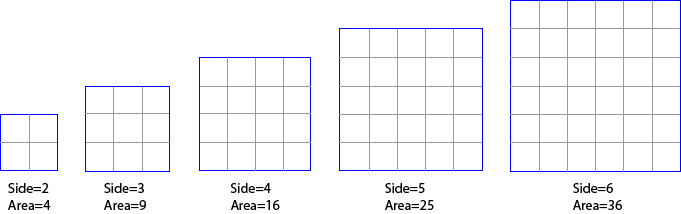
divisible is not linear like square side and area In this example, you can see that increasing the lateral measurement does not have an equivalent increase in area, but a larger increase. Also, doubling the length of the side does not double the area, it is much more than double! This is an example of a nonlinear relationship: in this case, a small increase in the side refers to a different increase in the area. Decibels are similar. A small variation in decibels refers to a different variation in the relationship between the two levels compared.
Decibels express a relationship
When we talk about audio levels, we observe voltages or amplitudes of sound waves. (Note: Power measurements (such as power differences in an amplifier) use a similar but different formula.) But without going into formulas, etc., we must accept the following summary of the linear relations of tensions and decibels. (I’m not showing formulas or calculations because I think most people skip them anyway, and if you like formulas any search engine will give you as many as you want)

