
Sound compression using software
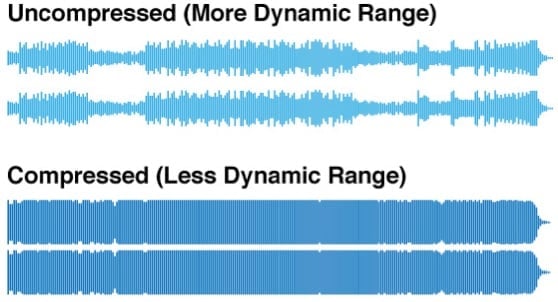
There are many types of compressors, as well as other sound processing units: digital and analog, hardware and software, manual and automatic, optoelectronic, valve, transistor, etc.

Any compressor has 5 main parameters:
– Threshold level. Expressed in decibels. This is the value above which the compressor begins to attenuate the signal.How a sound compressor works
Figure: 12. The principle of operation of the sound compressor.
Choosing the right threshold is the most difficult task. When set at a high level, the signal will be virtually uncompressed, and at a low threshold level, the signal will be damped and lose its information content.
–Compression ratio (ratio). Expressed in “x: 1” format. This value determines the degree of attenuation of the signal, the level of which has exceeded the threshold value. For example, if the ratio is 1: 1, the signal is not compressed. If the value is set to ∞: 1, then the signal is severely limited and the compressor performs the functions of another device, the limiter (English Limit – to limit). The amplitude of the compressor output signal when the threshold value is exceeded can be determined by the formula:
OUT = Threshold + (IN – Threshold) / Ratio
For example, if the input signal is IN = -4 dB, the threshold is set to -12 dB, and the compression ratio is 2: 1, then the output level is OUT = -8 dB.
– Attack time. It is usually expressed in milliseconds. This value defines the time interval between the signal exceeding the threshold value and when the compressor is activated.An example of an acoustic compressor application
– Recovery (release) time. It is usually expressed in milliseconds. This value determines the time interval during which, when the level of the input signal falls below the threshold value, its compression continues. Simply put, if the attack time determines the aggressiveness and responsiveness of the compressor, then the decay time is the inertia of the compression process.
By combining attack and recovery time settings, you can achieve a wide variety of results. For example, a long attack time allows compression without affecting fast transients. Most of the time, for natural reproduction, the release time is set according to the duration of the musical instrument. Some compressors do not allow manual adjustment of the attack and release times, but set them automatically by analyzing the input signal. This greatly simplifies working with the device, but at the same time somewhat reduces its capabilities, especially in the field of artistic sound processing.
– Amplification or restoration of a signal (compensation gain). Expressed in decibels. This value determines the amplitude of the compressor output. The compression process inevitably leads to a decrease in amplitude. Therefore, many of these devices have an amplifier at the output, with the help of which the so-called normalization of the signal is carried out, that is, bringing its amplitude to the value that the input signal had. In addition, normalization simplifies the work of the sound engineer, since the signals at the input and output of the compressor are of equal amplitude when listening.
Most modern compressors offer additional modes, settings and functions:
–Bypass (bypass). When this function is enabled, the input signal goes directly to the output without undergoing any processing. This allows you to effectively compare “clean” and processed signals, make adjustments to the compressor settings.
Sensitivity adjustment. This adjustment is usually done with a level switch and allows the compressor to handle signals with an amplitude of -10.0 or +4 dB.
Type of compression (knee). Distinguish between soft compression (soft knee) and hard compression (hard knee). The differences are in how quickly and smoothly the compressor will switch from “idle” to compression mode after the signal exceeds the threshold. Examples of acoustic characteristics for soft and hard compression modes
Hard mode is used to “limit” the peaks. The sound due to the “pronounced” break in the pitch characteristic is sharp and abrupt, especially at a high compression level. With a smooth response, compression starts early when the signal level approaches a predetermined threshold. The compression ratio increases smoothly and reaches the set value at the point corresponding to the threshold value. “Smooth” compression is preferred for most instruments and voices, as it sounds more transparent and natural.

