
How MP3s fool your ears. Part 2
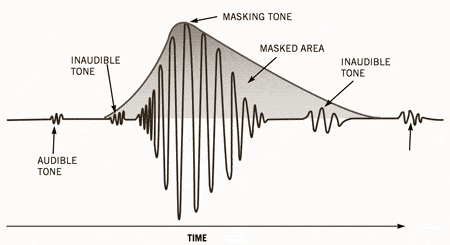
Usually, the compression we understand is repeated compression.

For example, if you go to the supermarket to buy 5 bottles of Coca-Cola, the receipt will not write 5 times of Coca-Cola, it will only write “Coca-Cola*5”. This process is equivalent to encoding the repeated parts of the file with shorter bytes. The file itself will not lose data, nor will any information be lost after decoding, but the file size will be reduced.
This is a lossless pressure drop, which is actually the last step of MP3, which uses an algorithm called Huffman Coding to complete. But if only this algorithm is used, the MP3 size will not be reduced significantly.
Because sound itself is extremely chaotic data with very high information entropy. So, in this way, it is impossible to reduce it to 10% of the volume of the CD.
Since lossless compression is no longer viable, we should throw away some information.
So what sound is missing from the MP3?
The easiest way to know the answer is to compare.
We put an MP3 of the same sound and its lossless version next to each other on two tracks, and invert one of the tracks, so that if they sound the same, they cancel each other out and we should get a mute effect. This is also how noise canceling headphones work.
But because MP3 is lossy compression, it actually sounds like this:
But only then we can’t tell the difference between MP3 and lossless. If a piece of music constantly switches between MP3 and lossless, can you really tell the difference? I think you can’t hear it.
This is the magic of MP3 algorithm, its compression is not just to lose the sound data, but to lose the data at the same time, you can’t notice it.
The history of the MP3
The story of Brandenburg and Dieter Seitzer
In the late 1970s, a German professor named Dieter Seitzer suddenly had an idea. He wanted people to be able to sit at home, use an ISDN phone line and call and play music on demand, like a jukebox.
ISDN was a popular digital line at that time, also called “single line communication”, you can use it to make calls, send and receive faxes, etc., but its speed is only 128kbps.
So when Dieter patented the idea, the patent office staff told him it was no good. Unless he can increase the speed of the ISDN network by a factor of twelve, that’s enough to transfer the volume of data on a CD.
When Dieter heard it, he probably couldn’t do it on his own, but if he invented an audio format that was only 1/12 the size of a CD, wouldn’t he be able to make this “digital jukebox”? So he turned around and handed the invention over to one of his students, Karlheinz Brandenburg.


