
Sound masking
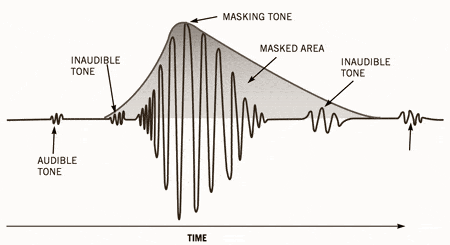
Sound masking is a phenomenon that affects the audibility of a sound (signal) in the presence of other sounds (interference).
Hearing impairment is usually expressed in an increase in the detection threshold of the signal and M. h. can be quantitatively evaluated by the number of dB, at a cutoff the hearing threshold increases in the presence of interference (masking threshold). Distinguish between simultaneous, direct and inverse sequential M. s. In the first case, the test signal and the interference (masker) sound simultaneously, in the second, the signal follows the masker, and in the third, the signal precedes the masker. Backward masking occurs only for short signals.
If the signal and interference are broadband, then the value of the simultaneous M. s. in a great dynamic. the range is proportional to the intensity level of the interference. If the signal and the masker are tones of the same frequency, then M. z. grows slower than the masker level. With a difference in the spectral composition of the signal and the interference M. z. determined by Ch. arr. interference components close in spectrum to the signal. To reveal the frequency selectivity of hearing, pure tones or very narrow band noise are used as the signal and masker. Frequency dependence of the masker level required to mask a weak fixed signal. frequency and level, characterizes the frequency setting of the auditory system in the area of the signal frequency (Fig.). In direct sequence mode. The selectivity of the masking frequency increases, which is explained by the manifestation of non-linear properties of the cochlea.
Frequency dependence of the level of the masking signal L M, required to mask a tone signal with a frequency of 1 kHz and a level of 20 dB: 1 – with simultaneous masking; 2 – with direct sequential masking.
3009-97.jpg
At the same time. masking a noisy tone signal, the spectrum of which is limited by a band with a center, a frequency corresponding to the signal, the spread of the spectrum of the masker at a constant integral energy at a certain value of the bandwidth does not affect the value of M. z. Expansion outside this band, called critical, leads to a decrease in M. s.
M. s has important characteristics. with binaural sound perception. When the signal has a frequency below 2 kHz or when it is at a higher frequency it changes rapidly in amplitude, M. h. it depends on the interural relationship (between channels) of the phases of the carrier (or, consequently, the envelope) of the signal and the masker. With the same interaural phase shift of the signal and the M. h. maximum, with a difference in interural phase changes of 180 ° M. h. generally minimal. This effect, apparently, is decisive for the phenomenon called “cock-tail-party” phenomenon and consists of the ability of a person to follow the signal coming from a source (interlocutor), ignoring interference with similar spectral-temporal characteristics ( other voices, etc.).


