
SOUND MASKING
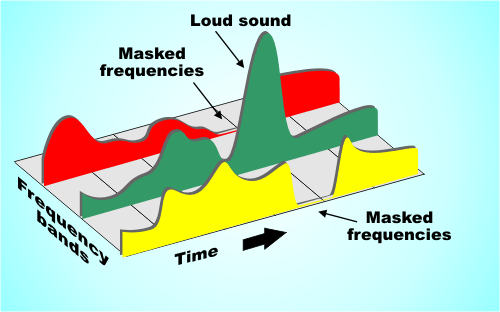
Phenomenon that consists in the alteration of the audibility of a sound (signal) in the presence of another sound (the so-called masker).

In general, the deterioration in audibility is expressed in an increase in the threshold to detect or distinguish a signal, and M. h. it can be quantified by the value (decibels) by which the threshold rises in the presence of a masker. Distinguish between simultaneous, forward sequential, and reverse M. s. In the first case, the test signal and the masker sound simultaneously, in the second, the signal follows the masker, and in the third, the signal precedes the masker. Invert M. z. appears only for short signals.
With the simultaneous masking of a noisy tone with a fixed energy and a center frequency equal to the frequency of the signal, the spread of the masker spectrum to a certain value does not affect the value of M. h. Expansion outside this frequency band, called critical, leads to a decrease in M. s. If the masker is amplitude modulated, then adding a sound that changes synchronously with the main. a masker, can lead to a decrease in M. z. (the phenomenon of commodity release from masking).
M. z. it depends on the interural (between ears) relationship of the signal phases and the masker. With zero phase shift M. z. maximum, with an interaural displacement of 180 ° M. h. generally minimal. This effect, called binaural unmasking, defines the cocktail phenomenon, which consists of the ability to follow the signal from a source (interlocutor), ignoring interference with similar spectral-temporal characteristics (other voices, etc.)


